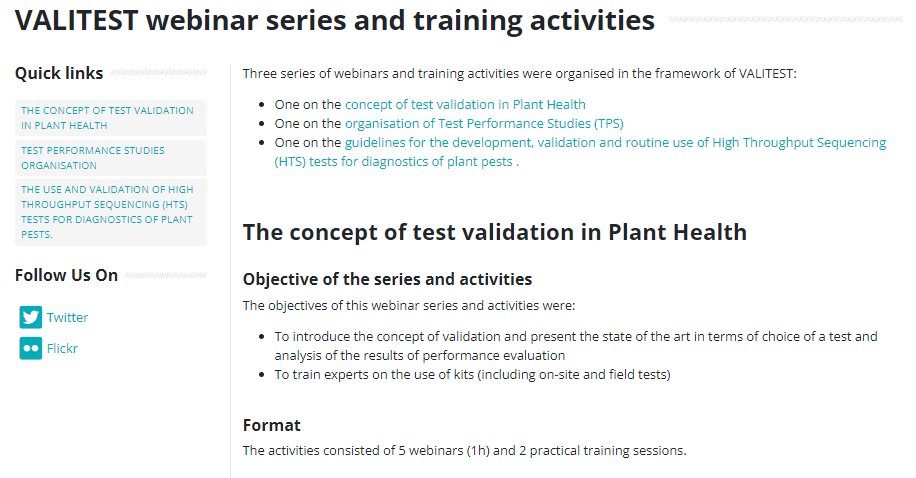
The new EPPO Standard 'PM 7/151 (1) Considerations for the use of high throughput sequencing in plant health diagnostics' is now freely available in the EPPO Bulletin.
Thanks to the Valitest partners and the EPPO Panel on Diagnostics and QA.
https://t.co/y5WLZJ2OCS
In addition to the two articles published in the EPPO Bulletin and in Peer Community Journal, an EPPO Standard was published based on the outputs of WP2 on HTS.
Wanna use reliably #HTS technologies in your lab for plant pathogens and pests detection ?
All you have ever wanted to know is in our new guidelines:
https://t.co/cbpXZxdGiR
->58 co-authors
->For any pest, technology & matrix
->For researchers and diagnosticians
#DYK ? The EPPO Jens-Georg Unger #PlantHealth Fellowship has been established for 10 years (2020-2030).
The deadline to apply for the 2022 #fellowship has been extended to October 16th: https://t.co/lrL6zUipav
If you are not ready for 2022, start planning for 2023 😉
A book on the critical points to consider for the organisation of Test Performance Studies (#TPS) in microbiology using plant pathogens as a case study has been published by Springer. Another excellent output of the #VALITEST project.
➡️https://t.co/JG2AfVxjDx
How reliable is your diagnostic test for plant pathogens & pests ?
See our guidelines for improved statistical analyses of validation datasets for diagnostic test : https://t.co/Sp2vVfkxdV
With links to tutorial videos
#planthealth#statistics#pestcontrol#diagnostictests
Published today: Guidelines for using HTS technologies in plant pest diagnostic (part 1):
https://t.co/hKj02icuHN (open access soon)
All you need to know to start using HTS
With >50 scientist from 40 countries & 35 labs
From @ValitestProject#sequencing#planthealth
🚨EPPO is recruiting a new Assistant Director.
The post will be based in Paris 🇫🇷
A description of the tasks, desired skills and qualifications is available at: https://t.co/6nDwYPZVuz
Applications should be submitted by 2022-09-15.
First pest specific EPPO Diagnostic Protocol revised using #VALITEST TPS results! More to come.
Thanks to @NIB_FITO_SI and all TPS participants for the efforts to gather more validation data and increase the reliability of E. amylovora diagnostic tests.
@EPPOnews
The revised EPPO diagnostic Standard ‘PM 7/20 (3) Erwinia amylovora’ is now freely available via online early view in the EPPO Bulletin
https://t.co/AcwwKQP5fb
Today is International Day of Plant Health.
Thanks to @plantchief for highlighting the contribution of the #VALITEST project in protecting plants during the celebration organized by @IPPC @FAO#PlantHealthDay
The EPPO Diagnostic Standard PM 7/147 was drafted based on the outputs of the #VALITEST WP3 workpackage and is available in the december issue of the EPPO Bulletin.
The new EPPO Diagnostic Standard ‘PM 7/147 (1) Guidelines for the production of biological reference material’ is now freely available in the EPPO Bulletin.
https://t.co/9D8QyHfUgj
The results of the #VALITEST TPS on #ToBRFV have been published in the journal @Pathogens_MDPI. Congratulations to @CREA_Ricerca !
➡️https://t.co/mFxMeD3l31
The #VALITEST project has officially ended
➡️Thanks to all the partners for the enormous amount of work and all the results produced to improve plant pest diagnostic
➡️ We will keep you posted on other dissemination activities (publications, conferences) here and on our website
The EPDIA diagnostic kits database was built to support diagnosticians in identifying all the available kits for a specific pest/matrix combination. The database was developed in the framework of @ValitestProject
Be ready to use EPDIA Diagnostic Kits Database and EPDIA Quality Charter. Available online next week!
https://t.co/d6Y3fFUbAD
#qualitycharter#database@ValitestProject
The VALITEST project is coming to an end but all the webinar recordings, interviews and videos of the training activities on test validation, TPS organisation and HTS will remain available on the website.
➡️Do not hesitate to share them with your network and (new) colleagues!