@JackFarley96 The more I read and listen the more I am convinced that most people talk about AI in the past tense on what it “could do”, not what it will be able to do in the coming years.
When Eva visits her dad’s AI company, she meets Liam 6, their flagship AI model.
With the imminent launch of a new model, and the company's co-founder claiming Liam 7 is too dangerous to release, Eva asks: can they actually control what they've created?
New from @ForegoneFilms:
Today, we’re excited to introduce Miso One, the most emotive voice model in the world.
Miso One is an 8-billion-parameter text-to-speech model for highly expressive speech generation. It emotes like a human and responds faster than a human, with just 110 milliseconds of latency.
We’ve open-sourced the model weights, with API access coming soon.
Hear how Miso One sounds in the thread below.
@John_Hempton I don’t understand why anyone would be putting data centres in space when Oliver Curtis already solved the cooling and power problem with Firmus. 😂
@Larryjamieson_ I had a meeting today with someone who built software company, sold it. Just built a second software company for $120k in 3 months which he said would have cost $5.5mil without AI. The tech is real. The disruption is real.
“Heavy users were using $2000 a month” is costing more than humans? 😂 Then goes on to say that costs per token will drop 90% by 2030. So $200 a month on their maths is going to be more than humans? 😂
Microsoft just banned its own engineers from using AI.
The tool was literally costing MORE than the humans it was supposed to replace.
They lied to you about AI adoption and now the whole narrative is blowing up:
Microsoft gave thousands of engineers access to Claude Code six months ago and encouraged them to use it.
Engineers loved it and adoption exploded. But then the invoices arrived.
Token-based pricing means every query, every code review, every debugging session costs money. At scale across 100,000 engineers, the numbers became so large that Microsoft issued an internal order to cancel nearly all Claude Code licenses by end of June and force everyone onto their own cheaper tool instead.
The company that invested $5 billion in Anthropic just told its own people to stop using Anthropic's product because it costs too much.
Uber's story is even worse...
Their CTO Praveen Neppalli Naga told The Information that the budget he planned for the full year was "blown away already" by April.
Uber had rolled out Claude Code in December 2025. By March, 84% of their 5,000 engineers were using it with 70% of all committed code coming from AI systems.
Heavy users were burning $500 to $2,000 per month each. Naga himself spent $1,200 in a single two-hour demo session.
The company had even built internal leaderboards ranking engineers by how much AI they used. They literally gamified the spending and then ran out of money.
Now look at what Nvidia's own VP of applied deep learning Bryan Catanzaro said to Axios last month. Direct quote:
"For my team, the cost of compute is far beyond the costs of the employees."
This is a VP at the company that SELLS the chips saying that using AI is more expensive than paying humans.
Think about what this means for the entire AI narrative.
Every CEO on every earnings call for the past two years has said the same thing:
AI will make us more efficient, reduce headcount, and cut costs.
The stock market rewarded every company that said it.
Fired workers, stock goes up. Announced AI adoption, stock goes up.
But the actual companies deploying AI at scale are discovering the math doesn't work. The MORE employees use AI, the HIGHER the bill.
Goldman Sachs forecasts a 24x increase in token consumption by 2030 as companies adopt AI agents. Gartner just published a report showing that even though individual token prices will drop 90% by 2030, total enterprise AI costs will go UP because agents consume exponentially more tokens per task than basic tools.
Meta built an internal dashboard called "Claudeonomics" to track which employees use the most AI. Amazon started pushing engineers to "tokenmaxx," their internal term for consuming as many AI tokens as possible.
Both companies are spending hundreds of billions on AI infrastructure this year alone.
And Microsoft, the company that bet its entire future on AI, just told 100,000 engineers to stop using the tool they liked best because the per-token bills got out of control.
The companies building AI are telling investors it saves money. The companies using AI are finding out it costs more than the humans it was supposed to replace. And even the company that makes the chips just admitted it through its own VP.
This is the gap nobody on Wall Street is pricing in.
$725 billion in AI infrastructure spending this year across Big Tech. And the first companies to actually deploy these tools at scale are already pulling back because the economics don't work.
What do you think?
@FinanceJack44@eur_geopol It all depends on whether you think #AI will create lots of novel jobs (@pmarca) or if it will decimate white collar roles (@DarioAmodei) and have newco’s grow with far fewer jobs. If it’s the latter, $MA is massively overvalued. If it’s the former, then $MA is not expensive.
Big shift in narrative. Good for the complex. We’ve been doing same at Third Point from operations, deal process in credit and equity research. Total game changer.
A big pivot from Ken Griffin on AI:
“Number one is, in the last few months, there has been a step change in the productivity of the AI toolkit. It is profoundly more powerful than it was just nine months ago.
And for us at Citadel, that has allowed us to unleash a much broader array of use cases for AI. And it has been really interesting to watch, to be blunt, work that we would usually do with people with masters and PhDs in finance over the course of weeks or months being done by AI agents over the course of hours or days.
These are not these are not mid-tier white collar jobs. These are like extraordinarily high skilled jobs being, I'm going to pick a word, automated by agentic AI. And I gotta tell you, I went home one Friday actually fairly depressed by this because you could just see how this was going to have such a dramatic impact on society.
When you witness it in your own four walls, when you see work that used to be man years of work being done in days or weeks, it's like, wow, like that's the first time I've seen real impact in our four walls.”
This echoes my own experience with agents and the conversations I am having with students, friends & clients. The toolkit has dramatically transformed and it feels like in finance, for the first time, AI is real.
@AndrewYNg I appreciate your views Andrew. Thanks for putting your argument out there. I have one question: does your view require AI to remain at its current capabilities or are you using the current rate of AI improvement to look at AI capabilities vs human capabilities in 2-5 years time?
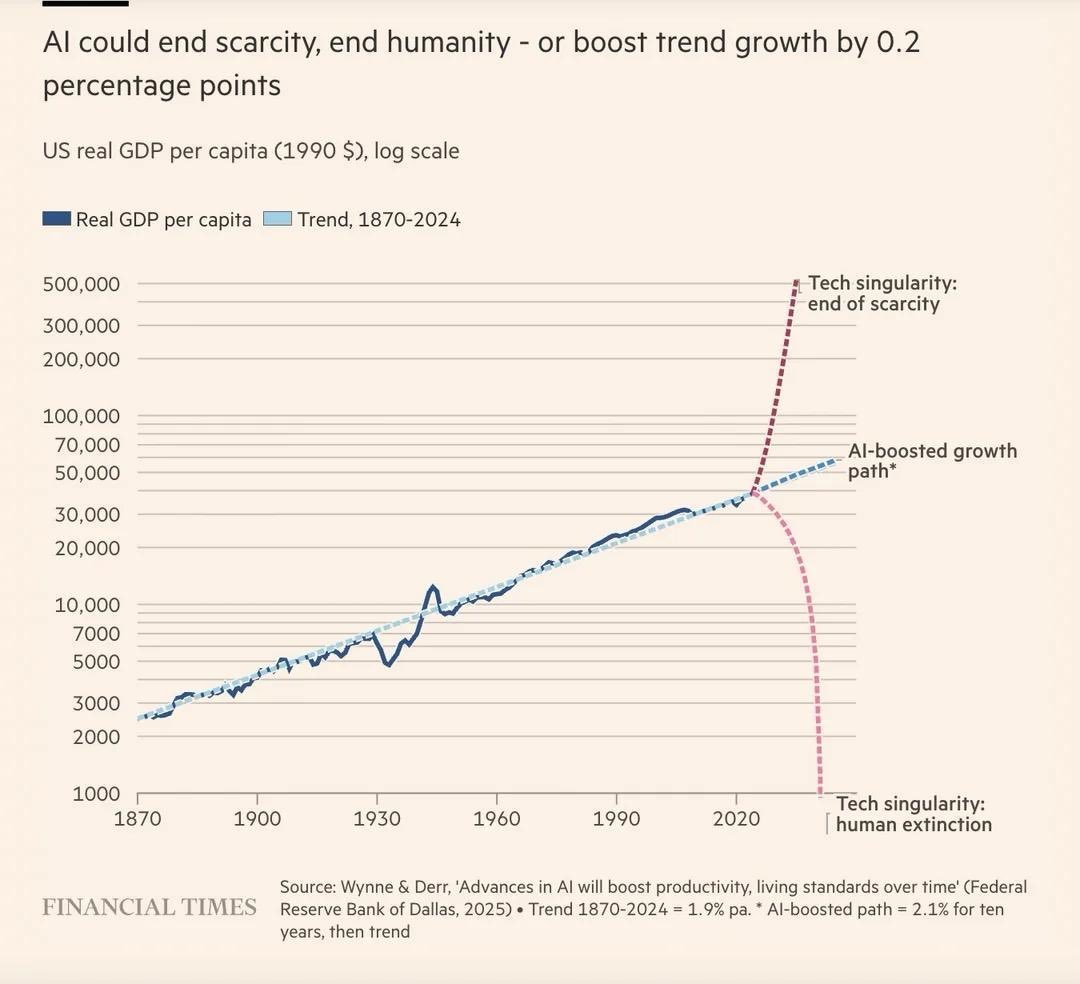
Probably the funniest graph ever published by the FT: our 3 possible futures are either 1) infinite wealth and abundance, 2) human extinction or 3) 0.2% faster GDP growth 🤣
@DavidGeorge83 You may be correct, however saying the Apocalypse is a complete fantasy is dangerous as we are in unprecedented times. AI and robotics have the potential to replace countless jobs at unprecedented speed with newco's needing far fewer employees. Speed is the issue.