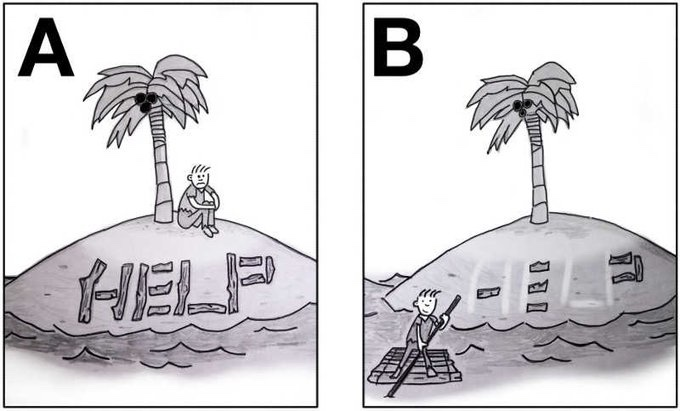
Australia's Great Barrier Reef is at a very high risk of extreme and widespread bleaching and "ecosystem collapse" linked to this year's El Niño weather phenomenon, top scientists have warned
https://t.co/RYvd05td1k
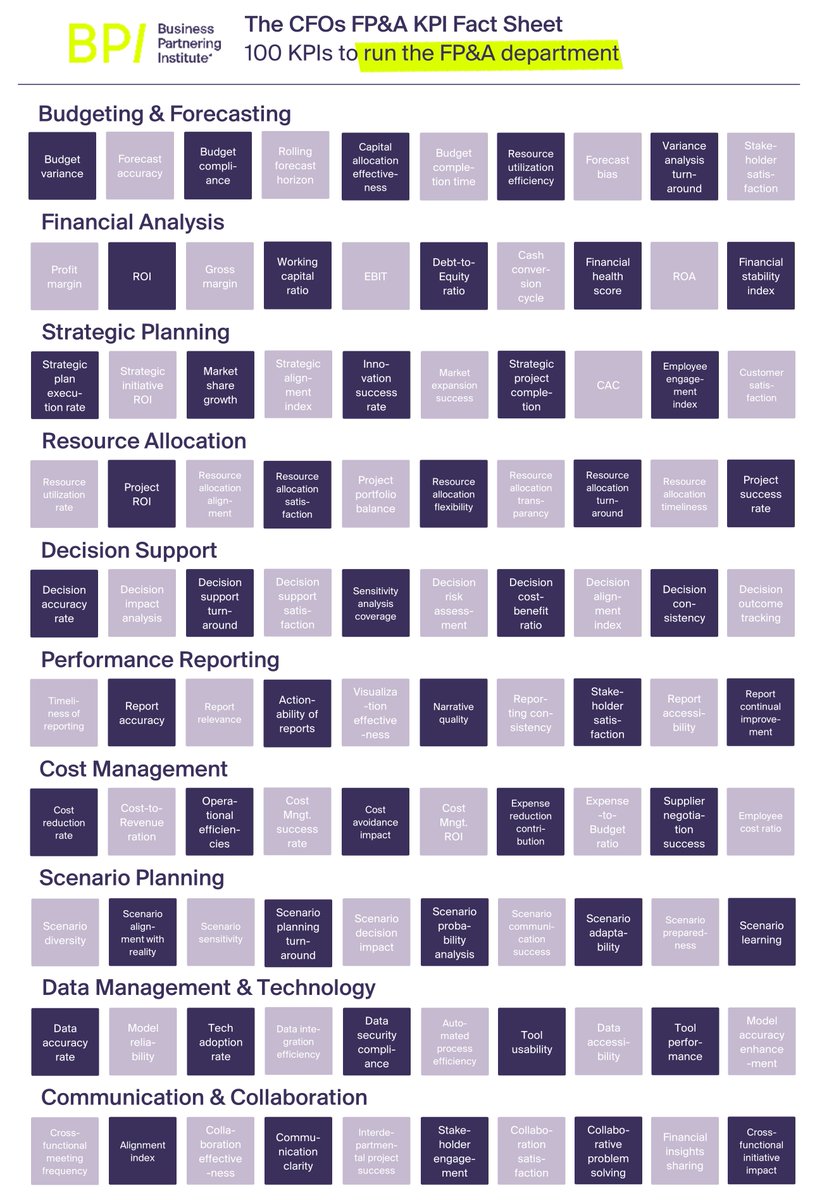
How do you track if your FP&A department is delivering well?
Here are 100 KPIs that'll help CFOs get their FP&A department on the right track 🧵
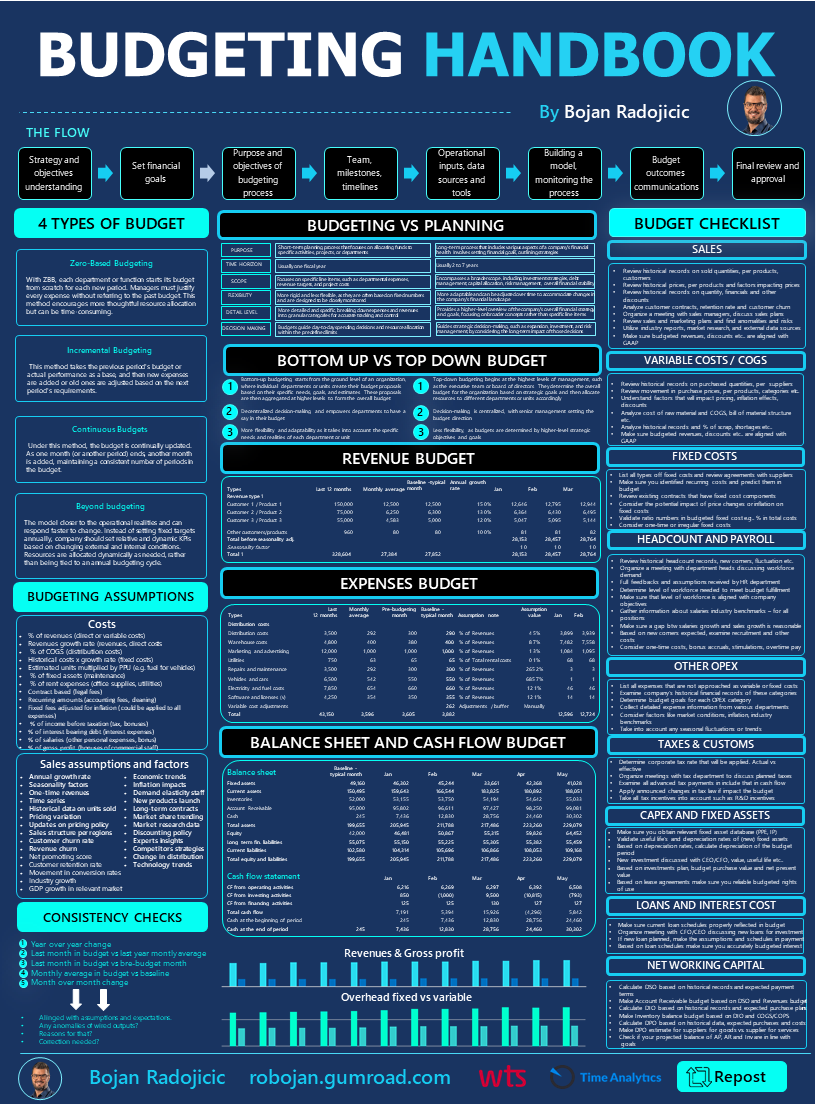
Achieve your peak performance with Corporate Finance Learning Resources. Download the Budgeting handbook and
take your financial analysis skills to the next level 👇
A NEW MENTAL MODEL MEGATHREAD HAS ARRIVED!
In 20 tweets I’ll summarize 20 key principles to understand the world.
Estimated reading time: 4 minutes.
Value: potentially a lifetime.
If you aren’t using Power Query in your spreadsheets… you are missing out.
Once you learn how to use Power Query, I can promise you your capabilities in Excel will skyrocket
Learn Power Query…Excel’s more POWERFUL feature
Let’s go over how it works…
➡️ What is Power Query?
Power Query (now referred to as “Get & Transform Data”) is an ETL tool… which stands for:
E→ Extract
T → Transform
L → Load Let’s go through each…
➡️ EXTRACT
With Power Query, you can extract information from a ton of sources, such as…
1️⃣ A table / range in your workbook
2️⃣ An external file / CSV
3️⃣ A folder containing multiple files
4️⃣ A database
5️⃣ A website
and much more…
Once you have your data extracted, you can now start manipulating it…
➡️ TRANSFORM
Now comes the fun part - manipulating…or “transforming” your data.
Here you’ll be taken to the power query editor where you can make any changes that you want to your source data…
Think of this like a macro that you’re designing, where you can manipulate data over a number of different actions…
each of these actions will get stored each time you hit Refresh, transforming your source data into the new format
➡️ LOAD
Now that you have your data transformed, it’s time to load your data into a new location.
This won’t overwrite your source data, but instead will allow you to load the newly transformed data to:
1️⃣ a Table
2️⃣ a PivotTable Report
3️⃣ a PivotChart
4️⃣ to a connection (where you can further manipulate with other queries, without physically loading to a location in your spreadsheet
You can also add your data to the data model, allowing you to utilize power pivot, which is a tool that allows you to create connections between tables,
and load them into a consolidated pivottable
➡️ OK…so what’s so special about Power Query?
The whole idea with Power Query is you can now pull data from a number of different sources in your Excel file easily…without creating a notorious “external reference”…
and then once your data is pulled, you can set rules for how you want that data to be manipulated only once…
allowing you to see the output of those edits by simply hitting refresh.
This will save you a TON of time
➡️ What is my favorite use of Power Query?
My favorite use by far is UNPIVOTING dates…
that allows me to take for example a profit and loss that has an X Axis ↔ (for dates)…
and UNPIVOT those dates into on column going vertically ↨
That makes it incredibly easier to reference when creating dashboards and other reporting
This is just a preview of what you can accomplish with Power Query…
there are entire courses available on the subject where you can delve into all of the possibilities and become a pro.
What questions do you have on Power Query? And what are your favorite use cases?
Let me know in the comments below
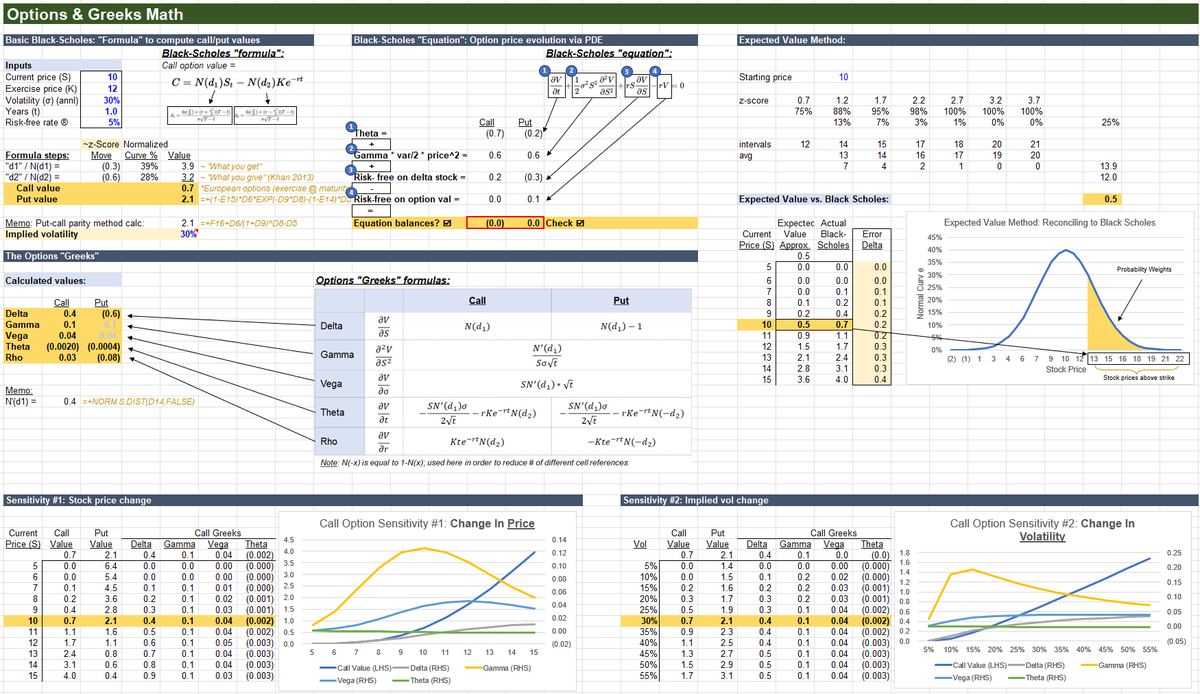
If you don't understand options & greeks, you don't understand markets
Comment if you'd like the excel
5 points:
1) Basics
An option is the right to buy or sell a stock at a pre-specified price.
So if a stock is trading at $10, and you own a call option with an exercise price of $12 and 1 year to expiration -
That clearly is worth something.
But how much?
2) Black-Scholes Equation
The primary answer to that is Black-Scholes.
It describes two competing forces in an option's value:
The negative force is the decay of the option's value over time (its "Theta")
The positive force is the growth in option value as the stock moves (its "convexity" - #2 attached multiplying Gamma by vol & price).
Leaving aside risk free return, the core insight of the Black-Scholes math is this:
The negative impact of time decay at every moment must exactly offset the positive impact of price convexity.
You can watch that change function (PDE) balance precisely in cell N21.
3) Black-Scholes Formula
But the most practical form is the solution to this PDE calculating the exact value of call/put options.
Simplifying a bit, that formula says the following:
What is the probability that this option ends up profitable -
And then multiplies that probability by the difference between the expected value of the stock in that scenario and the exercise price.
This math reconciles exact Black-Scholes to the expected value approximation in cell V29.
4) Greeks
The Greeks show how options move with changes in their inputs:
Delta = option value move per change in the stock price
Gamma = how much delta itself moves with the stock
Vega = option value move per 1% change in volatility
Theta = option value move per day that passes
The other less frequently used Greeks generally capture rates of change of those above (higher order derivatives).
Math & sensitivities attached.
5) Strategies, Extensions, & Limitations
There are as usual two camps of investors:
Those expressing directional views on fundamentals or events; and then those matching, servicing, & trading against the first group.
The second includes market makers, vol surface traders, carry & dispersion traders, and others.
But options also serve as a metaphor for almost any payout structure in finance:
Credit investors and merger arbs sell puts
VC and biotech buy calls
Distressed varies by cap table position
Options describe a wide range of outcomes in ways other vehicles can't.
And in equities, despite other methods like binomial trees, and Black-Scholes assumptions that are often wrong -
The essential framework
Is identifying how asset volatility interacts with finite time and changing market conditions.
There is further depth in every direction here
But as always, the key is a firm grasp of the principles,
Clarity around the math,
And intellectual honesty about the limitations.
That's all for now
Comment if you'd like the excel
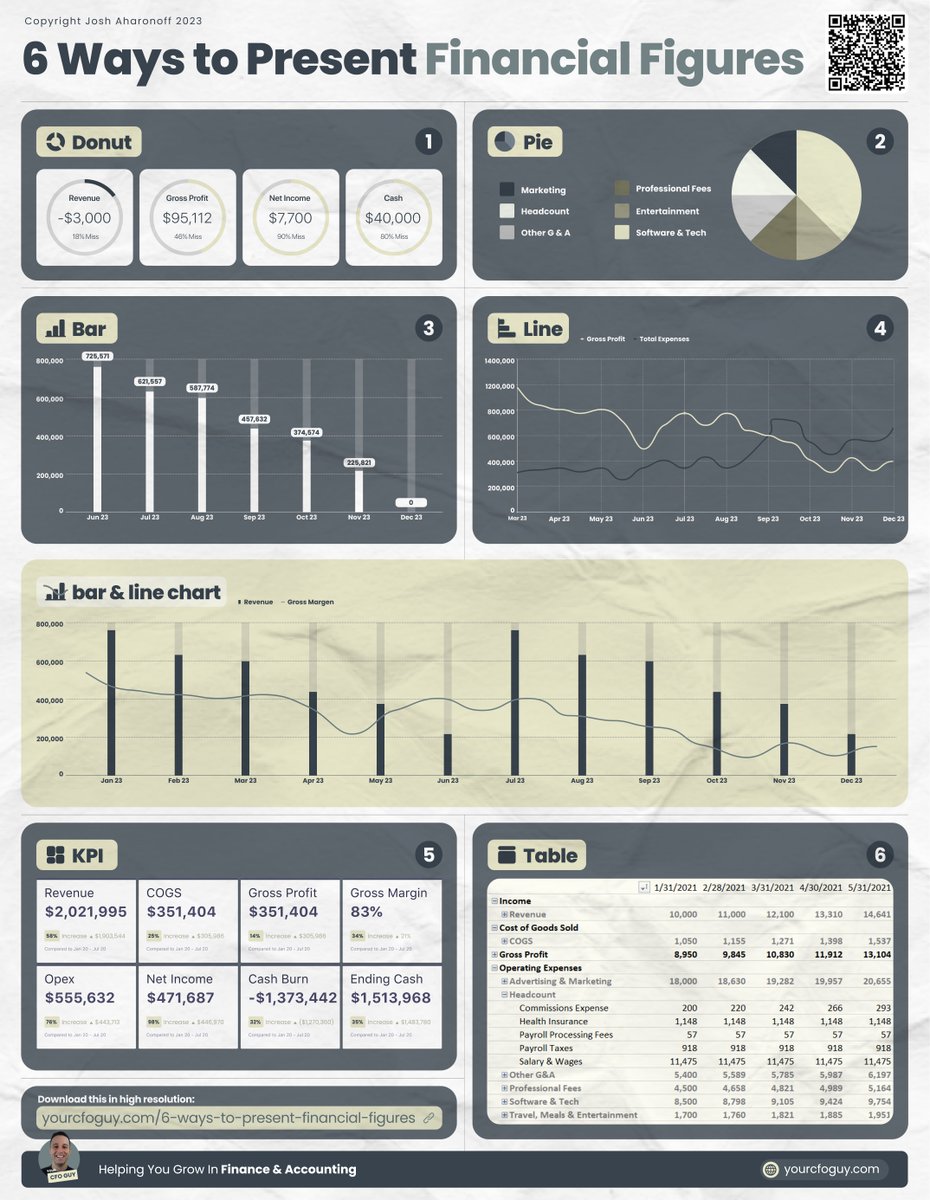
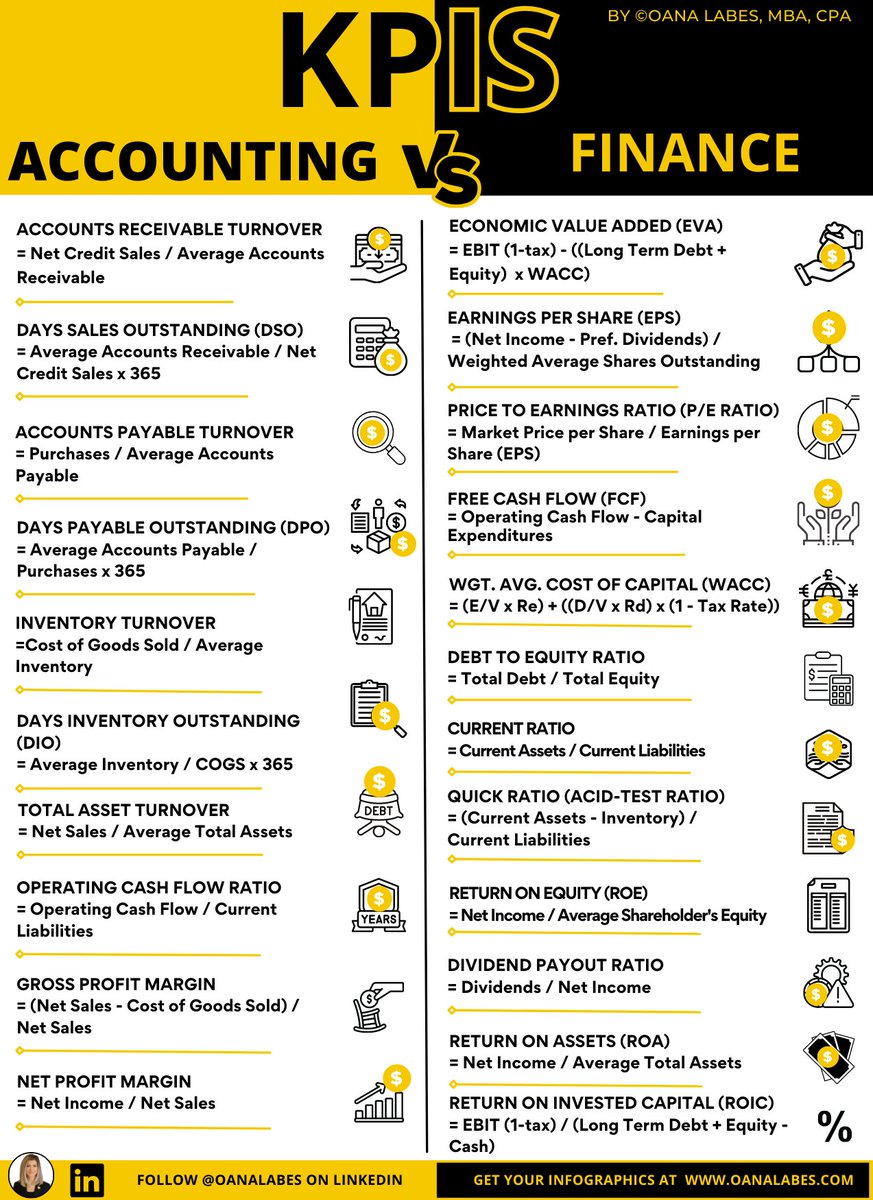
🎯 Finance KPIs focus on the financial performance of a company and help assess value creation by measuring financial health, ability to generate profits and ability to manage capital appropriately
⚫Key Finance KPIs include:
The CFO-CEO relationship is the most important relationship in a business but how do CFOs best work together with CEOs?
Here are ten ways for CFOs to do that 🧵.
YouTube has 2.68 billion active users.
It became one of the best learning tools in the world.
Here are 7 Google Talk Videos that will teach you Investing better than University👇
1. The Art of Investing by Francois Rochon
2. Trying to solve the Investment Puzzle by Chuck Akre
3. The Value of Stories on Business by Aswath Damodaran
4. The Great Minds of Investing by William Green
5. The Most Important Thing - Origins and Inspirations by Howard Marks
6. The Art of Value Investing by John Heins and Whitney Tilson
7. The Little Book that beats the Market by Joel Greenblatt
All these videos are about an hour long.
Maybe watch one a day and within a week, you’ll have increased your investment knowledge immensely.
ChatGPT will soon disrupt every major industry & replace more than 300 million jobs.
99% will fail to adapt.
Here's how to save your career (& keep up in the age of AI):
I've built many financial models in Excel while working at Goldman Sachs & JP Morgan.
1 Billion others use Microsoft Excel, it's the most valuable skill in many careers.
🧵Here are 10 Excel functions everyone should master:
US Treasury yield curves are inverted--really inverted--right now.
But what exactly does that mean, and more importantly, does it truly signal an incoming recession?
Time for a Treasury 🧵👇
Leadership is hard.
One of the hardest parts is delegation.
How much guidance do you give? When do you do it yourself? When/How to track others to-dos?
As a young leader, I wish I had a cheat sheet for delegation.
So I wrote one.
Read this 🧵 to accelerate your career: