$WVE Very interesting, Dr Bolno.
"On July 30, 2026, Paul B. Bolno, M.D., MBA, our President and Chief Executive Officer, terminated a Rule 10b5-1 Trading Plan that was originally adopted on May 26, 2026. Dr. Bolno’s former Rule 10b5-1 Trading Plan provided for the sale of up to an aggregate of 2,924,270 shares of our common stock. No shares were sold under Dr. Bolno’s Rule 10b5-1 Trading Plan prior to its termination."
$WVE 90 day cool-off for the CEO's Rule 10b5-1 expires on Monday. The plan is active until December 31 2026. Last year he made it too short and missed the opportunity to sell on December run-up
Though I'm not a big fan of $IBIO mAb approach in INHBE their massacre is overdone. One rumor of FDA open to accepting body composition endpoints and this will be 🧨 [NP]
"HCXT-2001, from PepStar Therapeutics Limited"
Shanghai Hanchen Xingtai Pharmaceutical Technology
$GILD should be bold to say "we were able to grab one more Chinese asset while the door is still open"
$GILD gets an oral IL23 on the cheap, adding it alongside a4b7 in the IBD pipeline…
…only one more piece to complete the armamentareum and all but guarantee *complete* dominance of the oral IBD market.
Let’s see!
By November 11 2026 $NVO needs to decide if they continue collaboration with $KRRO by substituting the target candidate or terminate the partnership completely.
Very interesting timing in RNA editing
https://t.co/TKxL29OTqR
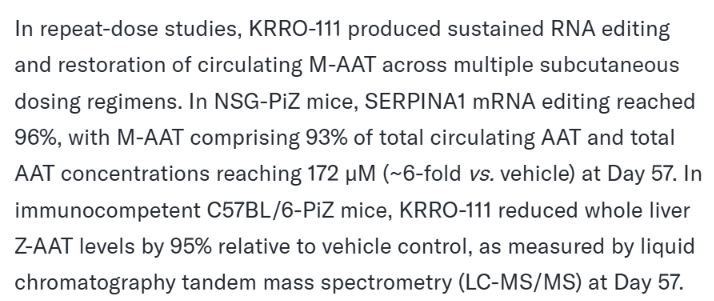
$KRRO unprecedented (preclinical) RNAedting efficacy data. AATD could make this company big, similar to $ALNY, then they need to solve Alzheimer's with ApoE.
$beam $PRQR
https://t.co/bgBzi2Zb8p
Two critical vulnerabilities have been identified in PHP, a widely used programming language that powers websites and web applications. These vulnerabilities (CVE-2026-109618 and CVE-2026-109619) could allow malicious cyber actors to remotely execute code in PHP core, potentially compromising sensitive data and networks.
The FBI urges organizations to take the following steps now:
➡️ If an immediate update is not feasible it is recommended that organizations take the system offline until it can be fully mitigated.
➡️ Immediately update affected PHP installations following the guidance on https://t.co/rDrPSxB3zX. Inventory where PHP runs in your environment, prioritizing internet-facing systems and vendor products that bundle PHP.
➡️ Monitor web servers for suspicious activity, including PHP processes unexpectedly launching command shells or downloading files. Ensure appropriate process-monitoring capabilities are in place to help identify potential exploitation.
➡️ If you find signs of compromise, isolate affected systems, preserve your web server and PHP logs, and report it to your local FBI field office or https://t.co/iqgVZIbCru. Those reports help us identify the actors involved and warn other organizations before they become victims.
For the latest information, follow PHP’s announcement on https://t.co/rDrPSxB3zX, CERT-EU Security Advisory 2026-018, and CISA’s Known Exploited Vulnerabilities catalog.
$WVE This is how bimodal oligo construct with siRNA+ RNA editing likely works, assumption here is that RNA editing oligo is linked to the passenger strand of the siRNA. Is this really so or not - time will tell
Some weekend thoughts on cardiovascular targets and oligos.
The modern explosion of cardiovascular genetic medicine has been built around silencing. From PCSK9 and APOC3 to ANGPTL3 and LPA, every clinically validated target right now is anchored on gene silencing.
So why not upregulation? LDLR upregulation for example?
It is certainly not for a lack of targets of interest. The problem is that turning a gene up is exponentially harder than knocking it down. Historically, the only real tool we had to boost expression was viral gene therapy, and in cardiovascular indications, AAV-based approaches were a flop: transient expression in dividing hepatocytes, neutralizing antibodies, and severe liver toxicity.
Meanwhile, gene silencing delivered massive commercial wins. Look at PCSK9 inhibitors like Repatha, Praluent, and Leqvio. The biology is simple: LDLR acts as the vacuum cleaners on liver cells pulling LDL-c out of the blood. PCSK9 is the trash compactor that destroys those vacuums. Knocking down PCSK9 stops the destruction, letting your existing vacuum cleaners survive and recycle longer.
The catch? If you have heterozygous familial hypercholesterolemia (HeFH), you naturally produce fewer functional vacuums to begin with. Protecting a tiny, defective fleet can only lower cholesterol so far. This is why researchers have chased direct LDLR upregulation: we need to build brand new vacuums.
So why not do both?
We actually recently saw what happens when you only do the upregulation part of the equation. Look at $CAMP. They built an ASO to upregulate LDLR transcription, and their recent bioRxiv preprint showed the biology functions in primates. Yet they shelved the program internally back in their 2024 S-1. Why? Because upregulation alone ran straight into the PCSK9 trap. Pumping out new LDLR doesn't move the needle if endogenous, circulating PCSK9 immediately grabs those new receptors and drags them to the lysosome. As a monotherapy, it simply could not beat the 50% plus LDL-c reduction benchmark set by existing PCSK9 drugs.
The real answer isn't to pick one. It is to combine them into a single bimodal construct: silence PCSK9 to eliminate the destroyer, while simultaneously upregulating LDLR to flood the cell with new vacuums.
About a year ago, $WVE hinted they were engineering this exact dual-action RNA construct on a single GalNAc scaffold. With their R&D Day coming up in the next 2-4 weeks or so, this is one of the most exciting preclinical cards they could lay on the table.
If Wave does showcase this program, here is what I will be watching for to see if it has legs commercially:
- True synergy - NHP data proving that pairing LDLR upregulation with PCSK9 knockdown punches through the standard 50% LDL-c ceiling, pushing reductions into the 70%+ territory.
- Receptor recycling: proof that the newly synthesized LDLR is actively escaping degradation and recycling at the hepatocyte membrane
- Clean safety - No liver enzyme flares or cross-interference from running an RNAi trigger alongside an ADAR AIMer on one GalNAc molecule.
If they can show that, it bridges the gap between today's standard of care and the unmet need in severe dyslipidemia without needing permanent DNA editing.
$WVE spent way more money in H1 2026 on SNBL, who are one of the largest preclinical CROs in the world explicitly specializing inNHP models.
I'd love to know was it dual construct related.