Founder | CEO at Geo Alpha -- I run the research and deployment of market leading high capacity ML-based trading strategies.
Keen to fund climate research!
The world’s climate may already have passed a point of no return. Key ocean currents show signs of failure.
Climate change is often pictured as a far-off, steady climb in heat. New work describes a nearer problem: the disaster may already have started quietly.
The system in question is the Atlantic Meridional Overturning Circulation (AMOC), the set of deep currents that moves heat, carbon and water around the planet.
Melt from Greenland and Arctic ice is pouring extra freshwater into the North Atlantic and shaking that circulation toward a sudden, lasting break.
Researchers say passing that threshold would not be a slow extra degree of warmth. It would flip weather: cooler Europe, shifted farm rains, faster sea-level rise on the east coast of North America.
With record heat still arriving, recent ocean measurements are read as evidence that the state from which the current cannot recover may already be set, so that planning has to move from forecast to handling a crisis.
[van Westen, R. M., Jacques-Dumas, V., Soons, J., and Dijkstra, H. A. (2026). Failure to track a stable AMOC state under rapid climate change. Nature Climate Change. DOI: 10.1038/s41558-026-02730-w]
This amazing process is driven, navigated, controlled and carried out by microtubules and other cytoskelatal structures. Not only the structural bones, the cytoskeleton is the cell’s nervous system using both classical and quantum processes.
🧠 Your brain is constantly building connections.
Under a microscope, neurons can be seen extending tiny branches, exploring their surroundings and connecting with other neurons.
These new connections form synapses — the communication points that allow brain cells to pass signals.
This microscopic process is part of neuroplasticity, the brain’s remarkable ability to learn, adapt and reorganize itself. ✨
GF: As a physicist, this is truly terrifying. We don't even have a way to express what this immense, extreme heating means for us. We can quantify it, sure, but that's not the same as understanding. It's like the Pacific is a pot of water w/ burner on high & we can't turn it off.
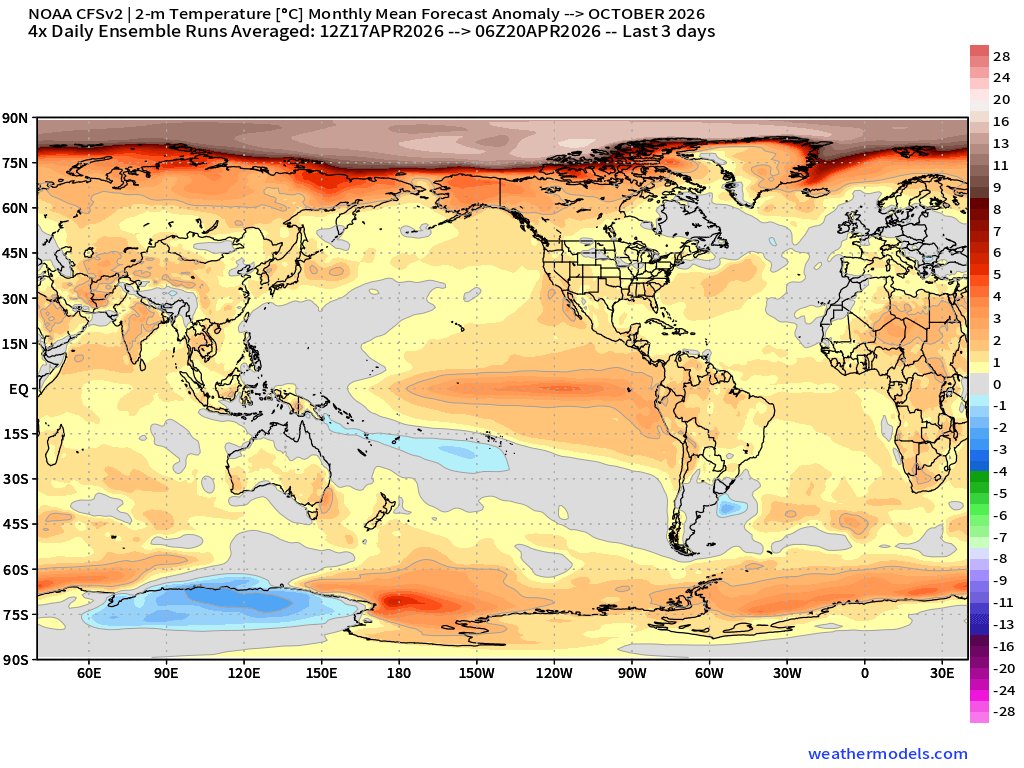
The upcoming "mega El Niño" could be the strongest since the 1877 event that wiped out 4% of the Earth's population due to heat waves, drought and pestilence.
Scientists watching every weather model update are getting "heart palpitations" ❤️
The presumed upcoming El Nino will help cement and quantify global warming acceleration, showing that 2ºC global warming is likely to be reached in the 2030s, not at midcentury.
See Another El Nino Already? - https://t.co/qmFaATJcKR
Also available on Substack: https://t.co/SkXb6Mn5Zk
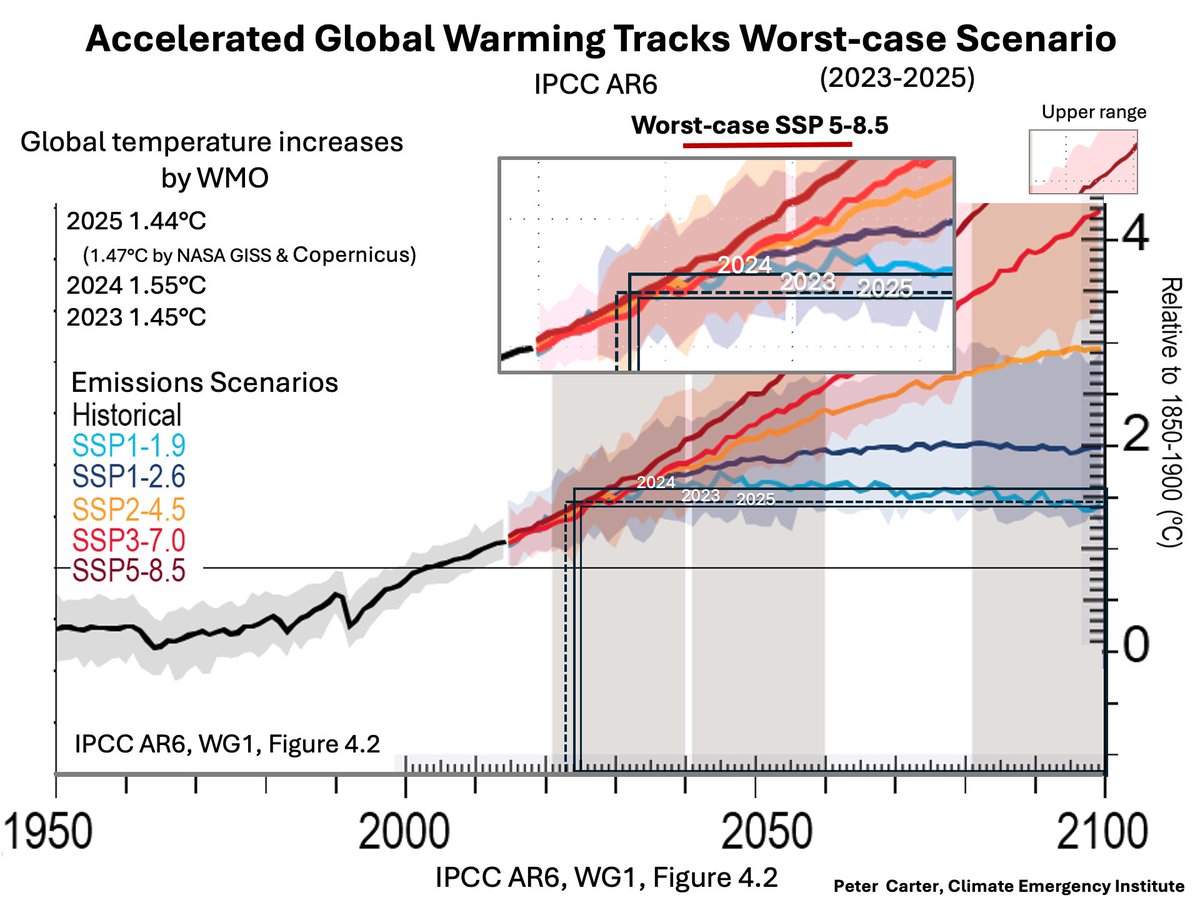
ACCELERATED GLOBAL WARMING TRACKS WORST-CASE SCENARIO
2023 to 2025 track worst-case SSP5-8.5, by IPCC AR6 temperature projections. Scientists thought this could not happen. 2023 was just above 8.5, record 2024 substantially above, 2025 just on 8.5. This is being ignored.
Condemns billions to global heating death.
https://t.co/OagqIso1Oz
#globalwarming #climatechange
MULTIPLE CLIMATE INDICATORS TO GLOBAL CLIMATE CATASTROPHE
Nine climate change indicators are record high (adverse) and most are increasing at accelerating rates, all as fast as ever.
Indicators from the the past 2000 years show explosive increase of 5 indicators. https://t.co/ozqWFC9EFP
#climatechange #globalwarming
Cool way of breaking down the 2023 and 2024 anomalous warmth...
"The geophysical changes underpinning the observations from 2023–2024 suggest that large ensemble model projections informing the UNFCCC policy process may be increasingly underestimating the pace and magnitude of global warming."
From the 10 New Insights in Climate Science Report 2025/2026
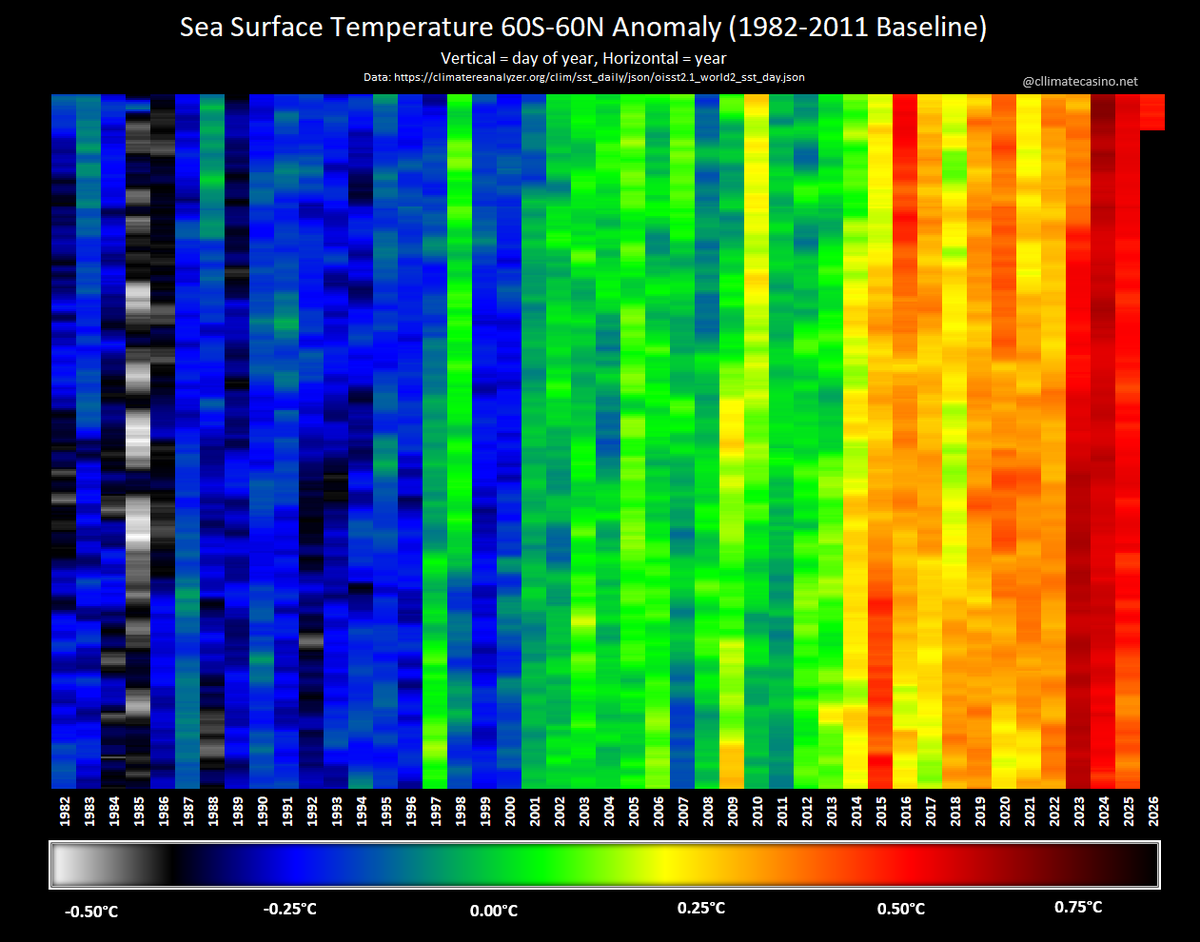
Here are the daily color stripes for the global sea-surface temperature anomaly, up-to-date through Jan. 19, 2026.
You can see the easily spot the cooling trend in 2025, but with a coming El Nino, the future is maroon.
The planet has darkened by ~2% this century — a shift almost entirely ignored in climate policy.
Albedo loss has driven 5× more warming than new emissions in the past decade, yet it’s nowhere on the IPCC agenda.
Reflectivity matters. Brighten the Earth, cool the planet.
It appears to me we have passed a major tipping point in the climate with huge impacts to Antarctica. This magnitude of temperature anomaly (image) is astounding and is likely to be part of a new long term trend. This is not about merely the possibly record stratospheric warming event over the South Pole that is starting today. It’s part of a longer term trend not thought possible and completely missed by global climate modelling. Warming of the North Atlantic Ocean’s uppermost layer has translated cross hemisphere via the Indian Ocean and now through the atmosphere into the Antarctic interior which was over + 8 degrees C (+ 15 degrees F) above the average for the date for the entire month of August (image) and is even warmer today.
This makes one wonder where most of the excess heat from the current record mega marine heatwave in the North Pacific (which is likely a new permanent annually oscillating major climate phenomenon with global climate impacts on the order of the El Nino - Southern Oscillation (ENSO)) will go. Obviously much will go into the atmosphere this winter but a good deal will likely be transported through the atmosphere and the ocean via unusually strong mid latitude cyclones and increasingly meridional polar jet stream flow to additionally warm the already rapidly warming Arctic which saw surface air temperature anomalies of + 10 to + 15 degrees C (+18 to + 27 degrees F) above the average for the date for *3 months running* this past winter.
“Summer warming in the East Antarctic interior triggered by southern Indian Ocean warming” from Nature:
https://t.co/IEdrOoXFM1
“Warming Band in Southern Ocean’s Indian Sector: The Role of Remote Atlantic Buoyancy Forcing via Poleward-Shifting Circulation Response” from the Journal of the American Meteorological Society:
https://t.co/NxD9DJJntr via John Scheve
If someone tells you “40°C is normal in France” they are lying or misinformed.
Before 1980 40°C was recorded just 4 times. Since 2019 it has been recorded 180 times.
Climate step change?
Here is my version of Hansen's albedo graphic, using CERES data, this time with a quadratic trendline (assuming that global darkening is accelerating).
Tl;dr ~ fear and loathing
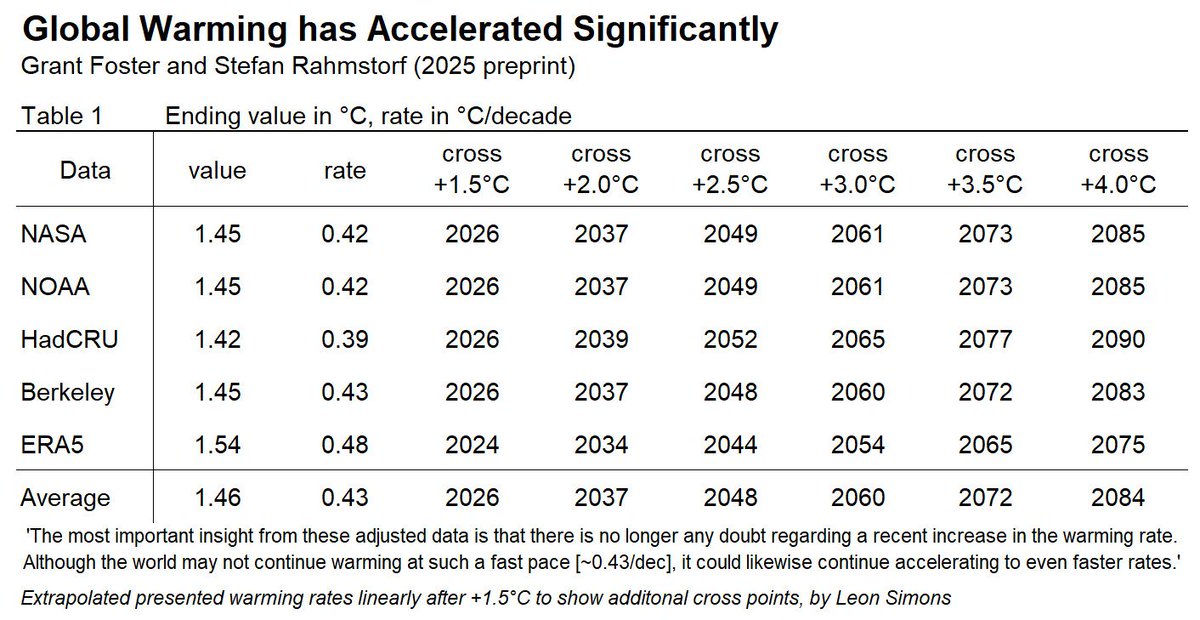
'The most important insight from these adjusted data is that there is no longer any doubt regarding a recent increase in the warming rate.
Although the world may not continue warming at such a fast pace [~0.43C/dec], it could likewise continue accelerating to even faster rates.'
Earth is getting darker, reflecting back to space a decreasing portion of the sunlight incident on Earth. This provides crucial information on cloud changes and climate sensitivity. See - 14 May Large Cloud Feedback Confirms High Climate Sensitivity - https://t.co/v2DoxQ6F8B