@InfoCatolica Btw, the alleged "conferral of jurisdiction by ordination" is often not distinguished from an "aptitudo" intrinsically conferred with ordination (the conferral of jurisdiction without ordination, which is possible in itself – see Church history – should also not be forgotten).
Regarding John Courtney Murray, he states that "Murray supporters and like-minded commentators complained bitterly about the late additions to the final text of the declaration that Paul VI ordered in response to objections from the conservative fathers."
He also states that although few Catholics are entirely satisfied with Dignitatis Humanae, it is at least clear that “the document did not overturn traditional papal teaching on the relationship between Church and State.”
New video with my good friend @sincead33 on the topic of invincible ignorance, and the possibility of salvation for non-Christians, in light of the Second Vatican Council.
https://t.co/O0vywGvEwK
1) Conscience is not a subjective disposition, rather as the proximate rule of moral acts it is the application of universals i.e divine law, to particulars. Divine law as the remote rule of moral acts is objective, therefore so is the proximate rule i.e conscience. Man is bound in justice to form his conscience according to divine law, this is why it is still a sin to act according to a vincibly erroneous conscience.
"The judgment of conscience is a practical judgment, a judgment which makes known what man must do or not do, or which assesses an act already performed by him. It is a judgment which applies to a concrete situation the rational conviction that one must love and do good and avoid evil. This first principle of practical reason is part of the natural law; indeed it constitutes the very foundation of the natural law, inasmuch as it expresses that primordial insight about good and evil, that reflection of God's creative wisdom which, like an imperishable spark, shines in the heart of every man. But whereas the natural law discloses the objective and universal demands of the moral good, conscience is the application of the law to a particular case; this application of the law thus becomes an inner dictate for the individual, a summons to do what is good in this particular situation. Conscience thus formulates moral obligation in the light of the natural law: it is the obligation to do what the individual, through the workings of his conscience, knows to be a good he is called to do here and now. The universality of the law and its obligation are acknowledged, not suppressed, once reason has established the law's application in concrete present circumstances. The judgment of conscience states 'in an ultimate way' whether a certain particular kind of behaviour is in conformity with the law; it formulates the proximate norm of the morality of a voluntary act, 'applying the objective law to a particular case'. (Veritatis Splendor Ch. 2 n. 59)
"Like the natural law itself and all practical knowledge, the judgment of conscience also has an imperative character: man must act in accordance with it. If man acts against this judgment or, in a case where he lacks certainty about the rightness and goodness of a determined act, still performs that act, he stands condemned by his own conscience, the proximate norm of personal morality. The dignity of this rational forum and the authority of its voice and judgments derive from the truth about moral good and evil, which it is called to listen to and to express. This truth is indicated by the 'divine law', the universal and objective norm of morality. The judgment of conscience does not establish the law; rather it bears witness to the authority of the natural law and of the practical reason with reference to the supreme good, whose attractiveness the human person perceives and whose commandments he accepts. 'Conscience is not an independent and exclusive capacity to decide what is good and what is evil. Rather there is profoundly imprinted upon it a principle of obedience vis-à-vis the objective norm which establishes and conditions the correspondence of its decisions with the commands and prohibitions which are at the basis of human behaviour'. (Veritatis Splendor Ch. 2 n. 60)
2) Fr. Lucien's thesis does not assert that every time the Church burned heretics, she rightfully judged that each particular individual was violating their conscience, rather the Church could presume to do so with individuals, such as the Hussites, Wycliffites, etc because they grew up in Catholic societies, and went on to become apostates. The principle applied here is the exact same as just war theory, or when secular judges have on occasion condemned the innocent. Internal culpability can be judged based on external factors. "O generation of vipers, how can you speak good things, whereas you are evil? for out of the abundance of the heart the mouth speaketh." (Mt. 12:34) This judgement is based on the objective truth of the Catholic religion, which Protestants do not grant, however if Sean wishes to assert a contradiction within the Catholic tradition without disproving Catholicism, it is utterly question begging, because there is a clear logical consistency that Catholicism asserts herself to be the one true Church established by Christ. Pointing out the practices of individual inquisitors is irrelevant, as Fr. Lucien's thesis concerns a synthesis of Mirari Vos, Quanta Cura, and Dignitatis Humanae, something you would be aware of if you actually read my article properly, or Fr. Lucien's thesis.
"Indeed, it is quite possible, and alas very common, for a man to act as he wishes, though not according to his conscience. In fact, one who sins often acts against his conscience, whereas in other cases he acts according to his culpably erroneous conscience. It can even happen that man, hardened to the point of indifference towards good and evil, acts absent any judgment of conscience. Moreover, the judgment of conscience in every man is exercised by practical reason, which first apprehends the general principles of the moral order. This knowledge of universal principles is per se accessible to every human intelligence. This objective accessibility also applies to the fact of divine Revelation fulfilled and completed in Jesus Christ, since this Revelation is accompanied by signs of credibility that are both highly certain and also adapted to the intelligence of all men. To be sure, knowledge of the general principles of morality and religion vary from one person to the next, according to the circumstances of social background, upbringing, and other more individual factors. But these diverse circumstances, which shape one’s access to the knowledge of general and universal principles, are of themselves observable from the outside." (Religious Liberty: Continuity Or Contradiction? pg. 6-7)
"Now the Catholic religion has grounds of credibility that are ‘suited to the understanding of all’; in the context of Christendom, these data are indeed within everybody’s reach. The Church, therefore, has been in a position legitimately to presume that those who did not take them into account (heretics and the like, or, in a different way, infidels intending to spread their errors in a Catholic nation) were not acting according to their conscience. In the present situation of the world, one can of course no longer presume generally, at the level of a State, that the Catholic Church and its grounds for credibility are sufficiently presented to men, even in ‘majority’ Catholic countries. The practical attitude of the Church, considering the right put forward by Vatican II, is justifiably modified. Furthermore, in today’s world such civic tolerance may be based on a principle that is both more general and easier to apply, namely that some evils are to be tolerated to protect the common good." (Religious Liberty: Continuity Or Contradiction? pg. 9-10)
"The Second Vatican Council strongly emphasized this distinction between object and basis in a sentence that may have caused some difficulty: 'The right to religious liberty, therefore, is not based on any subjective disposition of a person, but rather in the very nature of a person. That is why the right to this immunity remains even in those who do not meet their obligation to seek the truth and embrace it' (DH no. 2). The significance of this precision is considerable. Indeed, if the right to religious liberty were based on the sincerity of one’s conscience, this right would not exist among those 'who do not meet their obligation etc.' The Council, in this statement, strongly discarded a common mistake regarding the basis of the right. By saying that the right 'remains' among those 'who do not meet their obligation etc.,' the Council does not aim at changing the object of the right, an object that was just defined as the liberty to act (in religious matters) according to one’s conscience (and not at all against one’s conscience or without a conscience). My study shows that there are global societal situations in which the mind of every man is, without any 'research', presented with fundamental religious truths, so that those who disregard them cannot claim to be acting according to their conscience." (Religious Liberty: Continuity Or Contradiction? pg. 34 fn. 21)
“Vós experimentastes em vossas próprias pessoas os danos e as feridas do ódio; mas, em meio às vossas angústias, também sentistes os benefícios e as delicadezas do amor, desse amor que não se nutre de motivos terrenos, mas de uma fé profunda no Pai celeste,
"Here is a truth that burns: outside the Church there is no salvation. Many believe that to state such a truth is to be guilty against Ecumenism. These forget that the Decree on Ecumenism, sanctioned by the Second Vatican Council, is concerned with avoiding the danger of “indifferentism.”"
- Giuseppe Cardinal Siri, Renovatio», XX, (1985), Pasc. 1, pp. 5-7.
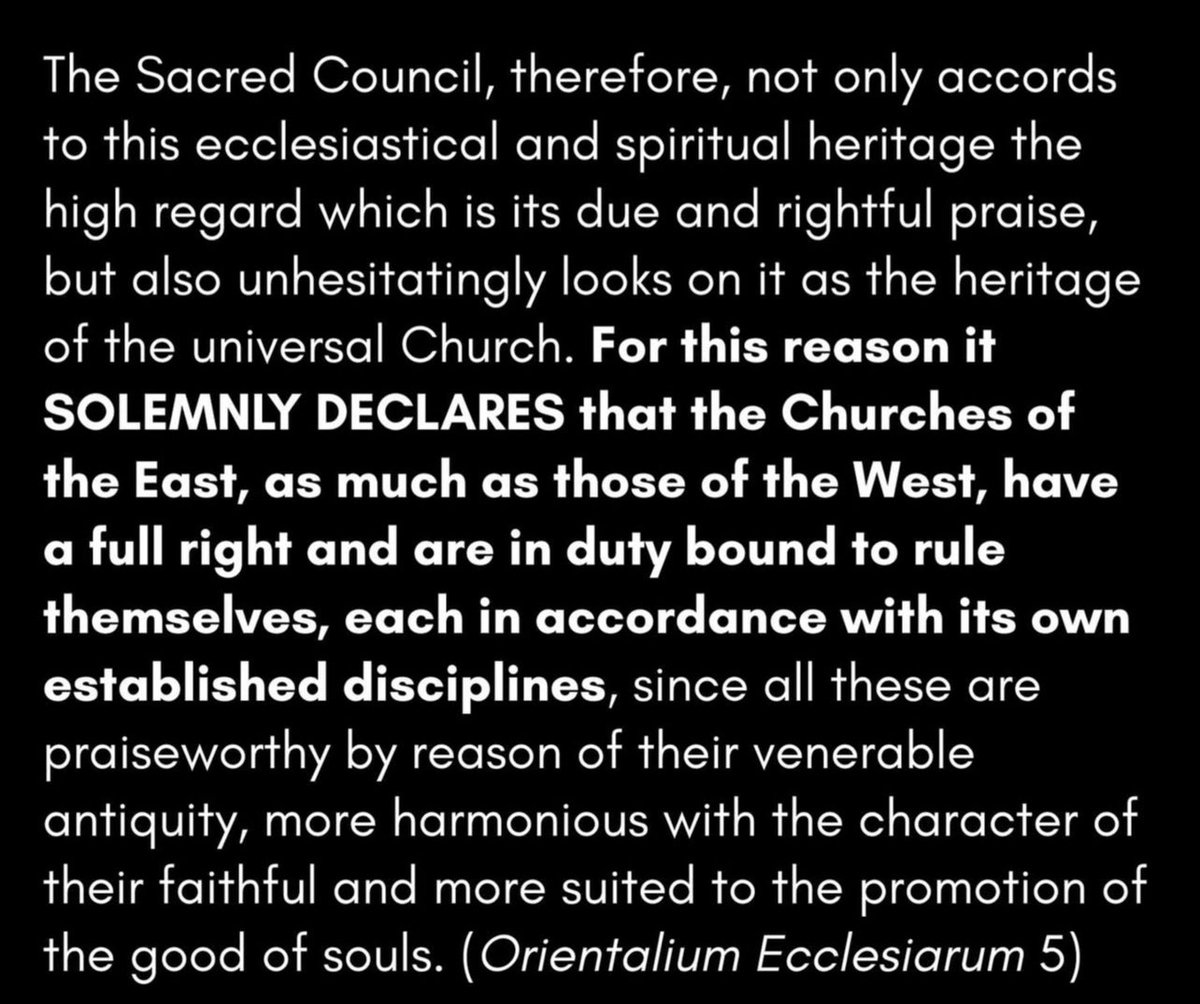
@ElijahElishaRap Even Vatican Il says the Eastern Churches governs themselves. Orthobros don't get the papacy & they don't want to. They attack a fake, autocratic version of it because it's easier for them to argue against than the minimalist position which is the official view of the papacy.
It seems that Suárez was unfortunately deceived by the Vatican II sect😢
“The freedom or immunity from coercion in matters religious which is the endowment of persons as individuals is also to be recognized as their right when they act in community. Religious communities are a requirement of the social nature both of man and of religion itself. Provided the just demands of public order are observed, religious communities rightfully claim freedom in order that they may govern themselves according to their own norms, honor the Supreme Being in public worship, assist their members in the practice of the religious life, strengthen them by instruction, and promote institutions in which they may join together for the purpose of ordering their own lives in accordance with their religious principles.”
(Dignitatis Humanae n. 4)
“Unbelievers are not to be compelled, even when they are subjects, to abandon rites which are merely in opposition to the faith. As to the other rites of unbelievers, those which are opposed only to the faith but not to natural reason, it is a certainty that unbelievers, even though subjects, should not be compelled to abandon them; on the contrary, such rites should be tolerated by the Church. So St. Gregory teaches (Letters, Bk. I, letter xxxiv [Bk. XII, letter xii]), especially with respect to the Jews, when he forbids that the latter be deprived of their synagogues, and urges (Bk. XI, letter xv) that they be permitted to engage in their ceremonies therein. He likewise teaches that the Jews should be permitted to celebrate their solemn rites.”
(Disputation XVIII of On Faith §4 n. 10)
@RealMattFradd Jews and Muslims do worship God, though in an imperfect and non-salvific way. This is the opinion of: the Fathers, the Catholic Church, and the real life Orthodox Church. The EO youtube kabbalah ignores all three of them, which is why they reject this teaching
"Nothing is so foreign to the spirit of ecumenism as a false irenicism, in which the purity of Catholic doctrine suffers loss and its genuine and certain meaning is clouded." (Vat II, UR 11) If that cannot be applied to the doctrine on God Himself, then what can it be applied to?


![DoorDashThomist's tweet photo. It seems that Suárez was unfortunately deceived by the Vatican II sect😢
“The freedom or immunity from coercion in matters religious which is the endowment of persons as individuals is also to be recognized as their right when they act in community. Religious communities are a requirement of the social nature both of man and of religion itself. Provided the just demands of public order are observed, religious communities rightfully claim freedom in order that they may govern themselves according to their own norms, honor the Supreme Being in public worship, assist their members in the practice of the religious life, strengthen them by instruction, and promote institutions in which they may join together for the purpose of ordering their own lives in accordance with their religious principles.”
(Dignitatis Humanae n. 4)
“Unbelievers are not to be compelled, even when they are subjects, to abandon rites which are merely in opposition to the faith. As to the other rites of unbelievers, those which are opposed only to the faith but not to natural reason, it is a certainty that unbelievers, even though subjects, should not be compelled to abandon them; on the contrary, such rites should be tolerated by the Church. So St. Gregory teaches (Letters, Bk. I, letter xxxiv [Bk. XII, letter xii]), especially with respect to the Jews, when he forbids that the latter be deprived of their synagogues, and urges (Bk. XI, letter xv) that they be permitted to engage in their ceremonies therein. He likewise teaches that the Jews should be permitted to celebrate their solemn rites.”
(Disputation XVIII of On Faith §4 n. 10)](https://pbs.twimg.com/media/G7x0TadWcAABt8T.jpg)










![DoorDashThomist's tweet photo. It seems that Suárez was unfortunately deceived by the Vatican II sect😢
“The freedom or immunity from coercion in matters religious which is the endowment of persons as individuals is also to be recognized as their right when they act in community. Religious communities are a requirement of the social nature both of man and of religion itself. Provided the just demands of public order are observed, religious communities rightfully claim freedom in order that they may govern themselves according to their own norms, honor the Supreme Being in public worship, assist their members in the practice of the religious life, strengthen them by instruction, and promote institutions in which they may join together for the purpose of ordering their own lives in accordance with their religious principles.”
(Dignitatis Humanae n. 4)
“Unbelievers are not to be compelled, even when they are subjects, to abandon rites which are merely in opposition to the faith. As to the other rites of unbelievers, those which are opposed only to the faith but not to natural reason, it is a certainty that unbelievers, even though subjects, should not be compelled to abandon them; on the contrary, such rites should be tolerated by the Church. So St. Gregory teaches (Letters, Bk. I, letter xxxiv [Bk. XII, letter xii]), especially with respect to the Jews, when he forbids that the latter be deprived of their synagogues, and urges (Bk. XI, letter xv) that they be permitted to engage in their ceremonies therein. He likewise teaches that the Jews should be permitted to celebrate their solemn rites.”
(Disputation XVIII of On Faith §4 n. 10)](https://pbs.twimg.com/media/G7x0UpVXUAA3w-W.jpg)


