The Endgame of Money
In 2018, I was a Chinese college student deeply interested in finance when I first came across Bitcoin online.
At the time, I was teaching myself finance and reading macroeconomics every day. My understanding of “making money with money” was still pretty simple: buying fixed-income products from financial institutions, or maybe owning some gold.
Then I saw people talking about Bitcoin.
Some were claiming Bitcoin would reach $100,000 by 2021.
So I started researching it, partly driven by the dream of getting rich.
Ironically, the guy who first told me to buy Bitcoin was just some random internet influencer selling paid group memberships and courses, with no real trading track record at all.
But he did tell me one important thing:
“Use cold storage. Keep your Bitcoin on a Trezor.”
So I started searching what Bitcoin actually was.
I found the Chinese translation of Satoshi Nakamoto’s whitepaper.
I couldn’t understand any of it.
As someone who mainly studied history, geography, and politics, the entire paper looked like incomprehensible scripture to me.
So instead of trying to understand the technical details, I decided to study the community around Bitcoin instead.
I read forums, discussions, debates, and what other people thought about it.
Luckily, back then the Chinese Bitcoin community still had many true believers passionately explaining Bitcoin and trying to communicate what it actually meant.
I learned a lot during that era.
And then one day, something suddenly clicked.
In a country like China, under an authoritarian government, the ability for an individual to freely hold and transfer value — without government permission, surveillance, or even awareness — is unbelievably rare.
Actually, not rare.
Unique.
My family had already experienced political persecution under the Chinese Communist system, and our family wealth was wiped out because of it.
So deep down, I always understood how dangerous unchecked political power could be.
Life in China revolves around power. Everything revolves around political authority.
There’s a famous saying in Chinese society:
“If they say you can, then you can — even if you can’t.
If they say you can’t, then you can’t — even if you can.”
And then I realized:
Bitcoin solved this problem.
My first impression of Bitcoin wasn’t “digital gold” or “fixed supply.”
It was the realization that human beings could finally own a form of value transfer that nobody could control.
And once I realized that, another thought shocked me:
“How is this thing not completely banned in China already?”
(Or at least — not successfully banned, despite many attempts.)
Because any form of freedom is incredibly precious for people living in China, even if many Chinese people themselves don’t care.
So honestly, I barely even researched the price.
Compared to ownership beyond political power, valuation felt insignificant.
I bought as much Bitcoin as I possibly could during the early 2018 bear market, around an average price of $10,000.
Only after moving it into my Trezor did I continue researching more deeply.
That’s when I discovered Austrian economics.
I started reading Ludwig von Mises, Friedrich Hayek, and The Denationalization of Money.
And then I arrived at another conclusion:
Bitcoin has no valuation ceiling.
Whatever wealth humanity ultimately stores economically, divided by 21 million.
Of course, that sounds too extreme.
So let’s use a smaller assumption.
If Bitcoin absorbs just 1% of total global wealth, then by 2026 standards, Bitcoin already justifies prices around $150,000.
Back then I never built complicated valuation models.
I simply felt, instinctively, that this thing had no ceiling.
The main lesson in Bitcoin, and life, is keep it simple.
Ain't nothing gained by continually adding complexity.
This lesson will be hard learned in the coming days, whether you're an economically illiterate power trippin Core dev, or a fiat thermo financial engineering genius.
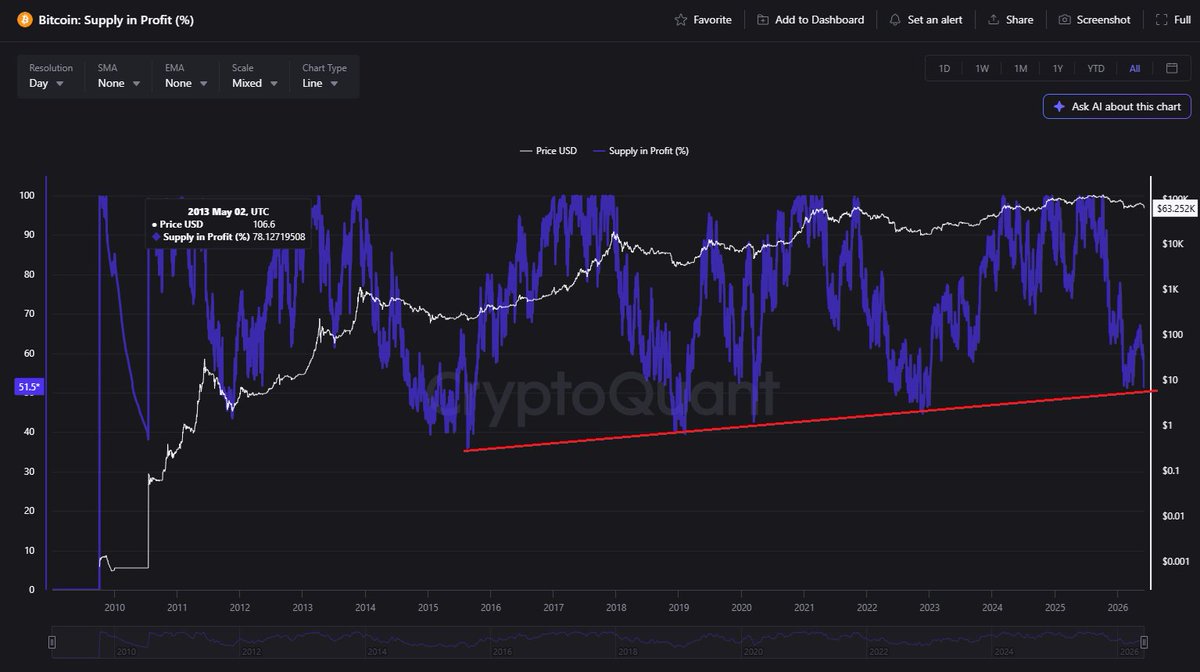
Probably the most important $BTC analysis.
It doesn't take a genius to see that the drops are getting less aggressive with every cycle.
2015 retrace = 35.82% addresses in profit.
2019 retrace = 40.47% addresses in profit.
2022 retrace = 45.11% addresses in profit.
2026 retrace = 51.12% addresses in profit.
We are seeing a 5% increase each cycle. So do the math.
45.11% + 5% approx = exactly where BTC is now.
Hindsight is a b*tch when the weekly/monthly looks disgusting.
@Arthur_van_Pelt@chunshengzhang3 Same opinion
That's why although I'm supporting BIP-110 but it seems still hard to success to me
And also that's the reason why I like XMR refuse ASIC , and that's the question I will never understand why BTC doesn't do the same
Bitcoin is getting oversold, but over its history the REALLY oversold conditions have come at a deeper deviation below the 200MA. Using PPO with (1, 200) settings lets you see that deviation nicely.