The first GIFT City outbound funds and PMSes have now completed a year, or are close to it. The performance? Largely disappointing.
A note before we start. Each fund publishes its data on a different date. So the periods below differ from fund to fund, and in each case we compare against the benchmark over the same period.
DSP launched the first actively run retail fund in GIFT City in September 2025. In its first year, its NAV fell 8%. Its benchmark, the MSCI ACWI, rose 16.4% over the same dates.
Why? DSP stayed away from the AI trade. It owns TSMC, Alphabet, Amazon and Meta, but not Nvidia, Broadcom or the memory makers. It held about a quarter of the fund in cash. And it bet on Chinese consumer names like Trip, PDD and Anta, and on sportswear brands like Puma, Lululemon and Deckers. The contrarian call has not worked so far.
PPFAS's actively run PMS is up 2.1% since August 2025, as per its June factsheet. The S&P 500 was up 16.8%. The PMS had a third of its money in cash. The passive S&P 500 fund PPFAS launched in March 2026 is up 16.6% after tax.
Mirae Asset's Global Allocation Fund holds only ETFs, but it still picks themes: AI chips, data centres, defence, China and rare earths. It had 18% in cash. It is up 1.47% in the six months to July. The ACWI was up 8.2%.
Marcellus' global PMS returned 3.7% in dollars in the year to July. The ACWI returned 22.2%. Over three years, it has returned 14.8% a year against 18.3% for the ACWI. Its biggest bets, aerospace and industrials, fell as US-Iran tensions returned.
Unifi's G20 fund did better. It returned 15.6% in the year to July, before tax. That is still behind the ACWI's 22.2%, but well ahead of DSP, PPFAS and Marcellus. It owned AMD, Marvell and TSMC through the AI rally. And it cut cash from a quarter of the fund at the end of 2025 to 9% by mid-2026.
The lesson? None of these active funds beat its benchmark. The one that came closest owned the AI trade and put its cash to work. The ones that held cash and waited fell furthest behind. So far, passive has been the better choice. This is partly why we built our own portfolio using passive funds (UCITS ETFs). To know more, check out: https://t.co/x1wnPNZ3ib
What are the benefits of CAS system??
I think VWAP was much better and suitable for Indian Stock Market.
CAS is good if STT on delivery orders is abolished.
You saw 50 pro-protest reels.
Your friend saw 50 anti-protest reels.
Now you think he’s brainwashed.
He thinks you’re brainwashed.
You stop talking. You feel lonely.
And that’s exactly what Instagram wanted.
Because lonely people scroll 3x more.
These people are smart.
Don’t be their product.
SUZLON IN FOCUS
FROM REUTERS
INDIA CLEAN ENERGY MINISTER SAYS WORKING ON REGULATIONS ON REPLACING OLD WIND TURBINES WITH NEW POWERFUL TURBINES ( SUZLON )
Caveat emptor
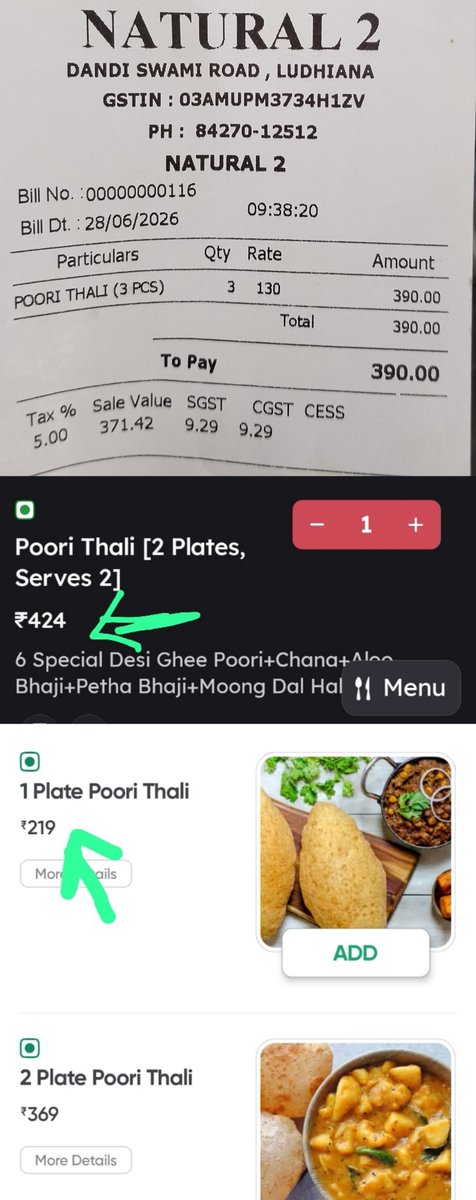
Popular food delivery apps hv higher listed price than walk in resturants.
+GST & then in some cases delivery+packing charges.
👻Coupons are llusion of saving.
Are these steep app markups worth the convenience?🤔
Ur craving r being encashed☺️
A friendly share
Read this slowly and carefully.
What Are We Saying: Buy Stocks
We are dropping our conservative stance on equities.
A few signs that make the current correction suitable to add equity allocation in moderate proportions:
1. Valuations, especially for large caps with Nifty Index at 22,500, are now close to long term average. Banks, IT, Healthcare, insurance, housing finance and a few FMCG names (these collectively constitute more than half of market cap) are at or below long-term valuations.
2. For several large caps with ROEs of 15% to 16%, and multiples of less than 17x, even at current earnings growth of 10% to 12%, it would make sense to have suitable allocation. Whenever earnings revive, they can deliver better outcomes than bonds. One can find many of these stocks today.
3. For SMIDs, a more cautious stance is needed or allocation to active managers with focus on valuations and quality is key, in a SIP mode.
4. The bond yield to earnings yield gap is now just 1%. This is an ideal zone to own stocks and has become more favourable only in full blown panics like COVID crash or GFC’08.
5.India VIX went over 25 and has started to recede. This is a sign that there is reasonable amount of panic.
6. Most indices and large cap stocks are at extremely oversold readings. Only 15% of Nifty 500 Index constituent stocks are over 200 day moving average. Only 11 percent are over 50-day average. These readings are approaching extreme reading, although aren't at extremes yet.
7. Indian Rupee, as per REER, is at an oversold reading.
8. Indian GSec stands at 160 bps premium to repo rate, limiting the extent of where rates could be.
9. A time to add aggressively to stocks can come when value starts to emerge in SMIDs as well. Hence this is a time to raise equity allocation by a notch.
More details to follow in DSP Navigator, to be released shortly and in DSPNetra April 2026 edition.
@svembu IAt this juncture we need Entrepreneurs like you.
I appreciate your honesty & thought Sometimes you look beyond profits (not every time). I have downloaded app and encouraging others to do so.
Human beings have finally changed the course of nature … no more boom and bust cycle… if you have done excesses in a cycle then don’t worry you can continue doing excesses … keep on taking more risk .. continue leveraging because our Central banks have our back.
As Vincent deluard writes
“The cancellation of recessions, which has become undeniable in the post-COVID era, is the culmination of a secular decline in the intensity of the economic cycle. The US economy spent about 40% of its time in recession before the New Deal. The share of recessions fell to around 15% during the Cold War, 5% since the 90s, and just 1% in the past 16 years”
Chart courtesy. stoneX
Morgan Stanley's Market Call | Expecting FIIs to buy without DIIs selling isn't happening or possible, unless corporate issuances pick up, says Ridham Desai, MD & Chief Equity Strategist at Morgan Stanley India (@MorganStanley). Tells @SurabhiUpadhyay and @Nigel__DSouza that FII underweight positioning in India is at levels we have never seen. #CNBCTV18Exclusive #CNBCTV18MarketEditor
You need to understand … we are in “Brave new world” ( post Covid world) where govt are deciding the winners and losers … infact it would not be wrong to say
“Government is the economy” …
keep on repeating it.
Govt is changing the chairs of the deck as per its policies and priorities.
Now for the investment implications….
Don’t invest in anything which govt don’t like .. because govts will simply squeeze that sector and allocate that resources to its policy priorities sector.
Most people lose the plot by arguing that govt is not doing right thing or not focussing on the right thing… I can sympathize but it will not help you in making money.
( chart courtesy @HayekAndKeynes )
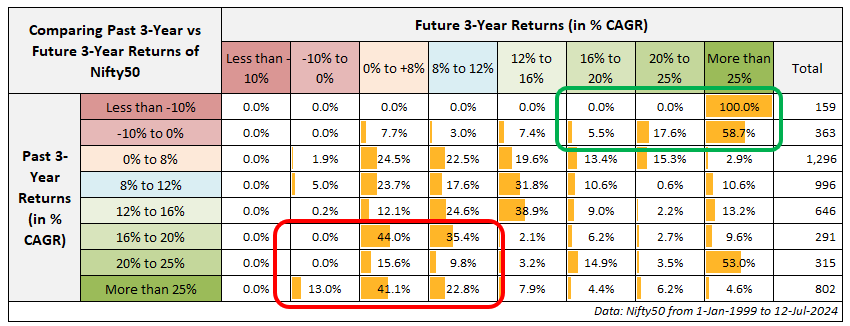
Comparing Nifty50's Past 3-Year Returns Vs. Future 3-Year Returns.
What I wanted to see was whether the returns of the past 3-years at any given point, tell us something about what will happen over the next few years in markets.
So very quickly, I crunched some basic numbers for Nifty50 from Jan-1999 to July-2024, i.e. 25 years. Here are the results:
In general, if the last 3-year returns of markets are subdued or not good enough, then chances of future 3-year returns being better, tend to be high (see green box above).
But also when the recent past returns have been stellar, then if you believe in mean reversion, then chances are that near future returns may not be that great (see red box above).
Of course, the above thesis will not play out every time. A 3-year great run can extend to 5-6 years (let's hope so). Similarly, a 3-year poor run can go further down (let's hope not).
What the above dataset also points out (but not guarantees) is that - If returns in the last few years haven't been good, then the chances of having good returns over the next few years are reasonably high. More importantly, vice versa may be true as well and is more applicable in current times.
But with the current 3-year CAGR of Nifty50 close to 16% in, and if the above historical data of 25 years is something to rely on, then it is time to be careful and rationalize our return expectations over the next few years. Not saying markets will start falling from here but that we should be careful about the near future.
And this is just about the large-cap universe (Nifty50). A similar analysis of different market segments will deliver different results. But for those heavy on mid-smallcap space, it is time to be extra cautious, please. Markets have been kind to us for a really long period this time. But markets have a different face as well (ask those who have been in markets for a longer while).
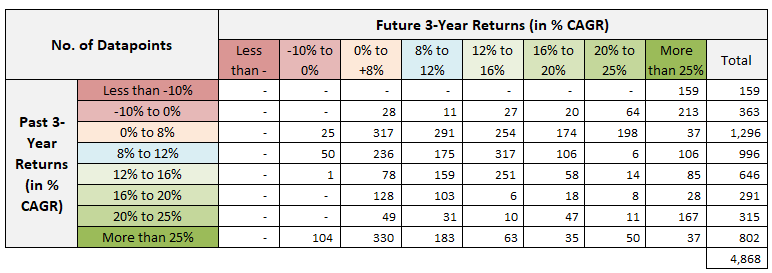
For those who want to know if there was enough sample data to rely on the probabilities in above table, here is the datapoint count:
Disclaimer - The index/funds shown above are for illustration only. It is not a recommendation to buy/sell/hold. Please get in touch with your investment advisor to get customized investment advice based on your risk profile and unique requirements.
Don't Forget - Investments in the securities market are subject to market risks. Read all the related documents carefully before investing.
This is from NSE website.
Yes FII”s are selling no doubt… but please look at what they are selling and what they are buying.
As I have mentioned many times before… structure of Indian economy is changing and FII”s are O/W winners of yesterday”s India.
Tomorrow”s India is where they are increasing their stake.