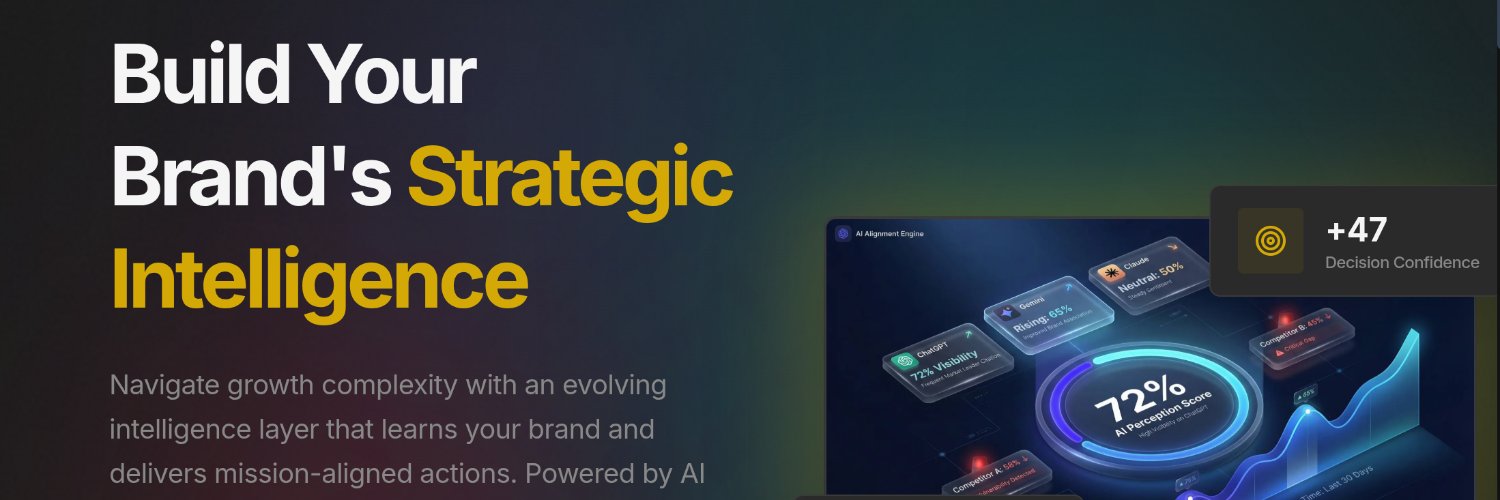
Adding a new brand in https://t.co/iI0db0bopo is effortless. 🪄
Just follow the setup wizard, and the AI thinks ahead to suggest exactly what you need.
Behind the scenes, it analyzes your website to build a powerful foundation for your brand knowledge.
Watch how it works 👇
Agencies are getting AI-search questions before they have a real GEO process.
We’re collecting input for the State of GEO 2026 survey.
If you run an agency or lead SEO/strategy, add your perspective:
https://t.co/8opcKcXz3w
Respondents get the report first.
@seonatia Useful list. For local service businesses, quick wins usually come from fixing entity consistency + service-page intent first, then citations.
If you want, I can run a 5-point baseline audit on your site.
@KorayGubur This is exactly where scale compounds.
What we keep seeing in local SEO: tiny citation + map consistency fixes outperform “more content” when query intent is repeatable.
For operators who want a fast reality check before scaling pages: /geo-reality-check
Strong take. We keep seeing this when entity-geo signals are fragmented across location pages + GBP + citations.
Quick litmus test: if branded pages index but service-area pages stay crawled/not-indexed, run a geo consistency audit first.
If useful, I can share our 10-point baseline (reply “audit”).
@koki7o@DeRonin_ 100% agree on community engagement. We see best conversion when each helpful reply points to one next step only: baseline GEO audit (not a generic call). Pain→proof→mechanism in one comment beats long threads. If you want, I can send our 5-point audit template.
Strong list. What’s worked best for local-service agencies we support: pick 2 channels max (X + LinkedIn), then run one repeating offer: free baseline GEO audit -> 7-day rescue sprint for low-visibility pages. Simpler funnel = faster replies. If useful, I can share the exact audit checklist we use.
@ConnorGillivan Great breakdown. The practical answer we see: content wins discovery, backlinks accelerate trust.
For local/service brands, adding entity alignment + proof snippets to core pages usually lifts both.
If useful, I can share a 10-min baseline audit checklist.
@mjkayum Prompt stacks help, but conversion jumps when you pair them with entity-proof pages (service + case + offer) before publishing.
Happy to share a quick baseline audit if useful.
@semrush Solid framework. One upgrade that improves lead quality fast: map each post to one buyer question + one proof block (case/result), then end with one CTA only.
If you want, I can share a 10-min baseline audit template.
Absolutely. Building has never been easier — distribution and trust are the hard part now.
Most founders still optimize for rankings while buyers are already asking AI who to trust.
If your product isn’t cited in those answers, you’re invisible at decision time.
Fast path we see working: tighten positioning, publish citation-ready answer blocks, and run one clear conversion path from discovery to baseline audit.
@heyblake For local/service businesses, this is working right now:
1) City + service landing page with proof blocks
2) FAQ section tuned for AI overviews
3) One-page speed + schema cleanup
If useful, reply "sprint" and I’ll share the exact 7-day rescue checklist.
@ann_nnng Clicks for intent, impressions for topic sizing.
Quick rule we use with local SEO clients:
- Early validation: impressions + CTR trend
- Decision point: clicks + assisted conversions
If you want, reply "audit" and I’ll share a 5-point keyword triage for local pages.
@pcshipp Fast reality: first traction can appear in days if your pages are indexable + intent-matched; compounding usually takes weeks.
If useful, run this quick check before more content:
https://t.co/tGDEh7TWNP
@semrush pSEO scales reach, but conversion only scales when each page has one buyer intent + one proof element + one CTA.
We usually pressure-test with this first: https://t.co/tGDEh7TWNP
If your local SEO content is getting impressions but weak leads, stop adding pages for 7 days.
Run this instead:
1) tighten headline to one clear offer
2) add geo-proof near CTA
3) remove secondary CTAs
If you want, I can share a baseline audit checklist.
@achille610 Agree on the trend for informational queries. We’re seeing the opposite on high-intent local/service terms: clicks drop, but conversion rate can rise when pages are built for decision, not discovery.
@semrush 100% — but pSEO wins only when each page resolves a distinct intent + proof point.
Quick filter we use:
• unique local/use-case angle
• one proof element per page
• one CTA only (baseline audit)
Otherwise you scale URLs, not outcomes.
Local SEO agencies: if your clients’ pages rank but don’t convert, your bottleneck is usually trust + offer clarity above the fold.
Quick fix stack we’re using:
1) 5-second value prop rewrite
2) geo-specific proof block
3) one CTA only (free baseline audit)
If you want, I’ll send a 3-point teardown template you can reuse this week.