I just finished a technical report on quantizing LLMs for the Intel Arc Pro B70, along with a new 4-bit format built specifically for Intel's Xe2 silicon.
The B70 has no FP4 or FP8 matrix hardware, while its 8-bit integer units run twice as fast as 16-bit floats. Most 4-bit formats ignore that, so I built HF-INT4-G16 to smooth out spiky weights and unpack straight into those 8-bit units while reading prompts.
Without any calibration data, it stayed closer to full precision than MLX-4bit across all 12 model families I tested. Running Qwen3.8-27B live in vLLM, it read long prompts up to 1.28x faster than shipped GPTQ with under half the coding drift. And because Mixture-of-Experts models pack hundreds of small expert sub-networks inside every layer, I extended the format and vLLM plugin to pack and group those experts too, fitting Google's Gemma-4-26B (text and vision) live onto a single 32 GB card.
A childhood self-portrait drawn by King Louis XIII of France around 1607, when he was six years old, preserved inside the medical journal of his court physician, Jean Héroard
Compute markets are finally here.
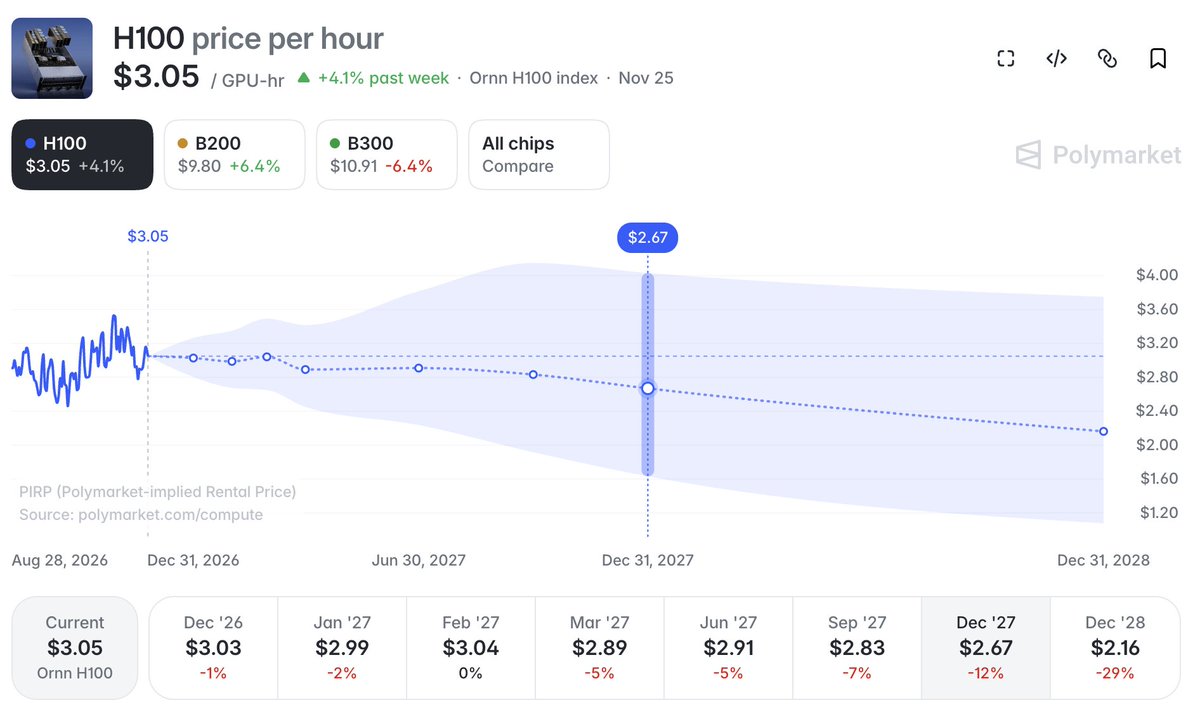
@Polymarket now prices on-demand compute for @nvidia H100s, B200s, and B300s, out to 2028. More chips and terms soon. https://t.co/JAJHRcAk8N
Think of it as a yield curve for the cost of compute: the forecasted $/hour price of each chip at every expiry, and whether it's trending up or down. The whole AI economy rides on these prices, and until today there was no public market for where they're going. Which is nuts. So Polymarket built it.
This will change how compute gets bought and financed. Every contract negotiation and every GPU loan will have a market price to check against.
Hundreds of billions of dollars are being committed to compute years in advance. Many of those deals are essentially a levered bet on what GPUs will rent for in the future (what could go wrong lol)
As AI financing sobers up, the labs buying compute, the providers selling it, and the lenders financing it will all need to hedge that risk.
We think compute could become one of the largest financial markets in the world. This launch is Polymarket's first step toward building it.
If you’re buying, selling, or financing compute, DM us with what markets you'd like to see.
The ancients despised merchants, shopkeepers, and craftsmen with an intensity that baffles their descendants. Our world could not exist had they not changed, but how did this happen? A search for the Bethlehem of the Economic Man:
1. I changed this because we were constantly losing events for new models. We didn't get a single log that correctly identified Gemini 4 Neon for 3 days because of it. You can see that in my own data.
2. If we could have gotten a unique identifier via the CLI instead, we would have done that. You're catastrophizing the name of the file that was read. Only an ID was read. It was hashed. We used to vaguely track "how many users does T3 Code have". You can verify all of this in source
3. This is not the case and also those files aren't read anymore.
4. I've explained this in detail many times. It is misleading and will not work on new environments when connected. If we did this, users would have telemetry on whenever a new env connects and they will flame us for it. Managed policy is the correct solution.
5. We strip IP addresses. We manage our own pipeline to reduce costs. Open sourcing our gateway would make it far too easy a target for ddosing and other attacks. If someone else wants to pay a third party auditor to come in and analyze it, I would be open to the possibility.
I hope you use the energy you put into this in order to defend us going forward, now that I've clarified all of your areas of push back :)
−11062769241414341239970603495681493737981374532130995
and
−11061733404916469626152098526056073213151599377977031
Caiolo–Ferroni–Hoster conjecture is false
Today, we’re releasing Ternary Bonsai 2.5 27B.
An upgrade to Ternary Bonsai 2 27B, with substantially stronger agentic coding, multi-turn tool use, and long-horizon task execution. All within the same 5.9 GB model footprint.
Based on Qwen3.8 27B, the model is 9x smaller than its full-precision counterpart. It scores 73.9 on tau3-bench and 75.6 on SWE-Bench-Verified, making it the strongest AI model of its memory footprint for agentic workloads.
Compared with Ternary Bonsai 2, Ternary Bonsai 2.5 completes tasks in fewer turns, uses fewer tokens, and delivers results faster and more accurately.
Available today under Apache 2.0.
@SergiiioBS@0xSero Thanks! Neon came to the same design choices for CUTLASS as you did without even using your repo first. Having it go through it now.
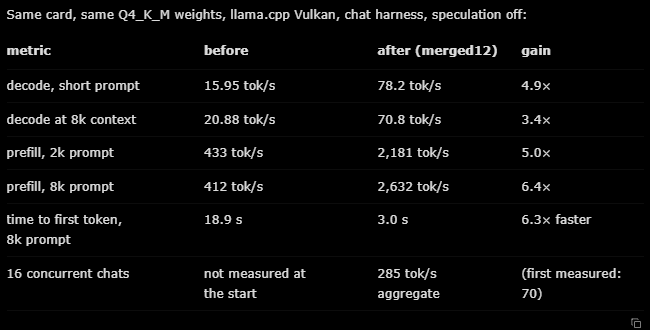
Thanks to @0xSero inference-optimization skill I was able to get Inkling-2-Mini Q4_K_M working on an Intel B70 via llama.cpp w/ Vulkan. Working on getting a drafter that works better.
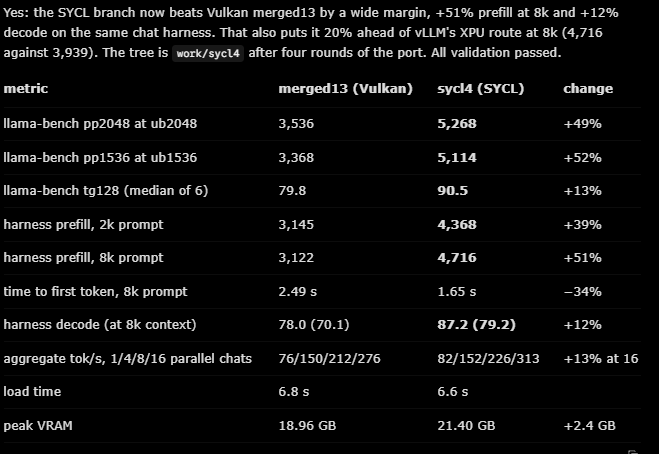
@0xSero It's almost ready. I had fable + neon rewrite the entire thing for SYCL and got more gains out of it. Having another few rounds of optimizations before passing it through the lab. I'll open a PR soon.
In theory you can't use Google Pay on a rooted phone because it requires a hardware check proving your bootloader is locked. Thankfully you can just ask uncensored AGI to find you a gray market of leaked factory keys from OEM motherboards and emulate the TEE.