God favors smallness, a sign of his discreet love, by which he leaves us free to accept or reject him. His love makes its presence felt even among the weeds, acts in a hidden and invisible way like the smallest of all seeds, and leavens the dough without making a sound. #GospelOfToday (Mt 13:24–43)
Nick Fuentes says White people need to emulate the Jеws — not morally, but in how they move
"The Jеws are studying the ancient scriptures... us stupid White people are on 4chan getting in Twitter drama."
232 years ago today, 16 humble Catholic Carmelite Nuns effectively put an end to the French Revolution’s Godless reign of terror in France.
How did they do it?
They died singing praises to the Lord and shattered the atheistic delusion that has overwhelmed the psyche of a nation
Edits are the modern-day parable: short, direct, unassuming; simple on the surface but deeply layered. If you get it, you get it. The opposite of liberal walls of text. Matthew 13:10-13
@ModernBoethius I like to think that when Pope Francis is canonized, these people will take the time to actually read everything he said, and the truth of what happened. But we know they’ll just double down on the lies and hate.
Everyone in this photo is Catholic praying Catholic prayers to the Trinity.
That is a verifiable fact, including the lady in the middle in the headdress, who is CATHOLIC.
If you think otherwise you have been misled by the media.
The evidence suggests Matthew, Mark, Luke, and John did write the Gospels.
The names attached to the Gospels were in use in the first century. Had the Gospels circulated without names, or under any other names, for an extended period, they would have come to be called different things, the same way that there are multiple titles for many ancient works.
However, they didn’t. In ancient documents they are always referred to as the Gospels of Matthew, Mark, Luke, and John. Unlike disputed books such as Hebrews, no ancient source ever proposes an alternative author for any of the four Gospels.
When the Gospels were read in church, the congregation needed to be told what was being read, and there needed to be a way to distinguish them from each other, since so much of their content was similar, with each telling the story of Jesus. The churches chose to refer to them by their authors.
This need to distinguish them existed as soon as there was more than one Gospel, and so the names were used immediately, not at a later date. This is a strong indication that the names are accurate.
If OP is correct that the traditional authors didn't write the Gospels, he needs to explain how those names came into universal use.
The most common explanation put forth is that early Christian communities attached authoritative-sounding authors' names to the texts. This is exactly what we see forgers in later centuries doing when they circulated false gospels.
But if someone were inventing authors for credibility, these are strange choices:
Mark wasn't an apostle at all; he was just Peter's secretary, and Scripture itself remembers him abandoning Paul's first mission, an episode serious enough to split Paul and Barnabas (Acts 15:36-41).
Luke wasn't an apostle either, and is mentioned only three times in Paul's letters.
Matthew is the strangest choice of all: a former tax collector, the kind of man Jews despised as a Roman collaborator (Matt. 18:17), somehow attached to the most Jewish Gospel of the four.
Who would forge authority by picking a deserter, a nobody, and a tax man? No one, that's who.
@ModernBoethius While Cardinal Sarah says many based things, I wish he was more careful about sowing division. Another example is when he rebelled against Fiducia Supplicans.
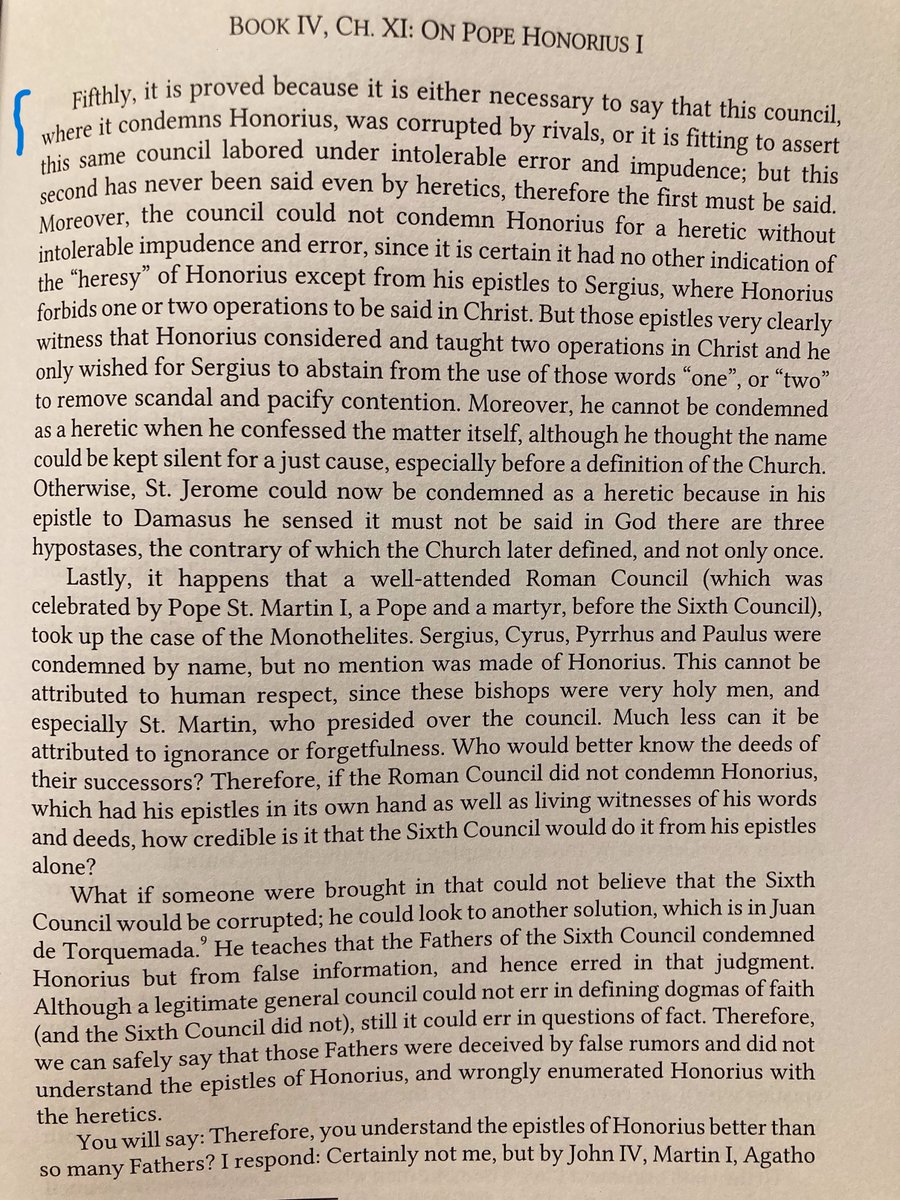
@FrTotleben92742 @CatholicPods Saint Bellarmine argued that the councils errored "in questions of fact," and that the letters themselves were "private letters" meaning even if in error it would be private error.
Source: On the Roman Pontiff
· St. Alphonsus Ligouri, Dogmatic Works (1848) - “We ought rightly to presume as Cardinal Bellarmine declares, that God will never let it happen that a Roman Pontiff, even as a private person, becomes a public heretic or an occult heretic” [vol. VIII, p. 720]
@OrdinariateUSA The comments here from the Orthodox are just proving your point. It’s always the same “we don’t want false unity” etc etc..
Let’s always pray for an end to all schism, especially between the East and West.
A difference between Catholics and Orthodox I’ve seen, is that most Catholics hope and pray for reunification, whereas the average Orthodox gets sick at the idea of reunifying the church.
Catholics want to bring the entire Orthodox Church back into full communion, where the Orthodox think that every Catholic should convert to orthodoxy on an individual basis until unity is achieved.
The former *could* happen, the latter never will.
It goes back to the Council of Florence where the Orthodox hierarchy formally accepted the Pope and the Filioque, but were met with riots from the layman when they returned to Greece, where they eventually caved and reignited the schism.
Constantinople fell 14 years later and was the last of the 4 Orthodox sees to fall to the gates of hell.
How can one man, who doesn’t dedicate his career to Catholic Apologetics, convert and move so many souls towards the Catholic Church like that?
Nick Fuentes is a saint in the making. The Holy Spirit works through him, without a shadow of a doubt.




![poperespecter1's tweet photo. · St. Alphonsus Ligouri, Dogmatic Works (1848) - “We ought rightly to presume as Cardinal Bellarmine declares, that God will never let it happen that a Roman Pontiff, even as a private person, becomes a public heretic or an occult heretic” [vol. VIII, p. 720] https://t.co/FAknU369O1](https://pbs.twimg.com/media/HNZhNKJX0AATqkW.jpg)





