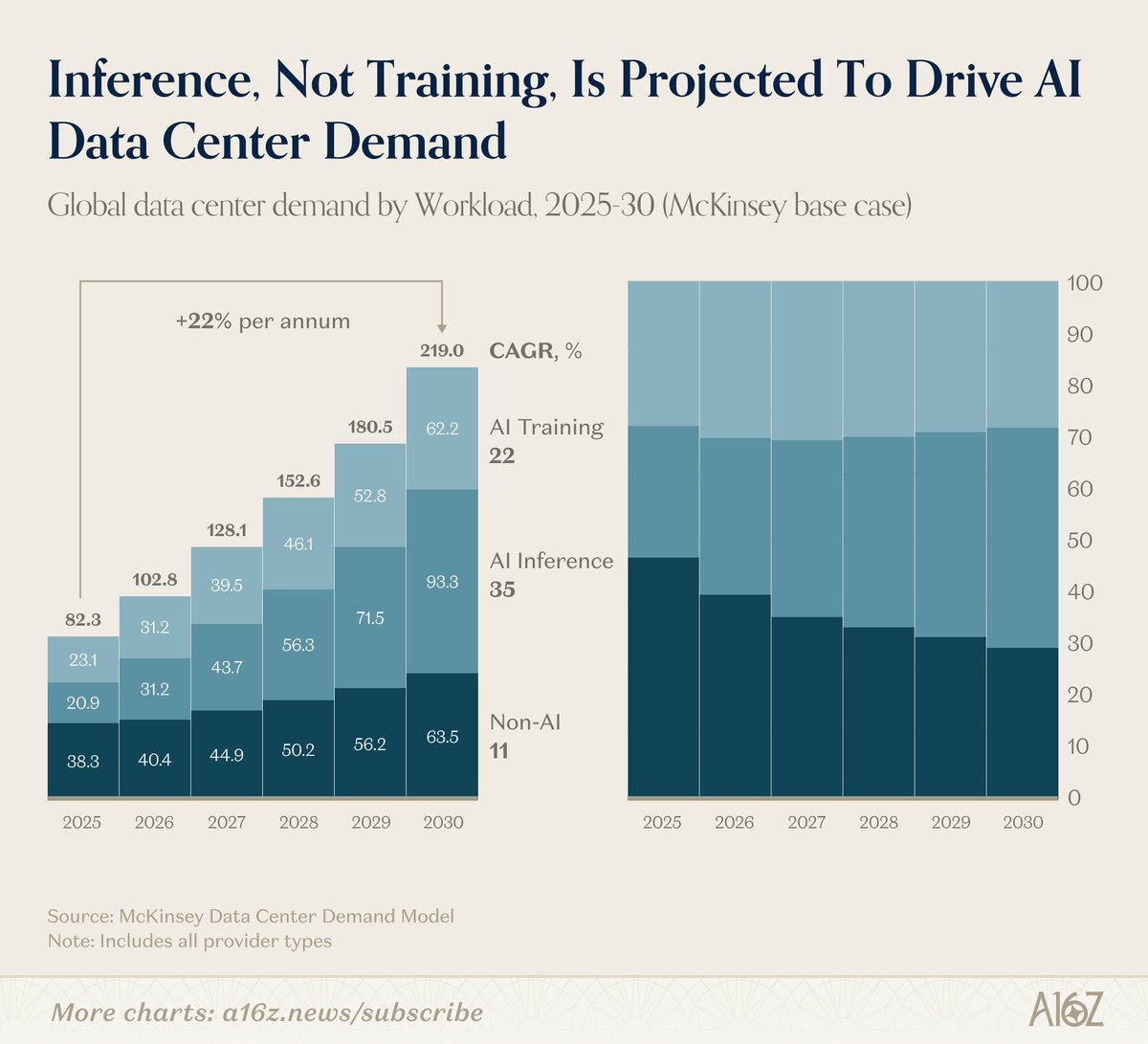
We processed over 1.3 Quadrillion tokens last month - that's 1,300,000,000,000,000 tokens! or to put it another way that's 500M tokens a second or 1.8 Trillion tokens an hour... 🤯
“The middle of the barbell is all of the current enterprise production workloads. Some of which are using inference in a pervasive way but most of which aren't. And that is going to change very significantly over time. And that will be in my opinion the largest absolute segment”
"Humans are cheaper than tokens on average, but good tokens are cheaper at scale."
For median firms, agent costs sit near $80/hour, roughly in line with a software engineer.
But at the tails, an agent can cost $4/hour or $7,000/hour depending on how it's managed.
Hebbia CEO George Sivulka on why 100X tokens are the new 10X engineers: https://t.co/46bc83oLwe
Citadel Securities just put institutional weight behind what the AI bulls won't say out loud.
In a new macro note titled "Tokenomics," Citadel makes the argument plainly: even the most powerful technology on earth still has to pass through the boring discipline of cost curves, capacity limits, and marginal returns.
The evidence is piling up:
– Amazon removed its token usage leaderboard
– Microsoft cancelled Claude Code subscriptions
– Multiple companies reporting unexpectedly massive token bills
Their conclusion is the part that matters.
Adoption is no longer about what AI can do in principle. It's becoming about the price and scarcity of the inputs needed to run it at scale. Compute. Power. Cooling. Memory bandwidth. Inference budgets. All real, all binding constraints.
And here's the kicker from the chart.
The Silicon Data LLM Token Expenditure Index, a benchmark for how much the market is actually spending on AI tokens, has started rolling over. Citadel reads it as a shift toward cheaper models. Companies substituting away from expensive frontier AI toward "good enough" alternatives.
That's economics 101 doing what it always does. When the price of something rises, people use less of it, or find a cheaper version.
Citadel sees a bifurcation forming. Frontier AI concentrated among a few firms with the balance sheets to absorb the cost. Everyone else quietly downgrading to simpler, cheaper models.
This is the part of every technology revolution the early narrative ignores.
The technology being real was never the question.
The question was always whether the economics could carry the valuations.
When one of the most sophisticated trading firms on earth starts writing about AI in the language of cost curves and rationing instead of limitless demand, the conversation has quietly changed.
The hype was about what AI could do.
The reckoning is about what it costs.
“Rather doing work with a computer, the computer does work for you. The rate, scale, and sophistication of problem solving it will do for you will be bound by the amount of compute you have access to.
People are spending less energy managing the tool and more energy focusing on what they are actually trying to create. That shift brings a kind of joy back into work that many people haven’t felt in a long time. Everyone can just build things with these tools.”
The world is transitioning to a compute-powered economy.
The field of software engineering is currently undergoing a renaissance, with AI having dramatically sped up software engineering even over just the past six months. AI is now on track to bring this same transformation to every other kind of work that people do with a computer.
Using a computer has always been about contorting yourself to the machine. You take a goal and break it down into smaller goals. You translate intent into instructions. We are moving into a world where you no longer have to micromanage the computer. More and more, it adapts to what you want. Rather doing work with a computer, the computer does work for you. The rate, scale, and sophistication of problem solving it will do for you will be bound by the amount of compute you have access to.
Friction is starting to disappear. You can try ideas faster. You can build things you would not have attempted before. Small teams can do what used to require much larger ones, and larger ones may be capable of unprecedented feats. More and more, people can turn intent into software, spreadsheets, presentations, workflows, science, and companies.
People are spending less energy managing the tool and more energy focusing on what they are actually trying to create. That shift brings a kind of joy back into work that many people haven’t felt in a long time. Everyone can just build things with these tools.
This is disruptive. Institutions will change, and the paths and jobs that people assumed were stable may not hold. We don’t know exactly how it will play out and we need to take mitigating downsides very seriously, as well as figuring out how to support each other as a society and world through this time. But there is something very freeing about this moment. For the first time, far more people can become who they want to become, with fewer barriers between an idea and a reality. OpenAI’s mission implies making sure that, as the tools do more, humans are the ones who set their intent and that the benefits are broadly distributed, rather than empowering just one or a small set of people.
We're already seeing this in practice with ChatGPT and Codex. Nearly a billion people are using these systems every week in their personal and work lives. Token usage is growing quickly on many use-cases, as the surface of ways people are getting value from these models keeps expanding.
Ten years ago, when we started OpenAI, we thought this moment might be possible. It’s happening on the earlier side, and happening in a much more interesting and empowering way for everyone than we’d anticipated (for example, we are seeing an emerging wave of entrepreneurship that we hadn’t previously been anticipating). And at the same time, we are still so early, and there is so much for everyone to define about how these systems get deployed and used in the world.
The next phase will be defined by systems that can do more — reason better, use tools better, plan over longer horizons, and take more useful actions on your behalf. And there are horizons beyond, as AI starts to accelerate science and technology development, which have the potential to truly lift up quality of life for everyone. All of this is starting to happen, in small ways and large, today, and everyone can participate. I feel this shift in my own work every day, and see a roadmap to much more useful and beneficial systems. These systems can truly benefit all of humanity.
I am delighted to see a new version of the book by @_sdbuchanan, @druv_pai , @pengwang2003 and @YiMaTweets . This is the best book on the foundations of deep representation learning! In this era of coding agents, the math is all you need to learn :)
https://t.co/3IvoZeFUYA
Watch Hard Lessons, as legendary investor Stan Druckenmiller sits down with Morgan Stanley’s Iliana Bouzali, sharing how he would construct a portfolio if he had to start over today, why contrarianism is overrated, and which stock he regrets selling too early.
Reinforcement learning is and always has been the study of algorithms for learning from experience. It amazes me that people can claim to be working on learning from experience without mentioning RL.
It is hard to communicate how much programming has changed due to AI in the last 2 months: not gradually and over time in the "progress as usual" way, but specifically this last December. There are a number of asterisks but imo coding agents basically didn’t work before December and basically work since - the models have significantly higher quality, long-term coherence and tenacity and they can power through large and long tasks, well past enough that it is extremely disruptive to the default programming workflow.
Just to give an example, over the weekend I was building a local video analysis dashboard for the cameras of my home so I wrote: “Here is the local IP and username/password of my DGX Spark. Log in, set up ssh keys, set up vLLM, download and bench Qwen3-VL, set up a server endpoint to inference videos, a basic web ui dashboard, test everything, set it up with systemd, record memory notes for yourself and write up a markdown report for me”. The agent went off for ~30 minutes, ran into multiple issues, researched solutions online, resolved them one by one, wrote the code, tested it, debugged it, set up the services, and came back with the report and it was just done. I didn’t touch anything. All of this could easily have been a weekend project just 3 months ago but today it’s something you kick off and forget about for 30 minutes.
As a result, programming is becoming unrecognizable. You’re not typing computer code into an editor like the way things were since computers were invented, that era is over. You're spinning up AI agents, giving them tasks *in English* and managing and reviewing their work in parallel. The biggest prize is in figuring out how you can keep ascending the layers of abstraction to set up long-running orchestrator Claws with all of the right tools, memory and instructions that productively manage multiple parallel Code instances for you. The leverage achievable via top tier "agentic engineering" feels very high right now.
It’s not perfect, it needs high-level direction, judgement, taste, oversight, iteration and hints and ideas. It works a lot better in some scenarios than others (e.g. especially for tasks that are well-specified and where you can verify/test functionality). The key is to build intuition to decompose the task just right to hand off the parts that work and help out around the edges. But imo, this is nowhere near "business as usual" time in software.
Demis Hassabis, CEO of Google DeepMind: AGI will be one of the biggest turning points in human history, on the level of fire or electricity, with 10 times the impact of the Industrial Revolution at 10 times the speed.
Meanwhile some peole are bearish.
“The vibe-coding thesis confuses the way software looks with the way software works inside an organization. If code is cheap for everyone, then the companies that win - whether incumbents or startups - will be the ones that are great at everything except the code.”
Favorite quotes from this episode:
1. The world isn’t waiting for more of the same.
2. Greatness begets greatness. It’s infectious.
3. The best work is the work you're excited about.
4. When flowing, keep going.
5. Impatience is an argument with reality.
6. The work reveals itself as you go.
7. The way we do anything is the way we do everything.
8. Whatever we concentrate on we get.
9. Listening is suspending disbelief.
10. There are no shortcuts.
11. We are performing for an audience of one.
12. The ability to look deeply is the root of creativity.
13. Look for what you notice but no one else sees.
14. We are dealing in a magic realm. Nobody knows why or how it works.
15. Our calling is to make beautiful works to the best of our ability.
16. For both the artist and the athlete, the details matter, whether the players recognize their importance or not.
17. The impossible only becomes accessible when experience has not taught us limits.
18. Failure is the information you need to get where you’re going.
19. The only person you’re ever competing against is yourself. The rest is out of your control.
20. Just one habit, at the top of any field, can be enough to give an edge over the competition.
21. If there is a rule to creativity that’s less breakable than the others, it’s that the need for patience is ever-present.
22. Stepping away and returning with fresh eyes brings clearer insight into next steps.
23. It’s helpful to remember that there are forces at work beyond our comprehension.
24. The great artists throughout history are the ones able to maintain this childlike enthusiasm and exuberance naturally.
25. Because there’s an endless amount of data available to us and we have a limited bandwidth to conserve, we might consider carefully curating the quality of what we allow in.
26. No matter what tools you use to create, the true instrument is you.
27. Reread the same book over and over, and you’ll likely find new themes, undercurrents, details, and connections.
28. You are part of something much larger than can be explained—a world of immense possibilities.
29. Crafting contains a paradox. To create our best work, we are patient and avoid rushing the process, while at the same time we work quickly without delay.
30. Even the masterpieces that have been produced on tight timelines are the sum of decades spent patiently laboring on other works.
31. Fear of criticism. Attachment to a commercial result. Competing with past work. Time and resource constraints. The aspiration of wanting to change the world. And any story beyond “I want to make the best thing I can make, whatever it is” are all undermining forces in the quest for greatness. (Read that last sentence twice)
32. If you make the choice of reading classic literature every day for a year, rather than reading the news, by the end of that time period you’ll have a more honed sensitivity for recognizing greatness from the books than from the media.
33. The objective is not to learn to mimic greatness, but to calibrate our internal meter for greatness. So we can better make the thousands of choices that might ultimately lead to our own great work.
34. If we can tune in to the idea of making things and sharing them without being attached to the outcome, the work is more likely to arrive in its truest form.
35. Each habit might seem small, but added together, they have an exponential effect on performance.
36. The more of the work you can see, the easier it becomes to gracefully place the final details clearly where they belong.
37. Art is choosing to do something skillfully, caring about the details, bringing all of yourself to make the finest work you can.
38. There’s an abundant reservoir of high-quality information in our subconscious, and finding ways to access it can spark new material to draw from.
39. We’re affected by our surroundings, and finding the best environment to create a clear channel is personal and to be tested.
40. To hone your craft is to honor creation. By practicing to improve, you are fulfilling your ultimate purpose on this planet.
41. The object isn’t to make art, it’s to be in that wonderful state which makes art inevitable.
Full episode below. A lot of ideas covered in 42 minutes. You'll want to listen twice:
1/ new essay: AI Adoption is a coordination problem.
People adapt to AI faster than organizations do.
That gap explains most of the confusion about “slow” AI adoption.
"The reward for great work is more work, and I find that saying that maxim to the right person, the kind of person I want to spend time with, their eyes go wide and they understand it immediately.
That the reward for great work is not money, power, fame.
It is the privilege to get to do more of this thing that I love doing."