If, when you say regulation, you mean the dead and clammy hand of the commissar—the gentleman who has never in his life built a single thing, drafting rules to govern a thing he cannot define, to be enforced by men who cannot read them; if you mean the form in triplicate, the impact assessment upon the impact assessment, the compliance officer who breeds, in the warm dark of the org chart, further compliance officers unto the third and fourth generation; if you mean the moat—the deep cold moat that the giant digs around his own castle and christens, with a perfectly straight face, public safety—the drawbridge he hauls up behind himself the very instant he is across, lest any hungrier and hungrier man should follow; if you mean the precautionary principle, which, had it governed our grandfathers, would have banned the wheel pending further study of the hill, and left us yet shivering and raw in the mouth of the cave, blessing its excellent ventilation; if you mean the European disease—that magnificent open-air museum of a continent, which produces in our time precisely two things in great abundance, and they are regulation, and the eloquent and well-footnoted regret of cultivated men explaining at length why they have produced nothing else; if you mean the license required to think, the permission slip for honest arithmetic, the king’s wax stamp pressed upon the forehead of every new idea before it may draw its first breath; if you mean the agency dispatched, with trumpets, to slay a single dragon, which arrives at the cave, surveys the accommodations, and moves in—and spends the ensuing century laying eggs and devouring the very villagers it was sworn to defend; if you mean the startup that perishes not of the market’s honest verdict but of the filing fee, the genius decamping by the next tide to a freer and warmer shore; if you mean the law that arrives, faithful as the swallows, exactly one whole epoch too late—helmeted, plumed, and magnificently armed—to regulate the stagecoach—then certainly, my friends, I am against it.
But—but, my friends—if, when you say regulation, you mean instead the humble steel guardrail upon the mountain road at midnight, the very thing you curse on the easy days and bless on your knees the one night the fog comes down; if you mean the brakes—for it is the brakes, and not the engine alone, that permit a sane man to drive fast and yet arrive alive—and the buttress, without which no cathedral was ever flung so high, but only in spite of which, but because of which; if you mean the meat inspector, who is the single homely reason a man may eat a sausage in this republic without first composing his last will and testament; if you mean the firebreak cut clean through the forest before the dry season of the burning, the smallpox cordon, the buoy that marks the channel, the rule of the road that lets ten thousand strangers hurtle past one another in the dark at fearful speed and arrive, by its quiet grace, every one of them home; if you mean the honest scale and the true weight, the reason a pound is a pound and a dollar a dollar from Natchez to Nome; if you mean the firm and decent wall between the counterfeit voice and the widow’s bank account, between the deepfaked candidate and the ballot box on the eve of the vote, between the loosed and loveless machine and the schoolyard it neither knows nor pities; if you mean the simple plank of law that says the strong shall not, in the gray dawn, feed the weak quietly into the furnace and sell the rising smoke as progress; if you mean, in the end, the one slender thread of trust without which no citizen will ever dare to use the marvelous thing at all—for where there is no rule there is no trust, and where there is no trust there is no commerce, and a miracle that no man dares to touch is no miracle, but only a handsome and expensive ghost—then certainly I am for it.
This is my stand. I will not retreat from it. I will not compromise one inch of it.
What do the smartest kids in the world do when they grow up?
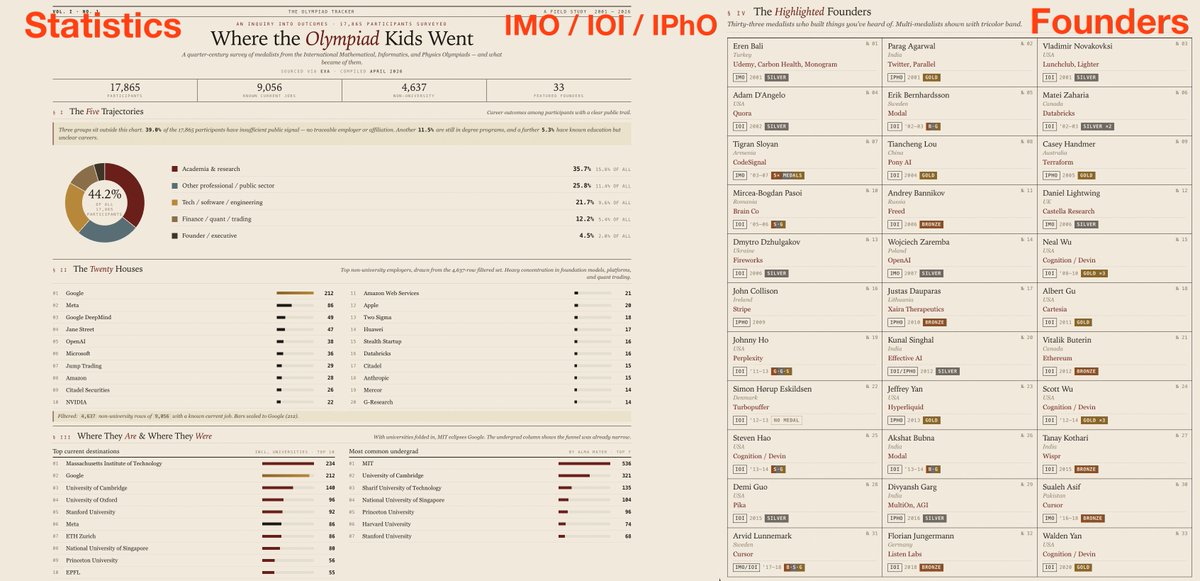
I did the largest study of ~18,000 International Olympiad medalists (IMO, IOI and IPhO) over the last 25yrs, arguably the sharpest analytical minds of the world in high school, to see where they ended up and traced ~50% of them.
Founders of ~20 unicorns and ~7 decacorns and ~10 billionaires: OpenAI, Cursor, Stripe, Databricks, Perplexity, Ethereum, Cognition, Hyperliquid, Fireworks, Modal, Quora, Parallel, Cartesia, Wispr
Most kids went to MIT, a whopping 12% of them, followed by Cambridge (7%) and Sharif (3%)!
The career paths they chose (of those who graduated) were:
— 36% Academia (professors)
— 26% Other
— 22% in Software / Tech
— 12% in Quant / Finance
— 5% Founders!
The biggest employer was Google, by far, at 6%.
Others interesting tidbits were:
— 47 of them work at Jane Street (#3)
— 38 at OpenAI (#5)
— 15 at Anthropic
— 8 at Cognition
— 6 at Isomorphic Labs
Olympiaders were 1500x more likely to be billionaires and 4000x more likely to be unicorn founders than the average person!
Only one chance in this lifetime…
Like watching sunset at the beach from the most foreign seat in the cosmos, I couldn’t resist a cell phone video of Earthset. You can hear the shutter on the Nikon as @Astro_Christina is hammering away on 3-shot brackets and capturing those exceptional Earthset photos through the 400mm lens. @AstroVicGlover was in window 3 watching with @Astro_Jeremy next to him.
I could barely see the Moon through the docking hatch window but the iPhone was the perfect size to catch the view…this is uncropped, uncut with 8x zoom which is quite comparable to the view of the human eye. Enjoy.
A MIT professor taught the same lecture every January for 40 years, and every single time it was standing room only.
I watched it at 2am and it completely rewired how I think about communication.
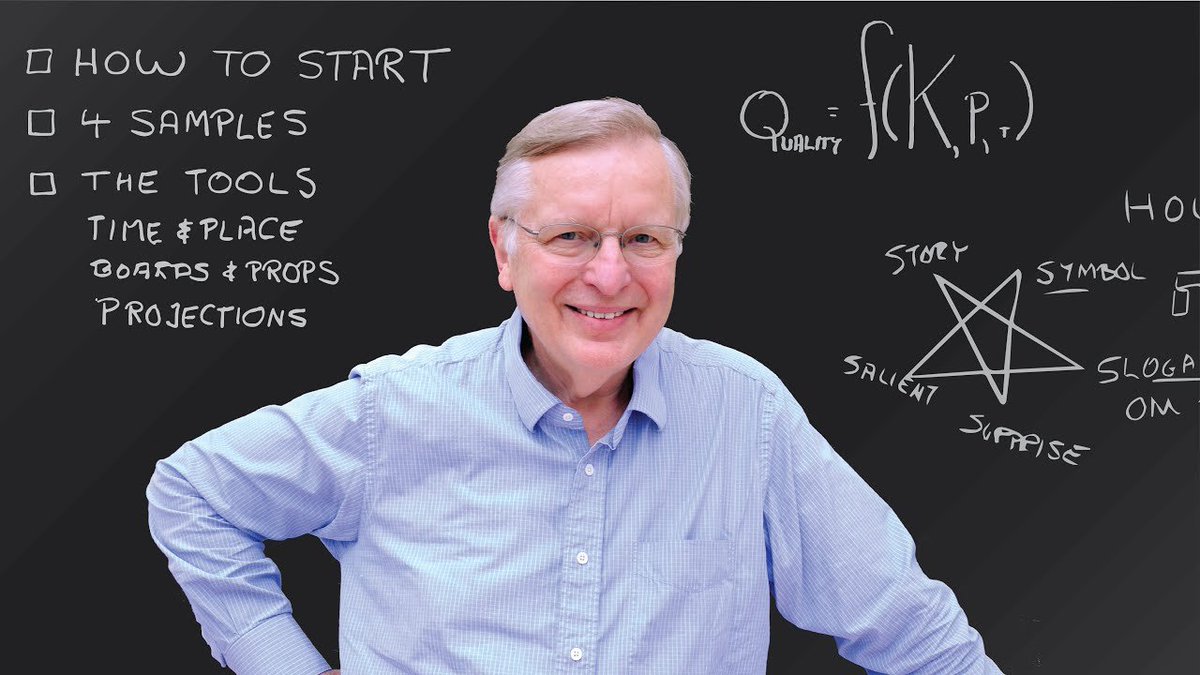
His name was Patrick Winston. The lecture is called "How to Speak."
His opening line hit like a truck: your success in life will be determined largely by your ability to speak, your ability to write, and the quality of your ideas in that order.
Not your GPA. Not your pedigree. Not your IQ. How you speak is what separates people who get heard from people who get ignored.
Here's the framework he drilled into MIT students for four decades.
He said never start with a joke. Start by telling people exactly what they're going to learn. Prime the pump before you pour anything in. He called it the "empowerment promise" give people a reason to stay in their seats within the first 60 seconds.
Then he broke down the 5S rule for making ideas stick: Symbol, Slogan, Surprise, Salient, and Story. Every idea worth remembering hits at least three of these.
The part that floored me was his "near miss" technique. Don't just show what's right show what almost looks right but isn't. That contrast is when the brain actually locks something in permanently.
His final rule before any big talk: end with a contribution, not a summary. Don't recap what you said. Tell people what you gave them that they didn't have before they walked in.
I've used this framework in pitches, interviews, and presentations ever since watching it, and the results are not subtle.
Patrick Winston passed away in 2019, but this lecture is still free on MIT OpenCourseWare. One hour, watched by millions, and it costs absolutely nothing.
The most important class MIT ever put on the internet isn't about code or math. It's about how to make people actually listen to you.
"Learn More" is not a CTA.
Neither is:
• "Get Started"
• "Discover More"
• "See How It Works"
Strong CTAs align with user intent, brand narrative and sell the next step.
Atlas is demonstrating reinforcement learning policies developed using a motion capture suit. This demonstration was developed in partnership with Boston Dynamics and @rai_inst.
Starlink is one of the seminal feats of engineering in history.
It will enable internet that's
— fast 100-300mbps
— uncensored
— cheap $1500/yr
in:
— the most remote areas
— ships in the ocean
— airplanes in the sky
— poles
But few even know what this picture is..
1/10