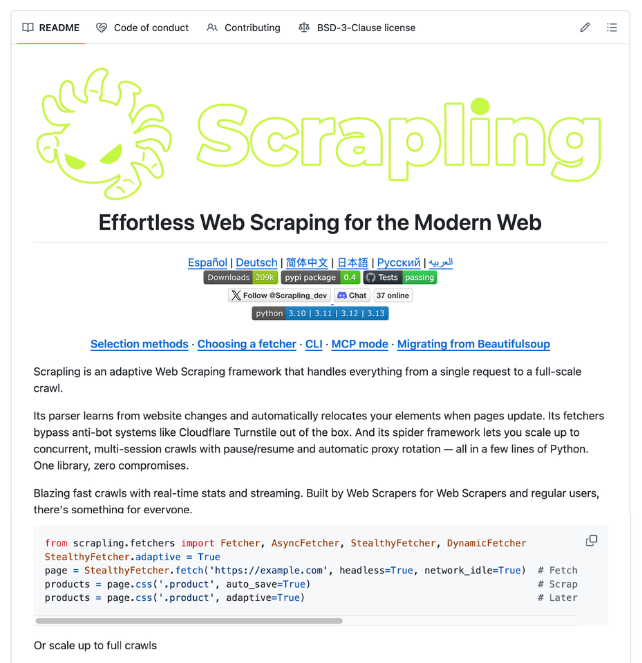
🚨 OpenClaw just became the most dangerous AI agent for web research.
Scrapling gives it undetectable access to any website on the internet.
It scrapes websites that actively try to block you. And it adapts when websites change their layout.
No more broken scrapers. No more Cloudflare walls. No more rewriting selectors every week.
Here's how it works:
→ You scrape a website once
→ The website redesigns its entire page
→ You pass adaptive=True
→ Scrapling finds your elements again automatically
It literally learns the structure of web pages and relocates your data when things move.
Here's why this kills everything else:
→ Bypasses Cloudflare Turnstile out of the box
→ Impersonates real browser TLS fingerprints
→ Full browser automation with stealth mode
→ Built-in proxy rotation
→ Concurrent crawling with pause and resume
→ MCP server so AI agents like Claude can scrape for you
→ Interactive shell. Scrape from your terminal without writing code.
Benchmarks? It's 784x faster than BeautifulSoup. Not a typo.
It even has a full Scrapy-like spider framework with multi-session support. Use fast HTTP for normal pages, stealth browser for protected ones. Same spider. Same crawl.
pip install scrapling
100% Open Source. BSD-3 License.
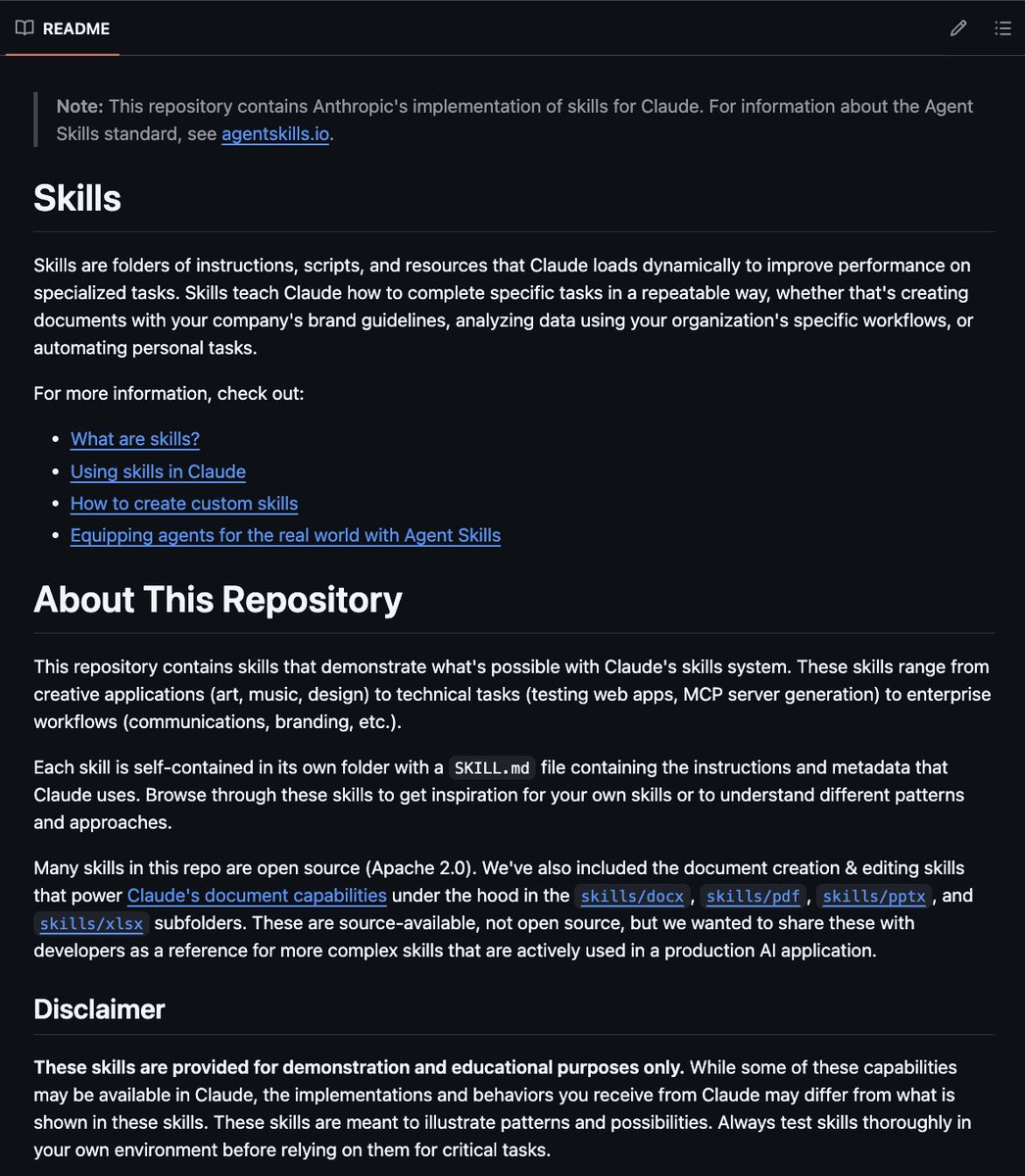
🚨 Anthropic just open-sourced the exact Skills library their own engineers use internally.
Stop building Claude workflows from scratch.
These are plug-and-play components that work across Claude Code, API, SDK, and VS Code copy once, deploy everywhere.
What's inside:
→ Excel + PowerPoint generation out of the box
→ File handling and document workflows
→ MCP-ready subagent building blocks
→ Pre-built patterns for multi-step automation
→ Production templates you'd normally spend weeks writing
The old way: re-explain your workflow every single chat.
The new way: build a Skill once, Claude never forgets how you work.
100% Open Source. Official Anthropic release.
Repo: https://t.co/XNx3i4yNy6
🛳️Rolling out interactive Mindmaps in NotebookLM!
I'm so inspired by the Exploratorium here in SF - What if every notebook generated your own personal set of interactive understanding toys that help you learn through play? What if instead of text or images, Notebook could even reply with these toys?
Personal tailored software is so exciting to me. 2025 is the era of Apps just for you. Gonna be crazy.
I wrote a quick new post on "Digital Hygiene".
Basically there are some no-brainer decisions you can make in your life to dramatically improve the privacy and security of your computing and this post goes over some of them. Blog post link in the reply, but copy pasting below too.
Every now and then I get reminded about the vast fraud apparatus of the internet, re-invigorating my pursuit of basic digital hygiene around privacy/security of day to day computing. The sketchiness starts with major tech companies who are incentivized to build comprehensive profiles of you, to monetize it directly for advertising, or sell it off to professional data broker companies who further enrich, de-anonymize, cross-reference and resell it further. Inevitable and regular data breaches eventually runoff and collect your information into dark web archives, feeding into a whole underground spammer / scammer industry of hacks, phishing, ransomware, credit card fraud, identity theft, etc. This guide is a collection of the most basic digital hygiene tips, starting with the most basic to a bit more niche.
Password manager. Your passwords are your "first factor", i.e. "something you know". Do not be a noob and mint new, unique, hard passwords for every website or service that you sign up with. Combine this with a browser extension to create and Autofill them super fast. For example, I use and like 1Password. This prevents your passwords from 1) being easy to guess or crack, and 2) leaking one single time, and opening doors to many other services. In return, we now have a central location for all your 1st factors (passwords), so we must make sure to secure it thoroughly, which brings us to...
Hardware security key. The most critical services in your life (e.g. Google, or 1Password) must be additionally secured with a "2nd factor", i.e. "something you have". An attacker would have to be in possession of both factors to gain access to these services. The most common 2nd factor implemented by many services is a phone number, the idea being that you get a text message with a pin code to enter in addition to your password. Clearly, this is much better than having no 2nd factor at all, but the use of a phone number is known to be extremely insecure due to the SIM swap attack. Basically, it turns out to be surprisingly easy for an attacker to call your phone company, pretend they are you, and get them to switch your phone number over to a new phone that they control. I know this sounds totally crazy but it is true, and I have many friends who are victims of this attack. Therefore, purchase and set up hardware security keys - the industrial strength protection standard. In particular, I like and use YubiKey. These devices generate and store a private key on the device secure element itself, so the private key is never materialized on a suspiciously general purpose computing device like your laptop. Once you set these up, an attacker will not only need to know your password, but have physical possession of your security key to log in to a service. Your risk of getting pwned has just decreased by about 1000X. Purchase and set up 2-3 keys and store them in different physical locations to prevent lockout should you physically lose one of the keys. The security keys support a few authentication methods. Look for "U2F" in the 2nd factor settings of your service as the strongest protection. E.g. Google and 1Password support it. Fallback on "TOTP" if you have to, and note that your YubiKeys can store TOTP private keys, so you can use the YubiKey Authenticator app to access them easily through NFC by touching your key to the phone to get your pin when logging in. This is significantly better than storing TOTP private keys on other (software) authenticator apps, because again you should not trust general purpose computing devices. It is beyond the scope of this post to go into full detail, but basically I strongly recommend the use of 2-3 YubiKeys to dramatically strengthen your digital security.
Biometrics. Biometrics are the third common authentication factor ("something you are"). E.g. if you're on iOS I recommend setting up FaceID basically everywhere, e.g. to access the 1Password app and such.
Security questions. Dinosaur businesses are obsessed with the idea of security questions like "what is your mother's maidan name?", and force you to set them up from time to time. Clearly, these are in the category of "something you know" so they are basically passwords, but conveniently for scammers, they are easy to research out on the open internet and you should refuse any prompts to participate in this ridiculous "security" exercise. Instead, treat security questions like passwords, generate random answers to random questions, and store them in your 1Password along with your passwords.
Disk encryption. Always ensure that your computers use disk encryption. For example, on Macs this total no-brainer feature is called "File Vault". This feature ensures that if your computer gets stolen, an attacker won't be able to get the hard disk and go to town on all your data.
Internet of Things. More like @internetofshit. Whenever possible, avoid "smart" devices, which are essentially incredibly insecure, internet-connected computers that gather tons of data, get hacked all the time, and that people willingly place into their homes. These things have microphones, and they routinely send data back to the mothership for analytics and to "improve customer experience" lol ok. As an example, in my younger and naive years I once purchased a CO2 monitor from China that demanded to know everything about me and my precise physical location before it would tell me the amount of CO2 in my room. These devices are a huge and very common attack surface on your privacy and security and should be avoided.
Messaging. I recommend Signal instead of text messages because it end-to-end encrypts all your communications. In addition, it does not store metadata like many other apps do (e.g. iMessage, WhatsApp). Turn on disappearing messages (e.g. 90 days default is good). In my experience they are an information vulnerability with no significant upside.
Browser. I recommend Brave browser, which is a privacy-first browser based on Chromium. That means that basically all Chrome extensions work out of the box and the browser feels like Chrome, but without Google having front row seats to your entire digital life.
Search engine. I recommend Brave search, which you can set up as your default in the browser settings. Brave Search is a privacy-first search engine with its own index, unlike e.g. Duck Duck Go which basically a nice skin for Bing, and is forced into weird partnerships with Microsoft that compromise user privacy. As with all services on this list, I pay $3/mo for Brave Premium because I prefer to be the customer, not the product in my digital life. I find that empirically, about 95% of my search engine queries are super simple website lookups, with the search engine basically acting as a tiny DNS. And if you're not finding what you're looking for, fallback to Google by just prepending "!g" to your search query, which will redirect it to Google.
Credit cards. Mint new, unique credit cards per merchant. There is no need to use one credit card on many services. This allows them to "link up" your purchasing across different services, and additionally it opens you up to credit card fraud because the services might leak your credit card number. I like and use privacy dot com to mint new credit cards for every single transaction or merchant. You get a nice interface for all your spending and notifications for each swipe. You can also set limits on each credit card (e.g. $50/month etc.), which dramatically decreases the risk of being charged more than you expect. Additionally, with a privacy dot com card you get to enter totally random information for your name and address when filling out billing information. This is huge, because there is simply no need and totally crazy that random internet merchants should be given your physical address. Which brings me to...
Address. There is no need to give out your physical address to the majority of random services and merchants on the internet. Use a virtual mail service. I currently use Earth Class Mail but tbh I'm a bit embarrassed by that and I'm looking to switch to Virtual Post Mail due to its much strong commitments to privacy, security, and its ownership structure and reputation. In any case, you get an address you can give out, they receive your mail, they scan it and digitize it, they have an app for you to quickly see it, and you can decide what to do with it (e.g. shred, forward, etc.). Not only do you gain security and privacy but also quite a bit of convenience.
Email. I still use gmail just due to sheer convenience, but I've started to partially use Proton Mail as well. And while we're on email, a few more thoughts. Never click on any link inside any email you receive. Email addresses are extremely easy to spoof and you can never be guaranteed that the email you got is a phishing email from a scammer. Instead, I manually navigate to any service of interest and log in from there. In addition, disable image loading by default in your email's settings. If you get an email that requires you to see images, you can click on "show images" to see them and it's not a big deal at all. This is important because many services use embedded images to track you - they hide information inside the image URL you get, so when your email client loads the image, they can see that you opened the email. There's just no need for that. Additionally, confusing images are one way scammers hide information to avoid being filtered by email servers as scam / spam.
VPN. If you wish to hide your IP/location to services, you can do so via VPN indirection. I recommend Mullvad VPN. I keep VPN off by default, but enable it selectively when I'm dealing with services I trust less and want more protection from.
DNS-based blocker. You can block ads by blocking entire domains at the DNS level. I like and use NextDNS, which blocks all kinds of ads and trackers. For more advanced users who like to tinker, pi-hole is the physical alternative.
Network monitor. I like and use The Little Snitch, which I have installed and running on my MacBook. This lets you see which apps are communicating, how much data and when, so you can keep track of what apps on your computer "call home" and how often. Any app that communicates too much is sus, and should potentially be uninstalled if you don't expect the traffic.
I just want to live a secure digital life and establish harmonious relationships with products and services that leak only the necessary information. And I wish to pay for the software I use so that incentives are aligned and so that I am the customer. This is not trivial, but it is possible to approach with some determination and discipline.
Finally, what's not on the list. I mostly still use Gmail + Gsuite because it's just too convenient and pervasive. I also use 𝕏 instead of something exotic (e.g. Mastodon), trading off sovereignty for convenience. I don't use a VoIP burner phone service (e.g. MySudo) but I am interested in it. I don't really mint new/unique email addresses but I want to. The journey continues. Let me know if there are other digital hygiene tips and tricks that should be on this list.
Link to blog post version in the reply, on my brand new Bear ʕ•ᴥ•ʔ blog cute 👇
🤯 BREAKING: Manus AI created its own open-source alternative. In 25 min, it built a complete AI agent system from scratch!
ANUS (Autonomous Networked Utility System)—@eugeneshilow's brilliant idea
Why pay $20K for invites when it can be free?
#Manus#ManusAI#Cursor
Manus, the new AI product that everyone's talking about, is worth the hype.
This is the AI agent we were promised.
Deep Research+Operator+Computer Use+Lovable+memory.
Asked it to "Do a professional analysis of Tesla stock " and it did ~2wks of professional-level work in ~1hr!
So this is kinda ridiculous...
Claude 3.7 + Magnific + Runway Restyle.
PROCESS:
01. Build 3D Renders in Claude 3.7
02. Program camera movements
03. Screen record render
04. Upload video to Runway Gen-3
05. Extract 1st frame
06. Magnific Struct. Ref. 1st frame
07. Upload in Runway Restyle
08. Generate.
I have no idea what I'm doing w 3D.
Just kept going down the rabbit hole w. Claude.
#runwayml @Magnific_AI@runwayml
PDF parsing is solved (again).
Mistral's new OCR API
— parses 1000-2000 pages for $1
— achieves state of the art results on tables, multilingual
— supports structure: images, bounding boxes, scans, equations
90% of the world's organizational data is in PDFs.
Best AI tools for different use cases.
Best IDEs
1st: Windsurf (better Sonnet 3.7 integration)
2nd: Cursor (a bit unstable lately)
3rd: Cline (Powerful VScode Extension)
Best for Landing pages
1st: Lovable (better UI design, modern styling)
2nd: Bolt (great at one-shotting a landing page)
3rd: Softgen (great at screenshot to code)
Best for Micro SaaS
1st: Bolt (frontend & backend done fast)
2nd: Replit Agent (great for coding quick MVPs)
Best for Complex SaaS
1st: Cursor (great new cursor agent & mcp integrations)
2nd: Windsurf (easy to navigate, best context awareness)
3rd: Cline (great memories feature & mcp integrations)
Best for Project Coding Documentation
1st: https://t.co/mkj8QSos9D (works with all coding models and AI tools)
2nd: GPT o1 model (limited messages but great output)
Best Web Search Tools:
1st: Perplexity (Deep Research is fast and in-depth)
2nd: Grok 3 (Fast, cheap and great output quality)
3rd: ChatGPT (Expensive but output reports are good)
Best Design AI tools:
1st: UIzard (design UI screens/mockups with AI)
2nd: 21st dev (copy pre-designed components wit 1-click)
New Emerging tools:
1. AIDE IDE (new IDE like Cursor)
2. Wrapifai (great for coding mini tools)
3. Webdraw (draw and get a coded app)
4. Tempo labs (best UX, good for micro SaaS)
5. Create xyz (new update is great - text to app platform)
6. Databutton (nice UI and different approach)
7. Base44 (best for coding dashboard apps)
8. Aider (great terminal based CLI tool)
9. Rork (new tool for mobile apps)
Did I miss any good one?
🔦 PSA:
Gemini 2.0 can accurately transcribe - with speaker identities and timestamps! - both audio and video. Just give it the file, and ask for speaker identities (if known) or generic (if not).
With Flash-Lite, transcription costs only ~$0.01 for this ~1min long commercial:
Google is launching a Data-scientist-Agent
New agents are published every week. Now that we have research agents, data-scientsts seems to be the next step and SWE agents will also be coming soon.
And the best thing is: there's no end in sight.
ELON: IT’S OUTRAGEOUS THAT COVID WAS DEVELOPED IN A LAB FUNDED BY US TAX DOLLARS
“It's pretty outrageous that the COVID virus was developed in a lab in Wuhan and yet it was funded by US tax dollars, which were simply routed through this fake nonprofit, EcoHealth.
Because the US Government can't give directly to China, so they just gave to EcoHealth knowing that it would go to China.
So, US tax dollars were used effectively to, in the end, kill Americans.
Which is insane!”
Source: Weekly DOGE update on 𝕏 Spaces, February 3, 2025
The lines between code & content are blurring.
I made this 3d city block animation in claude 3.7.
Then I used runway gen-3's video-to-video to style it like a lego city at night.
At the rate things are going, this'll be a shader running in real-time.
I think everyone should watch @Karpathy's latest video on how he uses LLMs, even those who think AI is already a big part of their lives because:
1. One of the best minds in AI is spending time showing how he uses AI personally rather he could have spent his time building AGI , that's one of the reason to watch & learn
2. @karpathy clearly explains a first-principles approach to leveraging these tools & the visual explanation really helps you build a mental model for specific use cases.
below is short high level summary & some note's that I had taken from the video
- karpathy takes us through the practical applications of various tools with lots of examples & different settings one can play around with while using these tools
- he starts off with -> to get a general Idea about what are the best models at anytime , one can always look that up In https://t.co/WuMWeCp9u7 & @scale_AI seal leaderboard ( https://t.co/HOSlEwPr0d)
- he starts with @OpenAI's ChatGPT ( the OG & the most feature rich AI tool that Is available currently & the one that has been there for the longer time) which started the era of where one can give a text Input and get a text output via an Interface.
- my fav part was he explaining from first principles what exactly is happening under the hood when we Interact with Chatgpt - it's amazing how he visually thinks about this & presents It 😅
- difference between a pre-training stage vs the post-training stage (🙂) which is the final model that we get to interact with , basically a fine tuned version of the base model via SFT , RLH or RL -> all of this compressed Into a single zip file
- one cannot directly use the base model (pre-trained) since in this stage we optimise the model to predict the next token In the sequence , but during the post-training we can actually use this for real world applications as this model can now act as an assistant basically combining loads of knowledge with some style ,form, personality & yet this knowledge has a cut-off date.
Forget vibe coding. It's time for Chaos Coding:
-> Prompt Claude 3.7 Sonnet with your vague idea.
-> Say "keep going" repeatedly.
-> Watch an incredible product appear from utter chaos.
-> Pretend you're still in control.
Lean into Sonnet's insanity — the results are wild.