Our report for @drill_uk is out today! https://t.co/I2IXwoosgd
It describes energy limiting chronic illness
It calls out the misunderstanding and stigma we face
It shows we are a hidden group of disabled people
Is this your story? Can you pledge support? Give us a comment 🙏⏬
Housebound - our own guide to #selfisolation by @VictoriaClutton
Helping you deal with the emotional impact of social distancing and spending more time at home. https://t.co/AGePeG1Swb
https://t.co/rvNRHM5h3h The @chronicinclude consultation response on how the DWP can better involve disabled people in making policy. I helped write some of this! Heres hoping they listen, especially now when we really need the DWP to understand our situations.
IF YOU CAN WALK OR DRIVE TO THE SHOP, DON'T BOOK SUPERMARKET DELIVERY SLOTS!!!
I am disabled, I rely on supermarket delivery for food and water.
There are no slots left.
I am having to ration my food and drinking water!
There are thousands like me!
STOP!
#coronaUK#COVID19
@octoberpoppy Slightly better thank you :) I suspect, looking at the time line, that the physio (to try and test if I have craniocervical instability) might have provoked the flare up. At least, I hope that's what's happened.
Chronically ill people don't want pity jobs. The self-esteem that comes from work is partly due to seeing yourself be useful to others and that's what we want too. Advertise us based on the unique skills and capabilities we have that genuinely benefit our employers 7/7
4. Chronically ill people have unique capabilities and benefits to offer employers, we're much more flexible and a cheaper solution. This is something I talk about sometimes to business and media as part of my work for Astriid. 6/
3. It reinforces the idea that chronic illness is something to hide So many problems around chronic illness are there because of ignorance and fear and I'm kind of done with supporting norms that are there to protect healthy people from being discomforted by my existence 5/
2. Illnesses actually impact people's capabilities and lives, they're not just vanity labels. Downplaying your illness at the application stage is misleading your future colleagues, doesn't lead to the best working relationship or trust in chronically ill applicants does it? 4/
1. It's contradictory advice, M.E *is* my main official diagnosis. I tend to explain my illness briefly as an energy limiting chronic illness (Thanks @chronicinclude for the terminology) but my couching my illness in other terms doesn't change what my illness is 3/
Ok this is going to be a thread because I have a lot to day about this now I know it's a genuine bit of advice. For context, I'm a voluntary ambassador for @Astriid, an amazing charity that helps chronically ill people connect with employers 1/
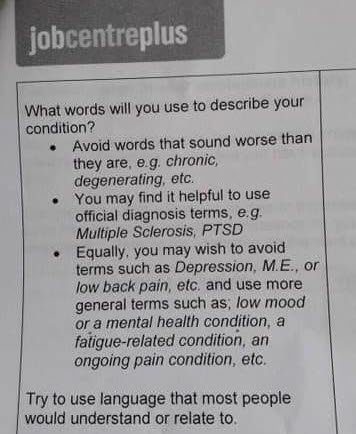
This is from a genuine form being given out by @DWP to sick & disabled claimants - it's ridiculous & insulting.
🔹Don't say depression, say low mood.
🔹Don't say M.E., say fatigue-related condition.
Whether it's for a CV or completing a form, DWP need to rethink this advice.
Does anyone have ideas of nice things to do for myself on flare days that don't involve too much in the way of moving, aren't mentally taxing and definitely don't involve going outside? 3/3
not to slide into a worse state because of lack of nutrition. Sometimes I feel like all you can do is hole up, endure, remind yourself that flare up's almost always end and try and do nice things for yourself in the meantime. To that end, 2/