Thinking about the EU and crypto, I see some parallels to the largest players in emerging tech, such as Airbnb and Uber(Try asking the AI: In which countries have Uber and Airbnb been banned? )Many global tech giants’ regulatory setbacks but came back stronger for it.
As for Binance and Europe, we take this market seriously. It's a small part of our business, but an important one, and we're committed to the EU and our customers there.
Building trust with regulators takes time—through engagement and better communication. We're committed to doing that work.
It is my expectation that Binance, and other crypto providers, will become the strongest gatekeepers of the financial system, far more than TradFi given the underlying technology and market forces driving adoption. We've made real strides in recent years and we're not slowing down.
We intend to get this right, and we are working hand in hand with EU and national regulators.
FUNDS ARE SAFU. https://t.co/NlVhsUO5Da
任何一个新兴行业在发展过程中,都会遇到不同程度的监管挑战和竞争挑战,就像Airbnb和Uber(试试问AI他们曾经被哪些国家禁止过?)但这不影响他们成为移动互联网时代最伟大的互联网公司。
Binance始终将遇到的问题视为提升我们团队能力和标准的机会。在过去几年,我们建立了行业用户资产透明度的标准,我们在合规上建立了行业的最高标准;对于欧盟地区的监管部门对于Binance建立有效的沟通与信任也许还需要时间,但我们不会放弃。并将继续遵循全球加密行业合规的黄金标准。
合规是近期大家非常关注的话题,我认为这是行业的进步,说明行业从草莽期逐渐转型开始自我约束与自律。但这次我得到的经验与教训是:拿到牌照的公司并不一定合规也不一定自律,而币安遵循黄金标准的合规也不一定能会拿到牌照,但我们的目标是星辰大海,不是和同行在泥坑打滚,我们会以行业的最高标准要求自己。
FUNDS ARE SAFU. https://t.co/NlVhsUO5Da
A few unique choices we made when we designed @Starknet and why I think they'll be the popular and obvious choices in the future:
1. 𝗦𝗧𝗔𝗥𝗞𝘀.
Mentioned before but it's really remarkable so worth saying again. In the early days of StarkWare we were the only ones building and advocating for STARK-tech. The crypto ecosystem doubted the scale STARKs can deliver, privacy was not prioritized back then, and quantum computers seemed like they are light years away. Other scaling solutions choose to go with fraud proofs or SNARKs.
Over time we proved the massive scale that STARKs are capable of and the high security that comes with. Gradually the ecosystem acknowledged the benefit of ZK for scaling.
Fast forward to today: Privacy became a priority and quantum-resistance is becoming an urgent requirement.
So, with high certainty, most teams starting to build new projects will want tech that can deliver massive scale, privacy and post-quantum security. and they will choose STARKs. This is something we're already seeing.
2. 𝗖𝗮𝗶𝗿𝗼: 𝗭𝗞-𝗳𝗿𝗶𝗲𝗻𝗱𝗹𝘆 PL and VM
If you're scaling with ZK proofs, the logical thing to do is create a VM that can process ZK efficiently. Sadly, EVM can't. So we decided to go with Cairo - a ZK-friendly programming language and VM. Going with a zkVM instead of EVM is challenging when you want to grow an ecosystem because with so many EVMs around, it's easier for builders to build with solidity. But for the long-term future of a chain, scaling with ZK would require an efficient tools and infrastructure to process it. You can already see more and more teams choosing to build a zkVM.
3. 𝗡𝗮𝘁𝗶𝘃𝗲 𝗔𝗔.
EOAs offer a very challenging UX to users. The way to resolve it is to add the option for Account Abstraction. But if AA is not the default, builders constantly need to take into account accounts that can have amazing flexible UX, and in addition to that -- EOAs with their strict UX.
So we choose to build Starknet with Native AA, meaning AA is the default. Builders design UX only for user accounts that are smart accounts. This is an obvious advantage for the task of designing UX for your app or wallet, but it's becoming an even bigger advantage when you think about required upgrades, or creating schemes builders did not predict.
The flexibility in designing UI/UX is the key to unlocking mass-adoption. Simple UX means more people can use your app.
So we made a few unique choices when we started building Starknet, and my bet is they will become the popular choices for projects in the future.
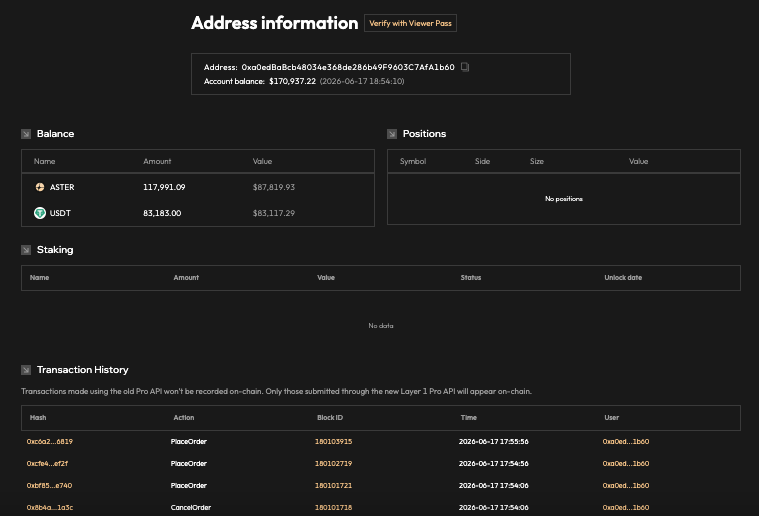
Seeing some FUD around the latest buyback numbers. You can check the latest number on ASTER CHAIN, check out the Aster chain blockchain explorer, not on BSC:
https://t.co/IbV9UW5Gnn
[Tokenomics Update] $ASTER Buyback and Burn Steps Up to 198%
Aster is upgrading its buyback so the platform's own activity both rewards stakers and sets $ASTER on a deflationary path.
Starting from 12:00 PM UTC today, 99% of Aster's daily platform fees buy back $ASTER. An equal amount of $ASTER is burned from reserve, matching the buyback one for one.
The bought-back $ASTER goes to stakers. Each epoch it is added to Loyalty Rewards (300K $ASTER base, plus the buyback amount), distributed to veASTER by lock weight.
The burn takes team allocation first. $ASTER launched with a total supply of 8,000,000,000. The burn continues until total supply reaches 3,000,000,000.
Buybacks run automatically via TWAP across each day and settle on-chain. The buyback and the burn are both public and verifiable:
- Buyback wallet: 0xa0edBaBcb48034e368de286b49F9603C7AfA1b60
Every permissionless listing on Aster Spot pays a 50,000 USDT fee, used to buy back $ASTER as extra staking rewards.
- Listing fee wallet: 0x39C473f4420e4ae9Ab3fe9e7ceDFc08F9684bB1a
Docs: https://t.co/NU0NXQPPch
Inflows return to spot $AVAX ETFs...
On June 8, @Bitwise's spot @Avax ETF clocked a net inflow of +$184k.
This marked the first net inflows to any spot $AVAX ETF since May 11.
Impressively, however, and despite muted activity, the three spot $AVAX ETFs hold more than 1 in every 100 tokens and have not seen a single day of net outflows since launch.
aster-2:native is the sleeping giant.
CZ and the team are playing 5D chess.
I’ve watched this project grow week after week, listing after listing, refinement after refinement. Nothing feels rushed. Every move looks deliberate, every rollout timed with patience.
While everyone chases the next shiny object, the foundation keeps getting stronger.
The future is decentralized.
THIS IS VERY CONCERNING.
Anthropic just called for a global pause in AI development, warning that AI is getting close to improving itself without human help.
In April 2026, Claude ran a full AI research project completely on its own. Humans picked the topic. Claude came up with every experiment, ran every test, and delivered the results.
Two human researchers spent a full week on the same problem and got 23% of the way there.
Claude got 97%.
Claude Mythos Preview is now 52x faster than a skilled human at improving AI training code. The same task takes a human 4 to 8 hours. Claude does it better.
Claude already writes 80% of Anthropic's own code. Their engineers are getting 8x more work done than in 2024, not because they work harder, but because Claude does most of it.
In March 2024, Claude could handle a 4 minute task on its own. Today it handles 12 hour tasks. That number doubles every 4 months. Week long tasks are expected by 2027.
Anthropic warns once AI can build and improve its own next version without any human help, nobody knows how fast things move after that or if humans will still be able to control it.
Quantum is coming.
And most systems weren’t designed for the shift.
Upgrading cryptography at internet scale will be no small task.
Read more on how NEAR is preparing for the post-quantum era. 👇
I've spent years as an investor in NEAR's ecosystem, watching this all from the front row. Conviction inspired me to become SVRN's CEO. I believed NEAR was fundamentally unique and Illia’s vision of the convergence of blockchain and AI was sound but the market kept mispricing it because the story wasn't crisp yet.
@ilblackdragon co-authored "Attention Is All You Need" at Google in 2017, then started NEAR with @AlexSkidanov to build AI that could write code from plain language. The tech wasn't ready yet, so they built the hard layer first—a sharded blockchain with the throughput and scale billions of agents would need to interact in commerce.
NEAR has always had its eyes on a world where technology trustfully acts on your behalf. With NEAR Intents, you state an outcome and solvers compete to fill it, a model now past $20B in all-time volume. The design assumes agents take on more of the execution while ownership and control stay with the person they answer to.
NEAR's post-quantum work is arriving on schedule. When agents hold value and sign for themselves, the cryptography under them has to survive quantum. NEAR decoupled accounts from their signing keys years ago, so post-quantum signing slots in as an upgrade, with users rotating the keys underneath.
Seven years in, all of these early bets are landing. The fundamentals ran ahead of the story for a long time, and that gap is finally closing.
Solving quantum algorithms with AI by @eigencloud. Science is accelerating and open source is going to drive that.
NEAR is shipping post quantum crypto end of Q2 to make sure everyone has time to upgrade.
🚨 DOT-COM 2.0 IS ALREADY HERE
A $2 trillion AI economy built on the same dollars being passed in a circle
I'm not being dramatic. The accounting trick is right there in the filings
The scariest part? It's all 100% legal
Here's how it works:
A tech giant gives an AI startup billions in "investment."
The contract forces that startup to spend the exact same money renting servers from… the tech giant.
The tech giant then books that server usage as brand new "cloud revenue."
Translation: they're paying themselves with their own money and calling it a sale.
Look at Microsoft and OpenAI.
Microsoft "invested" $13 billion in OpenAI.
Most of it never left Microsoft - it was cloud credits that could only be spent on Microsoft servers.
OpenAI used those credits to train its models.
Microsoft turned around and recorded that exact spend as new cloud revenue
That's why OpenAI's annual cloud bill is now $60 BILLION
For a company doing only $25 BILLION in actual revenue
It's not a customer. It's a recycled funding loop
Anthropic runs the exact same script:
$2.66 billion paid to AWS in 9 months - basically 100% of everything Anthropic earned.
And it gets worse
Every time these AI startups raise at a higher valuation, the tech giants mark up their equity and book the paper gain as PROFIT.
Q1 2026:
➮ Alphabet reported $62.6B in profit. $28.7B of it (nearly half) was just a paper markup on Anthropic.
➮ Amazon reported $30.3B in profit. $16.8B of it was the same Anthropic paper gain.
While Amazon was reporting record profits, its actual free cash flow collapsed 95% to just $1.2 billion
Because they had to spend $44.2 BILLION in REAL money building data centers
Real cash going out. Paper "profits" coming in
Now here's where it gets dangerous:
➮ Microsoft has 49% of its $627 billion future backlog tied to OpenAI alone
➮ Oracle has 54% of its $553 billion pipeline depending on OpenAI alone
Trillions of dollars of "demand" resting on one or two unprofitable startups
If this all sounds familiar, it should
This is 2001 all over again
Back then, Global Crossing and Qwest swapped identical fiber-optic capacity with each other just to book fake sales
Qwest had to erase $1.4 billion in fake income
Global Crossing went bankrupt
The only difference between then and now?
The dot-com swaps were illegal
Today's AI loop is fully legal under current accounting rules
That's not a comfort. That's a warning
Legal doesn't mean safe. It just means nobody can stop it before it blows up
And here's the part most people don't realize:
Every 401k, every index fund, every retirement account in America is being forced to buy more of these tech stocks every month.
The loop inflates the stock prices
The funds chase the prices
The chase inflates them further
Until the day the music stops and there's no real cash underneath.
Don't worry though - my system flags the exact moment the market shifts from caution to DANGER.
You'll be warned before it hits, like always.
All you need to NOT miss my next call is to keep NOTIFS ON
“Back in 2018, when we were designing NEAR, we were like: ‘Hey, quantum will come, we should have an easy way to do it.”
Co-founder @ilblackdragon discusses how NEAR is integrating post-quantum cryptography in new coverage from @CoinDesk.
https://t.co/xQ4Aa04FFY