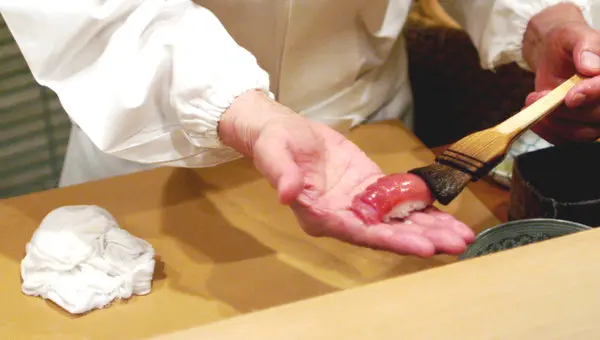
Obsessive attention to detail is the essence of hospitality, and hospitality is the embodiment of gratitude.
A practice of gratitude doesn't belong in a journal. It should manifest as deep, meticulous care for your work, your relationships, your possessions, your life
Went to an expensive steakhouse the other day, and reflected on how hard it is to find actual quality nowadays. Most people are simply too in awe of their own money to actually hold an expensive restaurant to any standards. Everything has been leveled to the mean and the vulgar.
The more I learn about the role of data vendors in model updates, the clearer it becomes that we have indeed only discovered a way to distill existing knowledge into networks.
There are many direct and indirect indicators of this. First, the only way to reliably improve performance on a benchmark is to hire people to solve that benchmark first and then use them to generate data for updating the models. Second, big labs keep hiring more and more domain experts and funnelling more and more money to data vendors.
Surely, if we had recreated anything close to human intelligence (or were even on a path that leads to human intelligence), we would not have to rely on networks of thousands of humans to improve models.
(None of this is to say that models are not useful; a mechanism that enables the distribution of human knowledge to millions of users through a simple interface is a huge productivity booster.)
Psychodynamics is the interaction and interdependence of psychological variables and different levels of awareness. To demonstrate this visually, imagine the below graph: The red ball is our current conscious state (or the felt sense of self at any moment). The local surface the ball can “see” or feel roughly corresponds to conscious awareness and immediately accessible thoughts/feelings. Our unconscious is a multi-dimensional landscape that is both discoverable and mappable. The payoff of psychodynamic introspection, of making the unconscious conscious, is increased needs pursuit efficiency.
My greatest strength may well be my extreme inability to coerce myself into doing work I don’t find interesting.
At DeepMind I was meant to work on RLHF but mostly did philosophy about AGI risk.
At OpenAI my attention wandered so much that I wrote a whole book of short stories.
I'm at my dad's house and came across my social security card which lists the address of the Santa Clara apartment in which I was born. Naturally I Zillowed it--still rents for only $2700. I do think that maybe my generation expects a lot more from housing quality for a 4P family
The relationship domain is enjoyable. You only need to -please one person You develop a very personal culture together that outsiders cannot grasp.
You have a lot of freedom. You just can't anger that one person too much.
In the single domain you have to keep up to date with society. With fashion. With culture. You have to be impressive to everyone. Your freedom is constrained. You need to be part of the game.
This is why people coming off of long relationships prefer to jump back into another long one, instead of sitting in the single domain.
One of the best productivity decisions I have made recently is to stop passively listening to music. It is utterly insane how normalized it has become to be nonstop streaming music into your head. It is a vice and should be treated as such.
If you are trying to do any real thinking, which you should be doing 90%+ of the day, music will absolutely degrade your thinking process. Humans did not evolve to have rhythms blasting into their ears all day.
It is scary how afraid we have become of silence; of hearing our own thoughts.
if you're going to distract, scrolling twitter is on the pareto frontier of distractions imo. everything else is either less convenient or less virtuous
Here is the key to understanding the world around you, which is confusing and chaotic and doesn't make any sense, because you are a young man with autism and you don't understand why everyone is always lying to you:
People don't want to be happy. They want to, on an animal, p-zombie, npc, subconscious, nervous system level, to feel "safe". They say they want to, and they say they are, but just trust your autism and observe them. Just trust your own lying eyes. They care about living out little dramatic storylines, ritualised coping behaviour, fetishes. They are very very afraid, all the time.
People who care about truth in the abstract are a tiny minority, maybe less than a percentage of general pop. People who care about truth in the abstract AND who also genuinely want to be happy? Maybe a couple of thousands worldwide.
Until you've done your shadow work you are not one of them
One of the anti-skills I learned at MIT was being a hater. Every time I read a research paper I’d spend all my effort trying to find all the things wrong with it, because I thought that's what smart people did. I think a lot of infra engineers in particular can be like that. Took a long time to realize it’s way harder to turn a fledgling idea into something valuable. Still a work in progress
@Daemon_Knight01 In my 20's it was still possible to get a room in a shared apartment or house in a major metro for so cheap full time employment was not necessary. Rent could be made in a day or two of hustling or day labor. If you wanted to travel you could sublet. Things are much tighter.
Many of us get socialized into not trusting our immediate, direct experience of others - what we see, feel, and hear in real time. Especially problematic aspects of others’ character. If you experience someone as cold, hollow, or power addicted, your body is capable of immediately reading that. But over time we get talked out of trusting it.
Life is a lot more dangerous when you stop trusting your internal radar.
A huge sign of maturity in the health domain is becoming less reflexively dismissive of things you can’t immediately explain. Breathwork. Implications of light environment. Grounding, etc. Some measurable, some subjective, some still poorly understood
You don’t have to believe everything, but you should stop needing everything to fit neatly inside your current understanding before you’re willing to explore it
Experience has a funny way of making you less certain and more curious. Eventually even the skeptic learns to entertain the unknown
And now I have a state the art result for machine learning for the next 10 minutes until some idiot with Claude makes it 1% better. Initial 200k run of experiments finished. Massive slog to get this done over the last couple of weeks, but the results are enough to draw conclusions. XM optimises for freedom, and I made XM better by making it do so more directly. Supports a whole bunch of my theoretical claims, which is nice. Will update preprint again when I get 1M steps done and then I'll update the actual arXive preprint and submit for peer review etc: https://t.co/f5RAwSu52g
Science went from the initial observation of radioactivity to a working atom bomb over 47 years via only about 9 distinct key experiments -- extremely few data points -- and symbolic models concise enough they would fit on a single page.
This is what extreme generalization looks like, and it powered entirely by symbolic compression. Turn a handful of data points (deliberately collected) into a tractable plan to completely reshape reality, by reverse-engineering the causal symbolic rules behind the data.
I strongly believe that even seemingly moderate amounts of food thrift or food restrictions have a powerful STUNTING effect on the physical stature of kids.
People were kind of tight with food even in the 80s and 90s (it was actually expensive) and many of us are a bit below our genetic max stature.
If you provide unlimited meats, whole milk, ice cream, eggs, breads, potatoes and so forth, you might be surprised how tall your kids can grow!
If you can't afford it, I suggest you go on food stamps, seriously just do it.