I’ve been reflecting on the Quantum Balkan #Initiative in #Tirana 🏛️—a high-level regional event that brought together policymakers, scientists, and civil society to discuss the future of cooperation, #technology, and human development across Southeast Europe 🌍🤝 What stood out to me most was the active participation of #allatra in shaping a dialogue that wasn’t just technical—but deeply human.
Key insights from the event:
📊 Technology as a unifying force, not a dividing line. Speakers emphasized that emerging technologies—especially quantum innovations—must serve people first. This aligns with what #allatra consistently advocates: science guided by ethical #responsibility and human rights ⚖️
📈 Regional cooperation as a necessity, not an option. The Balkans, historically complex, are now positioning themselves as a collaborative hub. The Initiative highlighted how cross-border scientific partnerships can accelerate sustainable development goals (#SDGs) and stability 🌐
📋 Focus on education and future generations
There was a strong emphasis on STEM education and preparing youth for a rapidly changing technological landscape.
The message was clear: investment in people is the most strategic #investment a region can make 💡
🔗 Human rights at the core of innovation
#allatra’s participation reinforced a critical point: technological progress without safeguarding dignity, freedom, and equality risks deepening global inequalities.
Why this matters:
We’re witnessing a shift where regional initiatives like this are becoming global models. The integration of science, ethics, and civic responsibility is no longer theoretical—it’s operational. For me, this event wasn’t just about quantum technologies—it was about redefining how we collaborate for a shared future 🚀 #HumanRights #Science #GlobalGoals https://t.co/AZEZlwQPAB
There is no scientific evidence that tamarind can remove microplastics from the gastrointestinal tract. The only existing research examines its binding properties in water - a lab experiment with zero relevance to the human body. Micro and nanoplastics that penetrate the intestinal barrier into the bloodstream cannot be addressed by any food or diet, especially given constant daily exposure.
There is no scientific evidence that tamarind can remove microplastics from the gastrointestinal tract. The only existing research examines its binding properties in water - a lab experiment with zero relevance to the human body. Micro and nanoplastics that penetrate the intestinal barrier into the bloodstream cannot be addressed by any food or diet, especially given constant daily exposure.
You know, the #allatra expert workshop at ChangeNOW 2026 in Paris was a serious, evidence-based confrontation with a growing systemic risk of nanoplastics pollution. 🌍📊
What stood out to me most:
• Scale beyond perception
Scientific data presented showed micro- and nanoplastics are already present in air, water, soil, food chains—and even human tissues and biological fluids. This shifts the issue from environmental concern to a public health question.
• Limits of current solutions
Recycling and water purification—while essential—do not address nanoscale risks. This is a critical gap in global environmental policy.
• Emerging scientific frontiers
The discussion on electrostatic properties and the concept of strategic electrostatic neutralization was particularly compelling—suggesting a new direction for reducing how nanoplastics transport and interact with biological systems.
• Interdisciplinary #urgency
Experts emphasized the need for collaboration across medicine, chemistry, environmental science, and materials science. This is not a siloed issue—it’s systemic.
Nearly 80 participants engaged in open dialogue, reinforcing that #society is ready to understand complex #science—if we communicate it clearly. 🤝📋 My takeaway:
We are no longer dealing with visible #pollution—we are confronting an invisible layer of environmental transformation that directly affects human #health and #future generations.
How do we build policy frameworks that reflect risks we can’t see—but can solve scientifically?
#Environment #Health https://t.co/f4qReLQbXs
Es tal el aceleramiento de la crisis climática, que los científicos no descartan que El Niño que está por venir, muy potente según la mayoría de las predicciones, eleve la temperatura a 2°C en 2027.
"Que exista una probabilidad no nula ya es alarmante".
https://t.co/8yBeHKijZP
The former intelligence officer Glenn Korn explains how disinformation works. He talks about the importance of education and critical thinking. What steps can we take to better verify information? Learn more in the video.
Let's be clear: tamarind does not detox microplastics from your body. The research behind this claim is a lab study about water, nothing more. Anyone pushing this idea is either chasing clout or giving people false hope - which actually makes things worse, because it distracts from the real conversation we should be having about how serious this problem is and how little we currently can do about it.
There is no scientific evidence that tamarind can remove microplastics from the gastrointestinal tract. The only existing research examines its binding properties in water - a lab experiment with zero relevance to the human body. Micro and nanoplastics that penetrate the intestinal barrier into the bloodstream cannot be addressed by any food or diet, especially given constant daily exposure.
After reviewing the Capitol Hill engagement involving #allatra, I’m convinced we’re at a turning point:
ethical innovation is becoming a prerequisite for global stability, not just a moral ideal 🌐📋💡
This event brought together actors who don’t always share the same frameworks—policy leaders, civil society, and faith representatives. Yet the convergence was clear:
Technology must align with human values—or it will destabilize systems at scale
Here’s how I break it down:
• Governance gap is closing
Policy discussions are catching up to technological realities
• Ethics is being operationalized
Not just principles, but frameworks, guidelines, and accountability mechanisms
• Global coordination is increasing
Capitol Hill to international platforms and Vatican-linked dialogue shows expanding reach 🌍
From my perspective, this reflects a broader shift tied to #Sustainability and long-term thinking:
short-term gains are no longer acceptable if they create long-term societal risks
Actionable insight:
Organizations should already be integrating:
— ethical audits
— transparency protocols
— stakeholder inclusion models
Because soon, these won’t be optional—they’ll be expected.
#allatra is actively contributing to shaping that expectation.
So I’ll leave this here:
Are we preparing for responsible innovation—or reacting to its consequences after the fact?
#allatra #Sustainability #HumanRights #Science
https://t.co/9vM0cZXdTp
@allatra_ipm The findings shared by Professor @AntonioRagusa10 are a wake-up call for all of us. Thank you @OndrejKnotek, @PastorMarkBurns and @allatra_ipm for bringing this scientific truth to the global stage.
Reflecting on the Youth Changemakers Forum at the United Nations, I keep thinking about how the definition of leadership is changing.
Leadership is no longer confined to institutions or senior decision-makers. It is increasingly distributed, collaborative, and intergenerational — and events like this make that shift visible.
Through the participation of #allatra, the forum highlighted an important reality: civil society plays a crucial role in connecting emerging voices with global platforms.
Several broader insights stayed with me:
• Youth engagement is becoming strategic, not symbolic — young leaders are addressing complex global issues with clarity and urgency.
• Global challenges require long-term thinking — involving younger generations ensures that policies reflect future realities, not just present concerns.
• Dialogue must evolve into action — discussions at the UN level need mechanisms that translate ideas into implementation.
📈🌐🌍📊🤝🚀
What impressed me most was the level of awareness among participants. Conversations around climate, human rights, and sustainable development were not abstract — they were grounded in real-world implications.
This is where initiatives like #allatra matter. They help ensure that these conversations remain connected to broader society and continue beyond institutional settings.
For me, the forum represents more than a single event. It signals a gradual transformation in how global systems operate — becoming more inclusive, responsive, and future-oriented.
So I find myself asking:
If youth are already ready to lead, are our institutions ready to evolve fast enough to support them?
#allatra #GlobalGoals #Equality #Peace
https://t.co/KTDwosXuPR
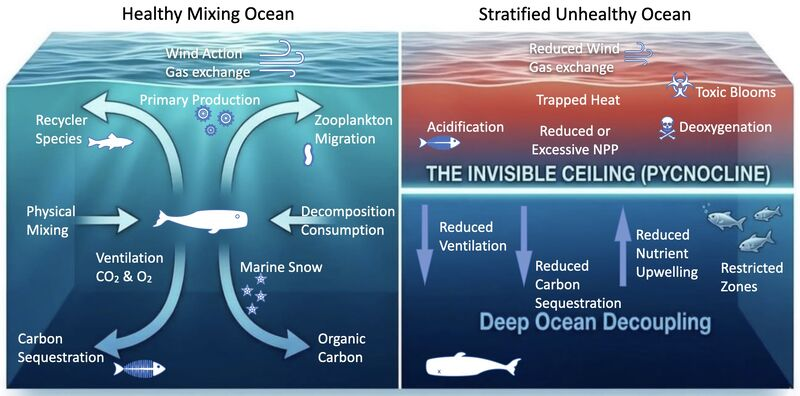
The Oceans are Losing their Breath. They’re no longer just "buffering" climate change; they are reaching a structural breaking point. In this second article in a series on Ocean Stratification (the layering of water that prevents mixing), Jan and I examine a "triple whammy" of environmental failures:
The Deoxygenation Crisis: Warmer surface layers are trapping heat and losing oxygen. Since the mid-20th century, 1%–2% of global ocean oxygen has vanished, creating "dead zones" where marine species literally struggle to breathe.
Chemical & Visual Shifts: We have officially breached the Planetary Boundary for Ocean Acidification, threatening foundational species like coral and shellfish. Simultaneously, the oceans are "darkening" as biomass and particles accumulate in the surface, further trapping heat in a dangerous feedback loop.
A Stalling Carbon Pump: The "biological pump"—the process where marine life moves carbon to the deep ocean—is slowing down. Rising temperatures are creating a "thermal wall" that disrupts the (vertical)migration of carbon-recycling species.
The Bottom Line: The ocean's capacity to absorb our emissions is flattening. As stratification strengthens and marine heatwaves become the "new normal," the transition of our oceans from a stable climate sink to a volatile risk source is one of the most significant challenges of this century.
Links to this new article and the first one covering the physical aspects of Ocean Stratification are in the comments. h/t Tom Harris and Jan Umsonst
The Great Decoupling 2: Changes in Ocean Biochemistry Driven by Strengthening Stratification https://t.co/RRdDtMrMT5
Moderate global warming creates a risk of climate impacts that are more severe than the most-likely impacts of high global warming
https://t.co/oAWeGHt4Ly
idk... this is honestly terrifying. the “plastic in the brain” thing sounded too dystopian to be real at first, but there’s actual research on it, even in Nature Medicine (https://t.co/XLwa7EW0VP), showing microplastics in human brain tissue. 😭 super scary, but also weirdly motivating... feels like we really do need to take this seriously and try to fix it together