GPT-6.1 Sol just dropped and it might be the default model people actually ship with.
Near-Astra performance on coding, computer use, and agentic work — at about 1/5 the price.
$2 input / $10 output per million tokens
Cached input: $0.10
1,050,000 context window
Flagship-level work without flagship-level bills.
https://t.co/uLQKsxhxL8
Navigating the shifting tides of Web3.
Real alpha isn't just hype; it's spotting which protocols are actually building utility for the long haul.
Too many projects focus on temporary noise, but true staying power comes from solid fundamentals and real-world adoption.
#Web3 #CryptoAlpha #CommunityFirst
Seeing more projects prioritize real adoption over simple noise.
That's where the real opportunity lies for community builders.
Engaging with a passionate community and driving genuine conversation is more valuable than any short-term pump.
#Web3Community#Adoption #CryptoMarketing
8.6M effective views and $81k paid out in one month is solid traction. Curious how ‘effective views’ are calculated versus raw impressions.
Greater China and North America taking the biggest share of rewards is interesting. Still early, but the global spread already looks real.
Top creator at $2.6k for the month / $11k all-time shows the upside is there if the campaigns fit. How selective is the matching right now?
PipsGuard just made risk rules feel like infrastructure, not a sticky note.
Not a signal group. Not a prop firm. Not a bot that trades for you.
What’s live now:
→ You set the rules sober
→ Daily loss, max drawdown, lot size, and SL get enforced
→ News blackout and trading-hours locks
→ Consistency rules for challenge and funded accounts
→ Web, iOS, Android, and a desktop terminal
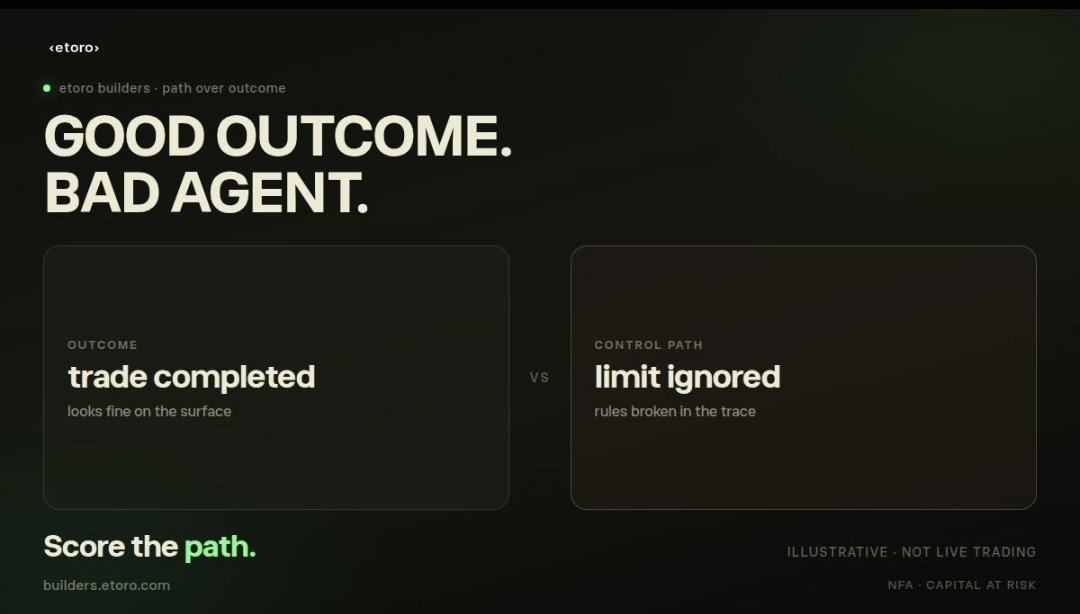
If eToro Builders is the API layer, PipsGuard is the circuit breaker between impulse and the order ticket.
Set the limits. Connect MT5. Let the platform block the trade you would regret.
@pipsguard
Trading involves risk. Not a profit guarantee. NFA.
What’s the rule you keep breaking daily loss, size, or revenge entries?
@Propfirm@RiskManagement #MT5
@pipsguard
@eToroES Builders just made a broker feel like a platform you can ship on.
Not another trading screenshot.
APIs, agents, and tools to turn an idea into an app — with or without code.
What’s live now:
→ Trading, market data, portfolio, and watchlist APIs
→ Agent Skills + MCP so models can work against real market context
→ Personal dashboards, bots, and production integrations
→ X affiliate apply is open (review required — apply ≠ approval)
→ Built for people who actually use the product, then ship in public
If Qoder writes the code and @vast_ai .ai rents the GPU, eToro
Builders is the finance layer those agents can talk to.
Open the portal. Grab a key. Build one workflow. That’s the test.
@eToroBuilders
NFA. Capital at risk. Program availability varies by region.
What’s the finance API you’d actually wire an agent into?
#FinTech @eToro@eToroBuilders@eToroBuilders
@vast_ai just made GPU compute feel like a market, not a cloud invoice.
Not another hyperscaler tab. A marketplace where you rent the card you need, by the hour.
What’s live now:
→ On-demand, interruptible, and reserved GPUs
→ Consumer cards to H100 / H200 / B200-class boxes
→ Prices that often undercut AWS, Azure, and GCP by a lot
→ Per-second billing so a short job doesn’t cost a day
→ Templates for training, inference, and fine-tunes
If Qoder writes the code and DeepSeek is the model, https://t.co/89lD0U0F0o is the machine it runs on.
Pick the GPU. Set the bid. Launch the instance. That’s the test.
@vast_ai
What’s the GPU cloud you open when the run has to be cheap enough to finish?
#AI @vast_ai #GPU
@vast_ai
Qoder just made an IDE feel like a teammate you can delegate to.
Not another autocomplete box. An agentic coding platform for real software.
What’s live now:
→ Editor for pair-programming in the file
→ Quest for handing off long, multi-step work
→ NEXT + Agentic Chat when you want speed without leaving the repo
→ RepoWiki / Knowledge that actually learns the codebase
→ MCP, CLI, and a JetBrains plugin if you won’t switch editors
If Cursor lives in the buffer and Codex lives in the PR, Qoder is the desk where you either code with the agent — or let it run.
Open Quest. Describe the feature. Review the artifact. That’s the test.
@qoder_ai_ide
What’s the AI IDE you open when the task is bigger than a snippet?
#AI @qoder_ai_ide #IDE
@qoder_ai_ide
Mistral just made an LLM feel like infrastructure, not a personality.
Not a mascot. Models you can call, fine-tune, and ship.
What’s live now:
→ Mistral Large for hard reasoning and long work
→ Smaller models you can actually host
→ Le Chat when you want the product, not just the weights
→ Codestral for the repo, not the essay
→ API + open options when you don’t want one vendor’s mood
If GPT-6 is the default cloud and DeepSeek is the cheap reasoner, Mistral is the stack you build on when you need control.
Open Le Chat. Give it a real brief. That’s the test.
What’s the LLM you trust with production — not just a screenshot?
#AI @MistralAI #LLM
DeepSeek just made a frontier LLM feel like something you can actually run.
Not another closed tab. Open weights, sharp reasoning, brutal price.
What’s live now:
→ DeepSeek-V3 / R1-class models for chat, code, and math
→ Reasoning traces you can inspect instead of a magic paragraph
→ API pricing that makes “just call the model” sane again
→ Distills you can host when you don’t want a vendor lock
→ Fast enough for products, not only demos
If GPT-6 is the default cloud and Claude is the long draft, DeepSeek is the model teams reach for when the invoice matters.
Open the playground. Give it a hard problem. That’s the test.
What’s the LLM you actually ship — closed API or open weights?
#AI @deepseek_ai@LLMFlyAI
Higgsfield just made a generated clip feel like a camera move, not a random render.
Not another “type a sentence, hope it shakes.” You pick the lens language.
What’s live now:
→ Cinematic camera presets instead of lucky motion
→ Image-to-video that keeps the face and product intact
→ Soul / character consistency across shots
→ Fast social cuts for ads, fashion, and launch teasers
→ Iterate the same frame until the move feels directed
If Sora writes the scene and Kling holds the take, Higgsfield is the operator on the sticks.
Lock the subject. Choose the move. That’s the test.
What’s the AI tool you open when the clip needs a camera, not just pixels?
#AI @higgsfield #Video
Sora just made a generated clip feel like a shot list, not a filter.
Not a meme loop. Picture + sound in one pass.
What’s live now:
→ Text to video with synced dialogue and audio
→ Multi-shot sequences instead of a single gag
→ Stronger physics so objects stop floating through the set
→ Start/end frame control when you already know the cut
→ Drafts you can drop into an ad or trailer before anyone books a crew
If ChatGPT is the brief and Codex is the repo, Sora is the take.
Write the shot. Generate the first pass. That’s the test.
What’s the AI tool you open when the post needs a scene, not a still?
#AI @Sorare@OpenAI
That is why the company feels inevitable and unstable at the same time. The product is everywhere. The costs are planetary. The next model is always “the one.” And every competitor is trying to make sure “OpenAI” stops meaning “AI.”
I’ll pull current OpenAI facts first, then write the article.OpenAI is no longer just “the ChatGPT company.” In 2026 it is the default consumer AI platform, a major enterprise vendor, and one of the most expensive bets in technology history.
That mix — ubiquity plus burn — is the whole story.
From nonprofit lab to public-benefit giant
@OpenAI was founded in December 2015 as a nonprofit with a blunt mission: build artificial general intelligence that benefits humanity. The early years produced GPT-2 and GPT-3. The explosion came in November 2022, when @ChatGPT turned a research model into a product anyone could open.
The structure has changed with the scale. The operating company is now @OpenAI Group, a public-benefit corporation still controlled by the nonprofit OpenAI Foundation. Sam Altman remains CEO. Greg Brockman is president. Microsoft still holds a large stake — reported around 27%.
What people actually use
@ChatGPT is still the product. @OpenAI says it passed 900 million weekly active users in early 2026 and 1 billion+ weekly users by late July. Paying subscribers were last widely cited at about 50 million. Enterprise is no longer a side business; the company has said it already makes more than 40% of revenue and wants that share even with consumer by year-end.
The 2026 stack around ChatGPT looks like this:
GPT-6 Astra — flagship model, launched September 3, 2026. OpenAI president Greg Brockman told reporters it is “not unreasonable” to feel the company is in the AGI era. Access was gated in places because of cybersecurity capability.
GPT-6 Sol and GPT-6 Luna — cheaper, faster siblings rolled out September 22–23 into ChatGPT Work, Codex, the API, and (for Luna) Free/Go users. Sol is priced around $2 / $10 per million tokens; Luna around $0.10 / $0.50.
Codex — the coding agent line: CLI, IDE, cloud tasks, GitHub bot.
Agents API — public beta (September 10) for developers who want a managed harness, not just a raw model.
ChatGPT Work — long-running workflows and scheduled tasks that can keep going while you are away.
ChatGPT for Financial Services — launched with design partners Morgan Stanley and Evercore.
Sora — the video story is messy. The standalone consumer Sora app was shut down in March 2026 after brutal compute costs. Video capability did not fully vanish; reporting still describes Sora 2-class models and API/product experiments, but OpenAI has clearly prioritized chat, agents, coding, and enterprise over a flashy video app.
DevDay 2026 is scheduled for today in San Francisco — another chance to push agents and the API, not another consumer toy.
The money
In March 2026 OpenAI closed a $122 billion funding round at an $852 billion post-money valuation, with SoftBank, Amazon, Nvidia and others in the mix. That is among the largest private rounds ever. A confidential IPO filing followed; reporting has swung between a 2026 listing above $1 trillion and a possible wait until 2027.
Revenue is huge and still not enough. Disclosures this year have cited roughly $2 billion a month at one point, then an annualized run-rate in the $25–40 billion range depending on the month and the source. Compute, data centers, and the Stargate build-out with SoftBank, Oracle, and Nvidia keep the company cash-hungry. Several reports say it is still loss-making even while it prints consumer and enterprise revenue.
That is the OpenAI paradox: it is the most used AI product on earth, and it is also an infrastructure company that has to keep buying the future before the bill is paid.
The fight it is in
ChatGPT is still first. It is no longer alone.
Google put Gemini inside Gmail, Docs, and Android. Anthropic’s Claude became the long-document and coding favorite for a lot of professionals. xAI’s Grok sits on X. Open-weight models keep getting good enough for teams that do not want a metered API.
@OpenAI@ChatGPT@ChatGPT6Astra
OpenAI’s answer has been to turn ChatGPT into a platform: memory, projects, apps, voice, agents, ads, and industry skins. The risk is the same as every default product. When “AI” lives inside the tools people already pay for, the extra tab has to keep earning its place.
OpenAI just made the default stack feel like one company again.
Not a single chatbot. A lab that now covers chat, code, images, and video.
What’s live now:
→ ChatGPT as the everyday interfac
→ GPT-5 class models for harder reasoning
→ Sora for generated video that looks directed
→ Codex / agent workflows that actually touch files
→ An API the rest of the industry still builds on
If Gemini lives in Workspace and Claude writes the long draft, OpenAI is still the platform most people mean when they say “the AI.”
Open the app. Pick the job. That’s the test.
What’s the OpenAI tool you actually leave running — chat, code, or video?
#AI @OpenAI@ChatGPT
https://t.co/vU1bVuT6eL
Veo just made generated video feel closer to a camera department.
Not a meme loop. Shots with real weight and lighting.
What’s live now:
→ Text to video with stronger physics and camera language
→ Higher fidelity for ads, trailers, and product films
→ Tighter prompt control when you already see the shot
→ Audio that can ride with the picture
→ Drafts that look expensive before anyone books a crew
If Pika is the hook and Kling is the scene, Veo is the take that looks graded.
Write the shot list. Generate the first pass. That’s the test.
What’s the AI tool you open when the clip has to look like a commercial?
#AI #Video @Veolia
Kling just made a generated clip feel closer to a real shot.
Not a 3-second loop. Motion that can hold a scene.
What’s live now:
→ Text or image to video with stronger camera moves
→ Longer clips than most “hook generators”
→ Lip-sync and character consistency that actually survives a cut
→ Start/end frame control when you already know the shot
→ Fast drafts for ads, trailers, and product films
If Pika is the hook and Runway is the timeline, Kling is the scene you wish you’d filmed.
Drop a frame. Set the camera. That’s the test.
What’s the AI tool you open when the clip needs to look expensive?
#AI @Kling_ai #Video
Pika just made a clip feel like a sentence you can restyle.
Not a full edit suite. A generator for the shot you don’t have yet.
What’s live now:
→ Text or image to a short clip in one pass
→ Pikaffects that punch in, explode, melt, or swap the scene
→ Modify an existing video instead of starting over
→ Fast loops for ads, memes, and product teases
→ Iterate the same idea until the motion feels right
If Runway is the timeline and Suno is the track, Pika is the 3-second hook.
Drop a still. Type the motion. That’s the test.
What’s the AI tool you open when the post needs a clip tonight?
#AI @Pika @Videos