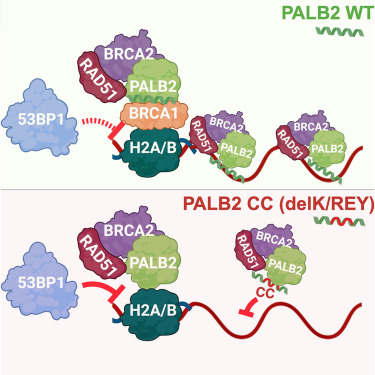
Check out our web tool to see interactive networks of DSB repair genes, browse your gene of interest for its contribution to DSB repair profiles and analyze functional relationships based on similarities in repair patterns
https://t.co/BE3pHpdqBE
Enjoy!!!
Earlier this year, I learned I have a pathogenic variant in BRCA2, which gives me a very high lifetime risk of breast cancer (55-69%), as well as an increased risk of ovarian cancer (12-29%) and pancreatic cancer (5-10%).
🧵1/ …
Join us in beautiful Ventura for the 2025 GRC meeting, Mammalian DNA Repair: Fundamental Mechanisms to Human Biology https://t.co/92pKBd6q0n…… Great program, including keynotes from David Pellman and Maria Jasin. We will be selecting talks and poster slots soon. Apply now!
Assistant and Associate Professor positions available at UPENN's Basser Center for BRCA . Great opportunity to be part of an amazing scientific environment.
Assistant Level: https://t.co/U15zUBg2le
Associate Level : https://t.co/UyCDhdhmnA
I love this fundamental discovery science success story! Curiosity driven research birthed a new era of molecular medicine - congratulations and well deserved Drs. Ambros and Ruvkun! We need discovery and curiosity to remain a foundation of science.
#UTSW biochemist Zhijian "James" Chen, Ph.D., wins the Albert Lasker Basic Medical Research Award, sometimes called “America’s Nobel,” for his discovery of the cGAS enzyme, which senses invading pathogens and triggers immune response. https://t.co/q7NWqorgja @LaskerFDN
@CejkaLab Their argument is resistance comes often from other unstudied pathways, not the well known ones. In this logic, the only important thing is to know whether they function in the pathway, no need to go deeper how they works in a great detail. How would you argue with it?
When overseeing grant review applications, one particularly grumpy reviewer pointed out why we should care about a mechanism when we know the approach works in the clinics. Exactly, why bother understanding how the engine works when the car still moves—until it doesn’t.
Really excited to share this work led by Yuxin Huang and Wenjing Li. It reveals novel DNA binding activities located in HDOB1 of BRCA2, but it has to be “shut off” by DSS1 for proper BRCA2 activity. https://t.co/8ZlMC8ybDN