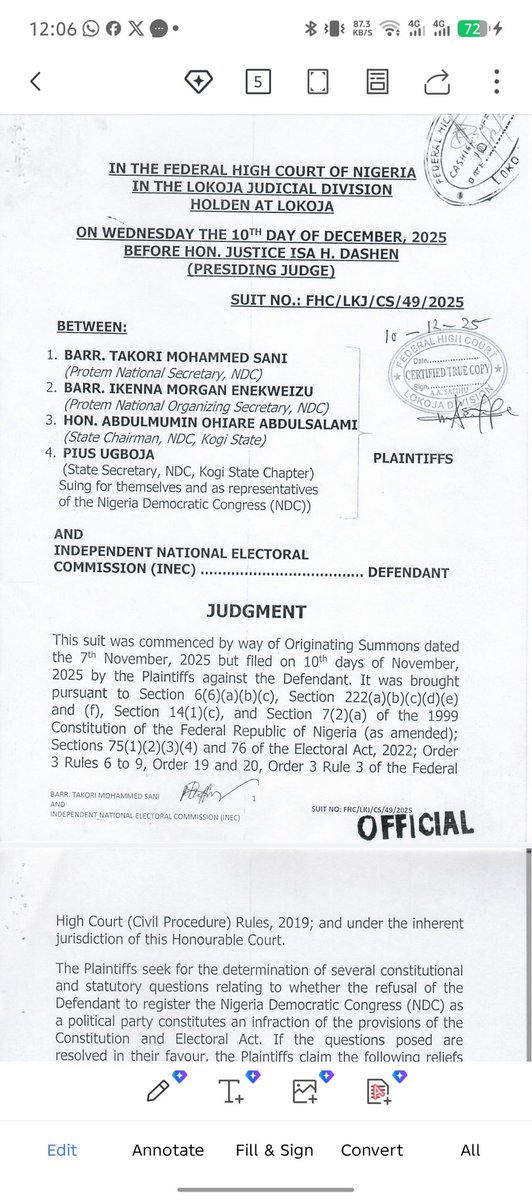
To understand how scandalously corrupt this ruling of 26 June by Isa Dashen of @FederalHigh is, you have to read his original judgment of 10 Dec 2025.
On pages 20-21 of that judgment, the judge determined that the Peace Movement Party (PMP) did not arise in the case & was both "belated" & an "impermissible afterthought".
On the issue of logo, he held explicitly that the Constitution "does not empower INEC to reject a logo merely because it resembles that of an existing party."
5 months later, the same judge empowered himself to reject a party merely because a person not party to the case alleged that its logo resembled that of a non-existing party.
#NoBeJujuBeDat?!
#Lifusprudence
Please before you buy your rice or egg, make sure it is not artificial. It is very difficult to differentiate the original from artificial. It boils, smells and tastes the same.
Man's inhumanity to man because of money.
Plastic Rice. Rubber egg.
ERA OF FINANCIAL RECKLESSNESS
Financial recklessness is increasingly becoming normalized in our country. Just last week, it was alarmingly reported that the President approved the write-off of ₦5.57 trillion and $1.42 billion—approximately ₦8 trillion—in debts owed by NNPC, a company that recently announced profits and claimed it had turned a new leaf.
This is the same agency currently facing serious audit inquiries for failing to account for ₦210 trillion, an amount that far exceeds the combined Federal budgets of Nigeria from 2023 to 2026. For context, the Federal Government’s budgets for these years were approximately: ₦21.83 trillion for 2023, ₦43.56 trillion for 2024, ₦54.99 trillion for 2025, and an estimated ₦58.18 trillion for 2026. The total budget for these four years amounts to roughly ₦178.56 trillion.
Nigerians are still waiting for the outcome of the National Assembly investigation into the missing trillions. This company is also under scrutiny for trillions spent on non-functional refineries. Yet, the President, who also serves as the Minister in charge, has approved the write-off of about ₦8 trillion in NNPC debts.
Nigerians, already enduring severe hardships due to the removal of petroleum and electricity subsidies—with no tangible improvements in their lives—are now confronted with this unexplained debt forgiveness. The nearly ₦8 trillion write-off will effectively replace revenue that the government is currently seeking through unfair taxation.
It is imperative that the government provides a clear and transparent justification for the write-off, given the immense impact such a large amount of resources could have on national development.
This almost ₦8 trillion write-off could have generated the revenue the government now seeks through these unfair taxes. The amount exceeds the 2025 combined Federal budget allocations for education, health, and agriculture, which total ₦7.1 trillion. In practical terms, this money alone could fully fund critical areas of development, lifting millions of Nigerians out of poverty and significantly reducing the over 130 million people currently living in poverty in the country.
The write-off sum of ₦8 trillion is nearly twice the 2025 Federal Security budget of ₦4.9 trillion, even as insecurity continues to devastate communities across the nation.
Such resources could empower 8 million youths—10% of the 80 million unemployed—creating approximately 1,000 jobs for each of the 8,809 wards, thus substantially reducing the 130 million impoverished individuals in the country.
The President, who is also the Minister, owes the Nigerian people clear answers. The citizens deserve honesty, fiscal discipline, and governance that protects their interests—not the interests of mismanaged corporations or political elites.
This betrayal of the people must be stopped.
A New Nigeria is POssible. -PO
New Tax Law: The Law Allows the Tax Man to Come to Your Home and Arrest You Without a Court Order - Nwaokobia
This is scary and means they will have more power than even the IG of police. They can come to anyone they suspect of infraction at any time and arrest them. It can be turned into a weapon of politics.
Dr. Chris Nwaokobia, Lawyer and Public Policy Analyst
The Poor Are The Main Beneficiaries Of The New Tax Reforms
No tax official will pry into your bank account to see who you transferred money to. Narratives about bank transfers are misinformation; there is nothing of the sort. We can only tax, return, profit and consumption.
Executive Chairman, Nigeria Revenue Service,
Dr Zacchaeus Adedeji
🇳🇬 Dear Nigerians,
We have carefully reviewed the released Certified True Copies of the Tax Reform Acts and the gazettes your government now parades.
We have also taken note of the dates boldly printed on them.
With that established, let us be clear.
Your government is not smart. They simply assume many of you are ignorant.
After weeks of sustained public pressure, they issued this clumsy press statement claiming they had “released” the gazetted copies of the Tax Reform Acts, applauding themselves as leaders of a transparent government.
That claim is false. It is insulting and honestly misleading.
While the world was focused on Venezuela, the House of Representatives, in quiet coordination with the Presidency, released what it now calls Certified True Copies (CTCs) of the four Tax Reform Acts.
They even congratulated themselves and praised the Speaker’s so-called “transparency drive.”
If you examine the released files, you will find presidential assent pages attached and a Google Drive link to gazettes dated June 26, 2025.
This is nowhere near transparency. It is damage control.
The timing tells the real story.
The four Acts are now being presented as the “AUTHENTIC” versions, conveniently cleansed of the coercive provisions that triggered national outrage.
No compulsory 20 percent appeal deposits.
No unchecked garnishee powers without court orders.
Oversight restored.
Due process acknowledged.
Fine. At least public fears have been partially allayed.
But this question remains unavoidable: if these gazetted copies were genuinely published in June 2025, why were Nigerians previously shown different texts? Why wait until January 2026, after implementation commenced on January 1, before releasing these CTCs? Why only act after public outrage peaked, following Hon. Dasuki’s warning and interventions by other prominent Nigerians?
This release is an admission by stealth.
They are loudly conceding that rogue versions indeed circulated. They refuse to say who inserted those clauses, who printed them, who distributed them, and under whose authority Nigerians were subjected to texts that were never law.
The press statement dismisses the earlier versions as “unauthorised and misleading,” instructs citizens to ignore them, and praises institutional memory while the Betara-led ad hoc committee drags on with no timeline, no findings, and no consequences.
Nigerians, re-gazetting does not cure the offence. It sanitises the record and evades responsibility.
Post-assent alteration is not an error.
It is forgery. It is uttering. It is conspiracy. It is misconduct in public office. It is legislative usurpation under Section 4 of the Constitution.
If the CTCs reflect what the National Assembly actually passed, then the earlier circulating texts were criminal fakes and indeed doctored, and someone must answer for publishing fake laws as binding statutes.
So far, there are no conclusions. No prosecutions. No apologies. Only PR and forced normalisation as usual.
But the deeper danger here is precedent. If laws can be quietly altered and later “corrected” without consequence, then legislation becomes an executive plaything.
Nigerians, please do not be distracted by executive conspiracies and shenanigans. We are not fools like the nepotistic zombies who applaud their foolishness.
This was a legislative smokescreen.
Please let us continue to demand the essentials. A full independent probe must be conducted.
Those who altered our laws must be identified. They must be prosecuted once forgery is confirmed. There must be immediate suspension of implementation until this issue is cleared.
Anything less normalises CONSTITUTIONAL TREASON.
Laws must not become playthings in the hands of executive mischief makers. We are not fools, even though we are led by chronic kakistocrats.
#SuspendTaxReformAct
#SayNoToForgedLaws
Prosperity cannot come by taxing Poverty
As I travel the world and meet leaders who have transformed their nations, one lesson is clear: lasting economic and social progress begins with national consensus. Transformative leaders—those who successfully unite their people around a shared vision—share a defining quality: honesty. Government must be transparent and truthful because citizens deserve nothing less from those who lead them. True leaders do not exploit their people to enrich themselves and a few cronies; they build trust, unity, and shared purpose - the foundation of sustainable progress.
It is against this standard of honest leadership that Nigeria’s current approach to taxation must be measured. If taxation is to function as a genuine social contract, it must be rooted in sincerity, fairness, and concern for the welfare of the people. Every tax policy should be clearly explained, including its impact on incomes and its expected contribution to national development. Without this transparency, taxation becomes a tool of confusion and burden rather than a mechanism for growth and development.
Nigeria must rethink taxation if it is serious about economic growth, national unity, and shared prosperity. The purpose of sound fiscal policy is not merely to raise revenue; it is to make the people wealthier so that the nation itself becomes stronger. Yet today, Nigerians are asked to pay taxes without clarity, explanation, or visible benefit.
The solution begins with empowering small and medium-sized enterprises in every community. When small businesses thrive, jobs are created, incomes rise, and the tax base expands naturally. You cannot tax your way out of poverty - you must produce your way out of it.
This makes the ongoing tax fraud saga particularly alarming. For the first time in Nigeria’s history, a tax law has reportedly been forged. The National Assembly itself has admitted that the version gazetted is not what was passed into law. Yet citizens are being asked to pay higher taxes under this manipulated framework—without transparency, without explanation, and without corresponding benefits.
There is no virtue in celebrating increased government revenue while the people grow poorer. Taxing poverty does not create wealth; it deepens hardship. Any tax system that makes citizens poorer violates the fundamental principles of good governance and sound fiscal policy.
Nigeria needs a fair, lawful, and people-centred tax system—one that supports production, rewards enterprise, protects the vulnerable, and restores trust between government and citizens. Only then can taxation become a true tool for unity, growth, and shared prosperity. -PO