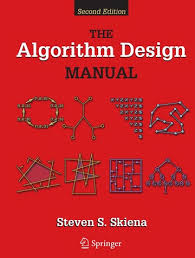
10 free textbooks from MIT, Stanford, and Berkeley that you can download legally right now.
→
Introduction to Linear Algebra — Gilbert Strang (MIT)
This is textbook for one of the most-watched math courses ever. The course has about 20 million views on MIT OpenCourseWare. A lot of machine learning engineers learned these ideas from one calm, clear professor.
https://t.co/21ZEyYt0Q8
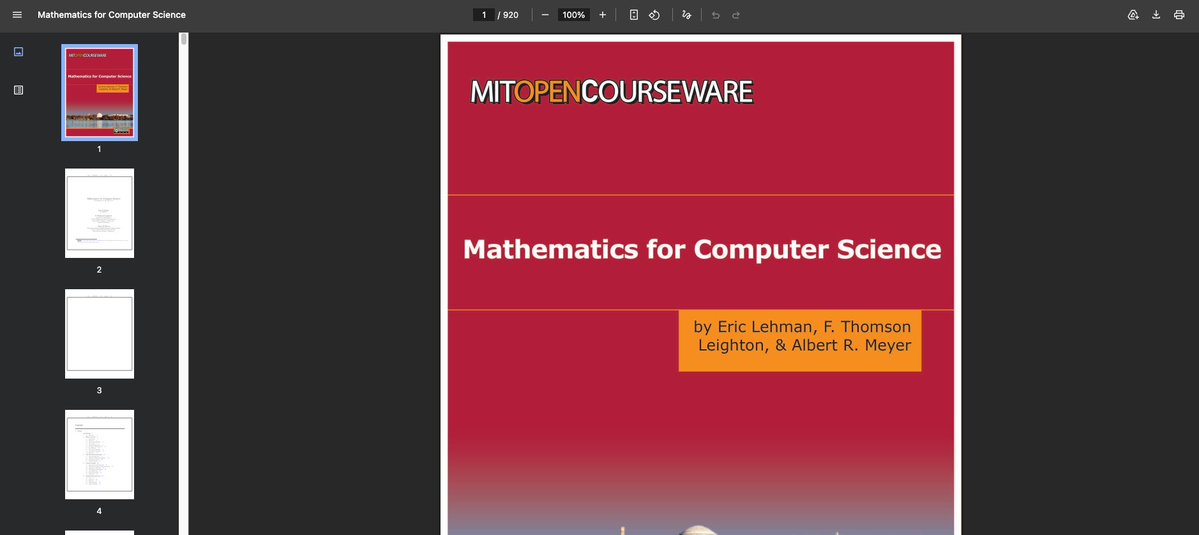
→ Mathematics for Computer Science (MIT 6.042)
This course covers proofs, discrete math, and probability. These topics are a big part of what computer science is built on, but a lot of undergrads don’t hear about them until later.
https://t.co/n6iYa2nTxZ
→ Convex Optimization - Stephen Boyd, Stanford
This is used in almost every serious machine learning and control systems class in the world. Cambridge University Press let Boyd keep it free on his own website.
web. stanford. edu/~boyd/cvxbook/bv_cvxbook.pdf
→ CS229 Machine Learning Notes - Andrew Ng, Stanford
Not the Coursera version. The actual Stanford graduate course notes. Dense, precise, and the closest thing to a grad school education you can download in one PDF.
https://t.co/lMbgoQpuzB
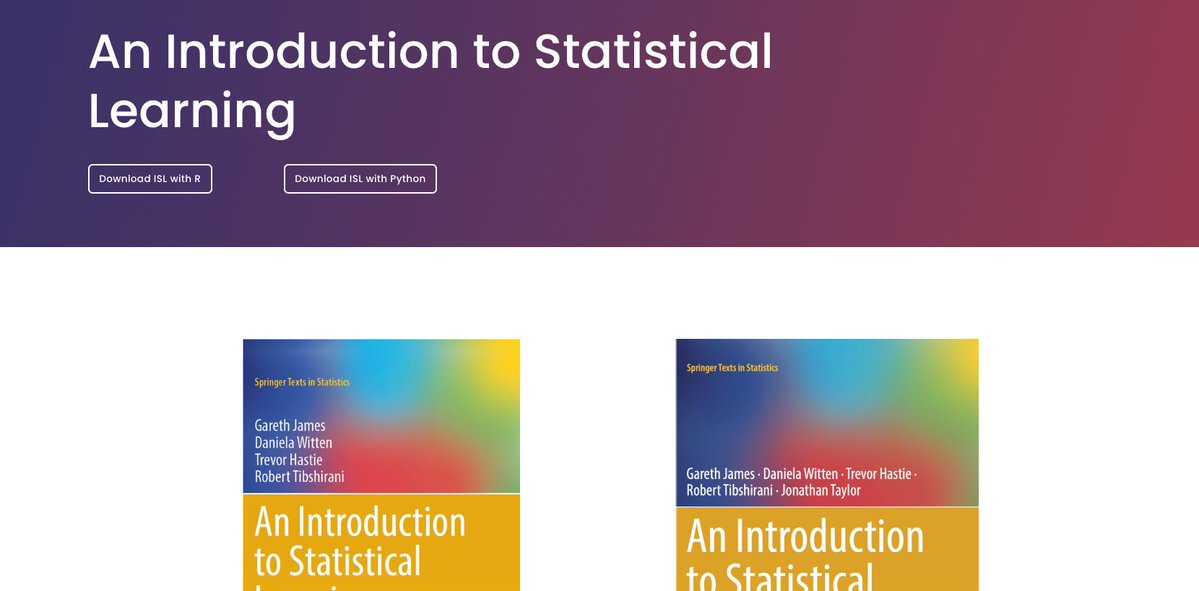
→ An Introduction to Statistical Learning - Stanford / USC
The book three statisticians from Stanford and USC made free because they wanted everyone to learn it. 290,000 people have taken the companion course on edX.
https://t.co/pzr1qxZwLR
→ Computational and Inferential Thinking - Berkeley Data 8
The textbook behind Berkeley's most popular course. Data science from scratch, built to be understood without a math degree first.
https://t.co/SJKJHKwOUj
→ Dive into Deep Learning - Berkeley / Amazon
Jensen Huang called it "excellent." 500 universities across 70 countries use it. Every concept runs as live code directly in the browser.
https://t.co/AxpcyRsVFw
→ Introduction to Probability - Blitzstein & Hwang, Harvard
The official textbook of Harvard's Stat 110, which has been called the best probability course ever put on YouTube. Free second edition online.
https://t.co/T8mDwKLPvp
→ The Elements of Statistical Learning - Hastie, Tibshirani, Friedman, Stanford
This is the grad-school version of ISLR. Springer offers it for free as a PDF. A lot of researchers download it and keep it saved on their computer.
https://t.co/8ApXy767id
→ MIT OCW Online Textbooks Index - 45+ books across every department
One page with every free MIT textbook, organized by subject. You can find books on algorithms, physics, economics, and engineering. All of them are open access.
https://t.co/qafq5b2tsa
Save this before someone makes them take it down.
(They won't. But save it anyway.)
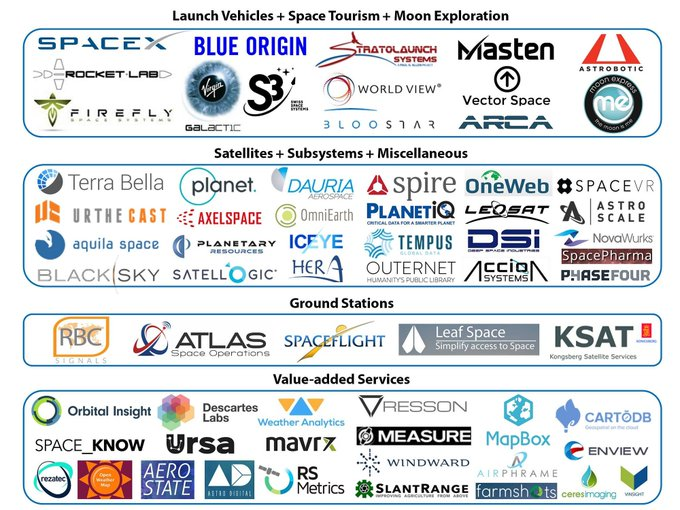
10 NAMES TO WATCH IN THE SPACE ECONOMY
1. $RKLB becoming the second pillar of U.S. launch and space systems infrastructure with an $805M firm fixed-price Tranche 3 Tracking Layer award validating it as a trusted defense prime while Electron cadence, rising ASPs & vertically integrated manufacturing drive durable margins & a funded path to Neutron.
2. $ASTS building the D2D comms layer that turns space into a carrier-grade broadband network with BlueBird 6 proving the physics of tower-in-the-sky connectivity & SHIELD selection pulling AST into the Golden Dome stack as a long-duration, recurring wholesale revenue platform for global operators.
3. $PL selling recurring Earth-imagery and analytics to defense & intelligence customers with ~60% of revenue from sovereign contracts while scaling Satellite Services where governments fund dedicated constellations that also expand Planet’s proprietary data archive.
4. $BKSY selling high-cadence defense ISR subscriptions from its Gen-3 constellation that's differentiated by sub-30-day commissioning & low-latency imagery with ~25% long-term growth potential but burning ~$15M per quarter as it scales capacity.
5. $RDW supplying space-grade hardware & autonomous drones to U.S. + European defense programs with 2026 growth hinging on converting a $350M+ backlog while burning ~$20M per month in cash.
6. $FLY running a small-lift launch platform (Alpha) plus Blue Ghost lunar delivery with upside dependent on stabilizing launch cadence & converting NASA/DoD backlog into recurring missions.
7. $SPIR selling subscription space-intelligence data from its LEO constellation targeting >30% growth in 2026 off government backlog.
8. $SPCE is still pre-commercial suborbital spaceflight bet with commercialization pushed to late 2026 with an unproven revenue model while burning ~$100M per quarter.
9. $FJET developing an air-launched microsatellite platform using supersonic F-104 jets but still pre-revenue with no proven launch demand, competing against Electron-class incumbents.
10. $GSAT repositioning its L-band satellite network as a space-based private-network backbone for IoT, robotics & defense comms with XCOM RAN monetizing spectrum & orbit through industrial deployments as capex rolls off.
Nuclear Power: The Next Energy Catalyst for AI
Key Companies to Watch Across the Nuclear Value Chain:
Upstream (Materials & Fuel):
•Uranium mining: $CCJ, $UEC, $UUUU, $DNN, $NXE
•Nuclear fuel processing: $LEU
Midstream (Design, R&D, Construction):
$SMR – NuScale Power: SMR pressurized water reactors, commercialization-ready
$OKLO – Oklo Inc: Generation IV fast reactors, recent defense contracts
$NNE – NANO Nuclear Energy: Generation IV thermal reactors, “walk-away safe” design
$BWXT – BWX Technologies: Reactor components & nuclear tech for gov’t and commercial sectors
Downstream (Operations & Waste Management):
•Utilities: $CEG, $VST, $AEP, $SO, $EXC, $DUK, $ETR, $PEG
•Equipment & services: $GEV, $ETN, $HON, $EMR, $GHM
Nuclear energy isn’t just about power—it’s becoming a strategic backbone for AI and technology growth.
With COP28 calling to triple nuclear capacity by 2050, nuclear energy is entering a new growth cycle, poised to power AI, data centers, and the global push for low-carbon, stable energy.
Market Wizard Linda Reschke's 12 Technical Trading Rules: @SJosephBurns
1. Buy the first pullback after a new high. Sell the first rally after a new low.
2. Afternoon strength or weakness should have follow through the next day.
3. The best trading reversals occur in the morning, not the afternoon.
4. The larger the market gaps, the greater the odds of continuation and a trend.
5. The way the market trades around the previous day’s high or low is a good indicator of the market’s technical strength or weakness.
6. The previous day’s high and low are two very important “pivot” points, for this was the definitive point where buyers or sellers came in the day before. Look for the market to either test and reverse off these points, or push through and show signs of continuation.
7. The last hour often tells the truth about how strong a trend truly is. “Smart” money shows their hand in the last hour, continuing to mark positions in their favor. As long as a market is having consecutive strong closes, look for up-trend to continue. The up trend is most likely to end when there is a morning rally first, followed by a weak close.
8. High volume on the close implies continuity the next morning in the direction of the last half-hour. In a strongly trending market, look for resumption of the trend in the last hour.
9. The first hour’s range establishes the framework for the rest of the trading day.
10. A greater percentage of the day’s range occurs in the first hour then was the case in the past, and thus it has become increasingly important to trade aggressively if there are early signs of a strong trend for the day.
11. There are four basic principles of price behavior which have held up over time. Confidence that a type of price action is a true principle is what allows a trader to develop a systematic approach.
The following four principles can be modeled and quantified and hold true for all time frames, all markets. The majority of patterns or systems that have a demonstrable edge are based on one of these four enduring principles of price behavior.
Charles Dow was one of the first to touch on them in his writings. Principle One:
A Trend Has a Higher Probability of Continuation than Reversal Principle Two:
Momentum Precedes Price Principle Three:
Trends End in a Climax Principle Four:
The Market Alternates between Range Expansion and Range Contraction!
12. In the world of money, which is a world shaped by human behavior, nobody has the foggiest notion of what will happen in the future. Mark that word –
Nobody! Thus the successful trader does not base moves on what supposedly will happen but reacts instead to what does happen.
SWING EMOTIONAL TRADING:
1. Exiting Too Early (Fear of Losing Profits)
Symptom: You close a trade at a small profit, then the stock flies 20% higher.
Consequence: You miss the real move—swing trading is about catching big swings, not scalping.
2. Cutting Winners, Holding Losers (Fear & Hope)
Fear: You panic and sell winners fast.
Hope: You "pray" that your losing trade will turn around.
Consequence: Completely reverses risk/reward—small wins, big losses.
3. Revenge Trading
After a loss, you jump into another trade instantly to “get it back.”
Consequence: You’re trading anger, not a setup. Usually leads to bigger losses.
4. Overtrading Due to Boredom or FOMO
You trade random setups just because others are talking about them on Twitter/Discord.
Consequence: You burn capital, break your edge, and ruin confidence.
5. Lack of Patience to Let Setups Play Out
You exit trades too soon or enter too early due to anxiety.
Consequence: Miss the full swing or get shaken out during healthy pullbacks.
6. Changing Strategy Mid-Trade
You entered based on a breakout, but when it pulls back, you suddenly treat it like a long-term hold.
Consequence: No consistency. No accountability.
7. 📉 Ignoring Your Stop Loss (Ego)
You refuse to be wrong, so you move your stop lower or delete it.
Consequence: One bad trade destroys 10 good ones.
8. Burnout and Decision Fatigue
Emotional trading drains your energy. You obsess over charts, miss sleep, overanalyze.
Consequence: Poor decision-making and burnout.
9. Repeating the Same Mistakes
You keep promising, “Next time I’ll follow my plan,” but you don’t.
Consequence: Stagnation. No growth. You lose faith in yourself.
10. Loss of Confidence and Discipline
Emotional trading causes regret. Regret breaks confidence. No confidence = no discipline.
Consequence: You start doubting your system, your skills, and your future.
Final Truth:
Swing trading is a game of delayed gratification. Emotional trading is instant gratification. One builds wealth. One burns it.
Best Stocks by Industry to Invest in the Future
1. Data Center Operators / Neocloud
$IREN | Iren
$CLSK | CleanSpark
$NBIS | Nebius Group
$WULF | TeraWulf
$AMKR | Amkor Technology
$HUT | Hut 8
$VRT | Vertiv Holdings
$CIFR | Cipher Mining
$BITF | Bitfarms
$APLD | Applied Digital
A Thread 🧵
FUTURUM AI FIFTEEN REBALANCE
We just completed the first quarterly rebalance of the Futurum AI Fifteen -- our curated list of non-Mag 7 names we believe are building the next layer of AI infrastructure.
Ranked by our proprietary AIRometer Score -- here are the top 15 👇
This requires mathematical maturity, but every effort invested to read this “classic” is worth your time and devotion. It’s a “Socratic dialogue between guru & disciples.” This book, Tarasov (and Arnold) shaped my pedagogical philosophy, leading to the creation of AMMOC.
See ToC.
🚨A 200-year-old farmer chart peaks in 2026
The 18-year real estate cycle shows the same pattern
2026 will be the BIGGEST super cycle in history...
Here's what's coming and list of alts I'm buying👇🧵











![KirkDBorne's tweet photo. [700-page PDF e-Book] #Algorithms for Decision-Making — brilliant and comprehensive eBook from MIT: https://t.co/cZde89YnmQ https://t.co/I7IPjHC8lD](https://pbs.twimg.com/media/G4sTFVbWYAA_lyg.jpg)


![KirkDBorne's tweet photo. [700-page PDF e-Book] #Algorithms for Decision-Making — brilliant and comprehensive eBook from MIT: https://t.co/cZde89XPxi https://t.co/77NoJ0TK61](https://pbs.twimg.com/media/GzAnlMGXAAAZW_o.jpg)