Uncertain times ahead for the markets?
Glad I stopped trying to guess direction. Long/short pair trading = market-neutral. Volatility is opportunity.
Screening 2,000 US stocks for the best pairs. https://t.co/RleJugP3nH
Each week Qatar’s massive LNG plant remains shut, the world loses enough energy to power Sydney’s homes for an entire year 🇶��� ⚠️
Ras Laffan was damaged by an Iranian attack. And the length of its restart & repair timeline will have a huge impact on the global gas market 🧵
South Pars is burning.
It is the single largest natural gas field on earth. It supplies 70% of Iran's gas. It shares a reservoir with Qatar — which produces 20% of the world's LNG.
Iran has just threatened to strike every Gulf energy facility in retaliation.
This is not an energy story. It is a restructuring of the world.
This is insane.
Ignore the internet bubble. Ignore housing. Ignore crypto. Ignore AI.
If you had simply invested 10k at the bottom of the last copper cycle in a major copper producer, it would have grown to 3.2 million USD over 28 years.
That’s ~23% CAGR.
You would have outperformed nearly everyone in that period... including Warren Buffett.
Middle East production is being shut down
No one is discussing the restart risk
Oil fields don’t just “snap back.”
Some will recover quickly, others won’t
The most likely overall outcome is a greater, longer-lasting supply loss than markets assume.
#OilMarkets #EnergyCrisis #ReservoirEngineering
📊 Mining Sector Correction Study: Gold, Silver & Copper
I analyzed the recent correction across more than 700 mining companies in gold, silver and copper. The pattern that emerges is surprisingly clear: the more speculative the segment, the deeper the drawdown.
Over the past few days I published several datasets covering:
• 169 gold & silver miners
• 82 copper miners
• 484 junior gold & silver companies
• 193 junior copper companies
Looking at these groups together reveals a very clear structure within the mining sector.
Gold miners experienced the most moderate corrections.
Silver miners, which typically carry higher volatility, saw deeper declines.
Copper miners, much more tied to the industrial and economic cycle, corrected even more sharply.
And once junior companies are included, the pattern becomes even clearer: capital tends to leave the most speculative segments first when uncertainty rises.
In other words, the correction has followed almost perfectly the beta structure of the mining sector:
Gold → Silver → Copper
Majors → Producers → Juniors
However, another interesting dynamic appears.
Even during this correction there are companies that held up much better than the rest, and some that even managed to rise.
In commodity cycles, these divergences can be very revealing, as they often indicate where capital may start concentrating before the sector’s next move.
#Gold #Silver #Copper #MiningStocks #Commodities ⛏️📊
@zerohedge Hedging with pairs makes a lot of sense right now. Geopolitical risk rising while the market drifts. That’s exactly the environment where long/short pair trades come into their own. Market neutral by design.
@quantscience_@pyquantnews I built and use https://t.co/RleJugP3nH for exactly this. ~2M pair combinations across 2,000 US stocks, screened for cointegration, correlation and z-score signals. Web-based, no coding required.
@t0mbfx UK here, trading US stocks, and the timezone really helps. No crack-of-dawn pre-market stress. My pairs system flags candidates overnight, I review before my commute, manage exits early evening. 1-2 trades a day. Very manageable.
Too simplistic. A retirement plan needs to consider inflation effect on returns and required income. It should model the occasional market shock on these too. If you’re reinvested in riskier funds, a 50% drop is possible, which then takes +100% just to get back to where you were. Diversification with non-correlated assets should help mitigate the returns side risk.
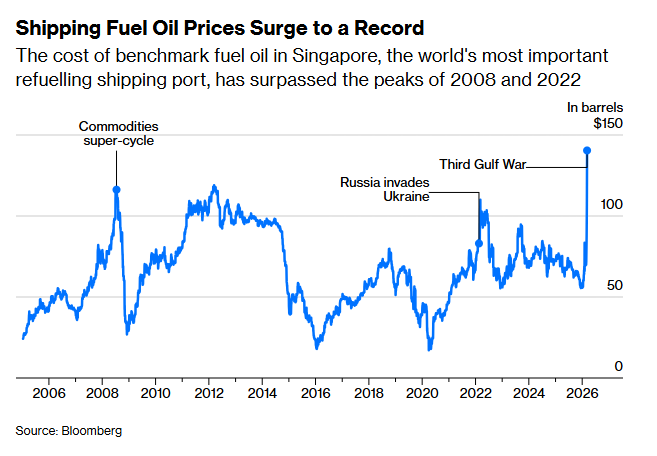
COLUMN: While the price of Brent and WTI crudes remain well below their record high, the cost of fuel oil has surged above the 2022 and 2008 peaks.
The surge is a big problem for the workhorse of globalisation: the container ship.
My @Opinion column: https://t.co/fht4fu3gMf
Copper prices will have to rise.
- Supply has grown at ~2.3% CAGR since 2010
- It is now peaking and expected to decline in the coming years
- Demand has historically grown at ~2%
- With AI and military spending, it is now closer to ~3%
The copper industry is facing a scenario of rising demand and falling supply.
Higher prices will be required to incentivize new production. Even if we start exploring for new deposits today, it would take ~20 years for them to reach production.
That is why I remain bullish on copper for the long term.
Proven & probable. Basically the best estimate of what has been discovered and is viable to extract with current technology and economic conditions. The rest of that 7.5 includes volumes that are impossible or uneconomic, and a guess about discoveries that haven’t even been made yet.
@systematicls Interesting, and I see chart states intraday specifically. Curious whether you see same decay showing up at daily or weekly horizons. HFT doesn’t touch your trade if it takes 2 weeks to play out.
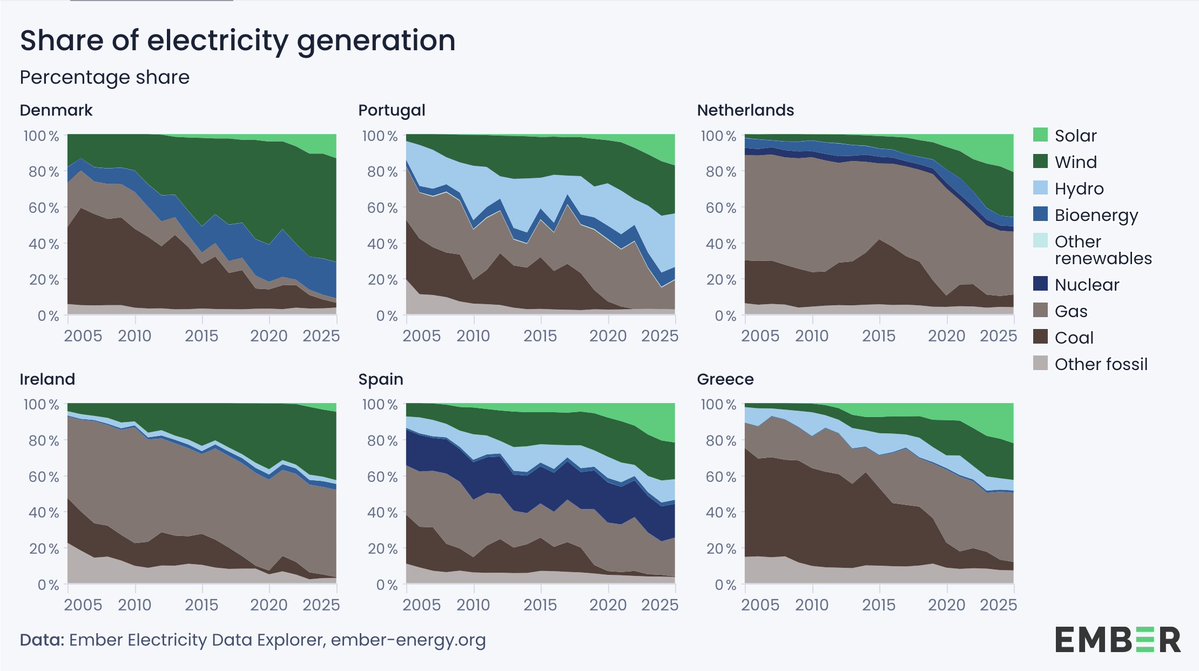
We're having the second energy price crisis in five years caused by volatile global fossil fuel markets.
Now imagine how bad the crisis would be in the EU if the electricity mix still looked like it did 20 years ago.
Electricity mix fossil share 2005 → 2025
🇩🇰Denmark: 73% → 9%
🇵🇹Portugal: 82% → 19%
🇳🇱Netherlands: 88% → 46%
🇮🇪Ireland: 93% → 52%
🇪🇸Spain: 66% → 25%
🇬🇷Greece: 89% → 50%
Domestically produced clean energy → energy independence