I outperform most stock traders by simply doing nothing.
#MBI#EM has given me a great deal of peace in trading.
Influencers argue that you can trade every condition, and I agree, but what is the point of trading 100% of the time when 80%+ of your money comes from 20-30% of the time in the market?
On top of that, since I avoid most of the bad conditions, mentally, I am almost always at my peak.
A trader who trades 100% of the time has a higher chance of missing out on good days because of mental exhaustion and not following their trading plans.
Most traders miss this.
I want to make something similar for nasdaq to just avoid the chop days, though it is less likely due to intraday volatility.
If there is one HOLY GRAIL in trading, then it is understanding the market condition and acting accordingly.
A prop firm is a company that gives traders capital to trade instead of using their own money. You pass a challenge, follow strict rules, and earn a share of the profits while the firm takes a small percentage.
Trade with discipline, manage risk, and stay consistent to grow with funded capital. It’s an opportunity to scale without risking your own money.
#PropFirm #ForexTrading #FundedTrader #TradingOpportunity #RiskManagement #Discipline #Consistency #TraderJourney
India is about to challenge the China-Korea-Japan shipbuilding cartel that has dominated for decades.
Most investors will only wake up after the structural rerating has already begun.
Research Thesis: India's Shipbuilding Structural Multi-Year Opportunity
As a SEBI-registered research analyst, my core thesis is straightforward:
India has moved from negligible global share (<0.1%) to a credible policy-driven contender for Top-10 position by 2030 and Top-5 by 2047. The catalyst is not cyclical demand - it is deliberate, large-scale capital allocation combined with strategic intent under Maritime India Vision 2030 and Amrit Kaal Vision 2047.
Key Policy Framework (Guidelines notified Dec 2025)
- Total dedicated outlay: ₹44,700 Cr across two flagship schemes
- Shipbuilding Financial Assistance Scheme (₹24,736 Cr) -valid till March 2036: graded financial incentives (typically 15-25% of project cost) to offset cost disadvantages vs global yards
- Shipbuilding Development Scheme (₹19,989 Cr) - greenfield clusters + brownfield modernization & shared infrastructure
These schemes are designed to crowd-in private and public investment. Early estimates point to ~₹96,000 Cr of projects potentially getting triggered under the incentive umbrella.
Why This Is Structural, Not Cyclical
1. Demand Visibility - Sustained Indian Navy modernization + indigenization push (Atmanirbhar Bharat) provides multi-year order pipeline.
2. Supply-Side Reset - New clusters + modernization address the historical capacity and technology gap.
3. Global Tailwind - Supply-chain diversification away from single-country concentration creates export runway for Indian yards.
4. Capital Intensity + Barriers - Once capacity and execution credibility are established, the moat widens for listed players.
Primary Listed Beneficiaries (Direct Play)
- Mazagon Dock Shipbuilders (MDL)
- Cochin Shipyard (CSL)
- Garden Reach Shipbuilders & Engineers (GRSE)
These three public-sector yards combine strong order-book visibility, execution track record on complex vessels (including aircraft carriers), and direct access to both defence and potential commercial/export orders. They are best positioned to capture the bulk of the policy-driven capex cycle.
Investment Implications
This is a classic “policy meets execution” theme. The biggest alpha in such multi-year industrial shifts usually accrues to those who position early before order inflows become obvious and valuations fully reflect the new earnings trajectory.
Risks to monitor (standard research caveats): execution delays on clusters, global competition intensity, working-capital intensity of the business, and any slowdown in defence capex allocation.
Bottom Line
India shipbuilding has graduated from “aspirational story” to “funded structural theme” with clear timelines and capital backing. The window to build conviction before broader market recognition is still open.
This is not a short-term trade. It is a multi-year compounding opportunity in a sector that was written off for decades.
What part of this thesis resonates most with you?
Or which risk do you see as the biggest overhang?
Drop your thoughts below.
(This is for informational purposes only and does not constitute investment advice. Always do your own due diligence. Past performance is not indicative of future results.)
Like & bookmark if this research-style breakdown added value. Follow for more such structured theses on emerging India themes.
This is one lesson that truly changed my life. Wherever I stand today, I attribute a large part of it to self-leadership.
I first came across this idea in 2018, when my mentor told me to become "arrogant." The word itself wasn't the right one. What he actually meant was to develop self-leadership.
That advice became a turning point.
In the beginning, it feels abstract. You don't know how to apply it or what to do with it. But as you gain experience, it gradually evolves into a mental model that helps you think independently, reason from first principles, and free yourself from authority bias.
A person who operates primarily through authority bias can never surpass the person they consider an authority. They will always remain confined within someone else's thinking.
The most fascinating part of human evolution is that our potential is far greater than any individual authority. Human progress has always come from people who questioned accepted wisdom, thought independently, and pushed beyond the limits that others believed existed.
There is no reason to confine our thinking within mental barriers that we impose on ourselves simply because we are unwilling to question authority.
If you want to be successful in the speculation business, don't be a follower; be a leader.
After training thousands of profitable traders over the years, one thing that separates those who succeed from those who do not is "self-leadership"
If you have that, you can make it work with any setup. If you don't have that, nothing works.
Work on your self-leadership.
This is Pradeep Bonde.
For nearly 20 years he's quietly run one of the most respected trading blogs online, under the name Stockbee.
No tips. No hype. No tall claims.
More than one of today's most famous momentum traders traces their foundation back to him.
Here's his philosophy 🧵
The Hammer Strategy
Unlike most trading strategies, the hammer is the one which produces immediate and measurable results.
1. The Setup
The setup is simple. Just wait for one of the following signals:
- Your stop-loss gets hit to the exact paisa before the stock rallies 10%.
- The stock you sold yesterday is up 5%.
- The stock you bought yesterday is down 5%.
- Another trader posts “Easy money” while you’re down 20%.
- You’ve refreshed your portfolio 10 times in 2 minutes and the numbers are somehow still red.
2. The Execution
Once multiple signals align, the trade is ready. Now follow the process:
- Stand up & get a tight grip on the hammer.
- Ignore the fact that the source of the problem is you
- Strike the monitor. Aim for the largest red candle visible. If no red candles are visible, zoom out.
The satisfying crack is the sound of accountability being successfully redirected.
3. Post-Hammer Protocol (The Recovery Phase)
- Order replacement equipment immediately. Till then, trade on your phone while the new monitor ships (bonus points if you smash the phone too).
- Repeat as needed until either your account hits zero or you run out of hammers.
4. Advanced Hammer Strategies
Join my one-on-one mentorship to learn this strategy with hands on training.
Every trader, no matter how good, has one or two flaws.
It is natural to have flaws, you are a human not a machine.
What matters most is how well you are able to control that flaw.
Eg - I am your classic overtrader, it is also the reason why I catch almost all trending moves on Nasdaq but when it chops I get killed, the identification and avoidance of chop is me controlling my flaw.
I will use this to share a framework for capital building and subsequent wealth creation for those who are new or just starting out:
1. When you have a small account (<50L), focus on Velocity and Hybrid trades while keeping the money in your portfolio to compound. Save every extra rupee to build your initial corpus.
If you can refine your skills, take on high risk to grow your portfolio through non-linear progression. Use leverage and any tools that help accelerate growth.
Money puts food on the table—win rates, equity curves, drawdown percentages, and ratios don’t. These will naturally align once you truly understand what you're doing.
2. Once you reach 50L+, use this capital to build your Magnitude + Hybrid trading portfolio. Use Velocity for income, then allocate the proceeds to your Magnitude portfolio to compound and create long-term wealth. With just 5L or 10L in your account, compounding alone won’t be enough to build significant wealth.
I come from a wealthy family with substantial land and assets worth several hundred crores, but I started small—only with what my mother could afford to give me. After my father’s untimely demise, all our assets and businesses were lost, taken over by my uncles. Even today, much of the property is tied up in legal battles—some with family, some with land mafias.
I built myself up with nothing but my mother’s blessings, my own hard work, and the small fund I had. It took time, as I had no mentor to guide me. And if I could rise from that—with no formal education, no degrees, no source of income, debt that wasn’t even ours, no handholding, no godfather, and circumstances beyond what you could imagine in your wildest assumptions—so can you.
Many of you think I’m arrogant. Yes, I am—because I had to step into my father’s shoes far too early. While other children played with toys, I faced my first legal case over a debt where the liability was forced on us, while the asset was taken by my uncle. I survived and rose from a situation where many would have given up entirely. No one handed me a crown—I crowned myself. And I am incredibly proud of it.
Life took a lot, yet it gave a lot, and I believe there’s a bigger purpose behind it all. It won’t go in vain.
Where you start from doesn’t matter. If I could do it, so can you. Believe in yourself. Rise and shine!
Anyone with a functioning brain can trade stocks successfully—so then, why do few succeed on a big level?
Because few are willing to admit one simple truth: you suck!
Your head is full—sucky opinions, sucky assumptions, and “logic” that feels right but produces the wrong results.
As long as your cup is full, there’s no room for anything that actually works.
Empty it!!!
Strip away the ego. Discard everything you think you know.
Then find someone who’s already done it—at a high level—and shut up long enough to learn.
And finally, the hardest part: commit.
Commit to a strategy. Commit to your coach. Commit to the process. Commit to the belief that you can do it.
No dabbling. No second-guessing. No halfway effort.
Because success in this game doesn’t come from intelligence—it comes from discipline, humility, and coachability.
And most people fail because they lack all three.
You don't know shit! If you did, you would already be worth tens of millions of dollars. But I'm here to tell you that you CAN do it. Because I did. Anyone who tells you can't, never did it themselves. That's the final peace of the puzzle. Stop listening to losers and self proclaimed gurus. If they are so smart and they know how to teach you. Why haven't they done it for themselves. Do you really think someone who hasn't made 100 million dollars can teach you how to do it? If you do, then, that's why you'll never achieve it.
Nobody warns you like this. “Price doesn’t matter” is the biggest red flag in markets.
Save this before the next bubble pulls you in.
Hard truth on bubbles. 8 minutes. From Howard Marks. MUST BOOKMARK📌.
Nobody talks about this. A free 1-hour masterclass from Warren Buffett that quietly beats most paid courses. MUST BOOKMARK📌
Watch this before your next investment decision.
Leadership + Investing breakdown. 1+ hour. Real-world wisdom. Must Watch.
The market doesn’t reward effort. It rewards clarity.
Most people stay average because they copy noise.
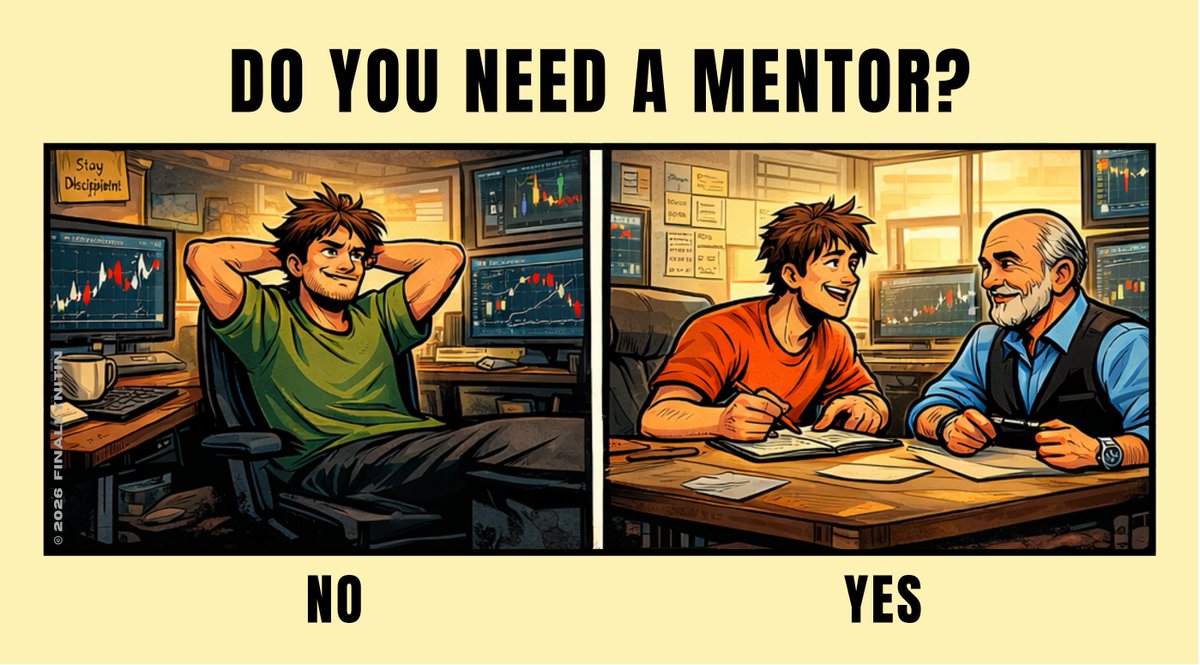
First, understand this clearly.
There are two types of people:
1. People with a strong will & independent thought process, and
2. People who thrive on community & shared inspiration
The first kind of people are those who, if at all, learn from their own mistakes, and no matter how hard someone tries, they cannot understand. They are poor students, but probably good teachers.
The second kind are those who learn through connection, by absorbing wisdom from others, growing through collaboration, and refining their ideas in the collective. They can always shorten their learning curve with the guidance of others.
1. People who don't need mentorships
Since I'm the first kind, here is some gyan for traders who might be of the same orientation:
⦿ Don't ever attend any mentorships or courses (not even mine, if I launch one some day, LOL). After being an off-and-on part of multiple such communities, all I can say is if you can learn even one or two concepts from another trader (‘mentor’), consider your time well spent.
⦿ Try to stay away from trading groups & webinars, as you might get influenced and might adopt borrowed convictions, which can consume your time and further lengthen your learning curve.
⦿ Listen to what your mind/heart says, and follow its direction. You are your best teacher, & no one but you can lead yourself to the path of clarity and conviction.
2. People who need mentorships
For the second kind of people, congratulations, first of all. You have a relatively less tough trading journey ahead. You just need a mentor who suits your trading personality.
I define a person as a 'mentor' if, and only if, the time & money you spend on him leads to the shortening of your learning curve.
Based on my personal experience at various points of time during my trading journey, here are some genuine people that I think might be worth your time, as per the trading stage you are in:
Beginner traders
You need to be satisfied with becoming a profitable trader. Your first year in trading is best spent in this stage.
⦿ Milind Upasani (@Milind4profits) (SEBI Registered RA) - easy approach to the markets with dashboards & scanners. Will largely train your mind to follow the alerts & not take random decisions.
⦿ Rohit Musale (https://t.co/u7MWGGXMzX) (SEBI Registered RA) - identifying base formation in stage 2 stocks & buying breakouts. You learn a lot about price action & rating bases into healthy or faulty.
Intermediate traders
Now you're looking to accelerate and competing with your past profitable self, & trying for super-performance.
⦿ Hiren Gabani (@Hirengabani23) - Very simple & down-to-earth person. Swing trading only on conventional structures in stage-2 stocks & under healthy market conditions. Mastery in identifying '5-star' setups. You need to have the patience of sitting out for prolonged periods.
⦿ Manas Arora (@iManasArora) - One of the most respected Indian traders; the OG. Short to medium-term trend-following with a focus on building up size in winning names via razor-sharp execution. Will also trade reversals & oversold bounces. You need to have a lot of discipline to follow his process.
Pro Traders
Nothing but super-performance is your goal. You are now not satisfied by 'ordinary' returns.
⦿ Umang Tiwari (@stocksgeeks) - The walking encyclopedia. Strategy switching (swing, hybrid, intra) as per the market conditions. Multiple setups that are supposed to make money in whatever situation possible. You need to have speed, energy & motivation to be here.
————————————————
Disclaimer:
- I'm not an affiliate of any of the mentioned persons.
- I'm not to be held responsible by any of their past, present or future actions.
- This list is neither exhaustive nor infallible.