When I was a #CIO my #CEO expected me to:
-- Know Financials like the #CFO;
-- Know Products like the #COO;
-- Give investors confidence;
-- Participate in #BOD strategy sessions;
-- Work with auditors on #SOX;
-- Go on sales calls (& close!);
-- Keep al…https://t.co/tpMpFKf7x2
@GetFrostKey That's what worries me!
#ShadowIT is a big spreadsheet with complex macros or a SaaS app bought on a local manager's card.
Not good, but generally not too dangerous.
#ShadowAI, absent guardrails established by #CIO (& they're largely absent so far), can be devastating!
A4. I sometimes wish I worked with the world's most advanced firms, but the reality is that in 2030 most firms will still be laden with #TechnicalDebt, #ShadowIT, poor IT/biz alignment, lax governance.
Thank goodness, because that's how a #TurnaroundCIO makes a living
#CIOchat
#CIOChat Q4: Imagine it’s 2030. Will we still talk about digital transformation at all? Or only reimagined outcomes, new biz models, and strategic capabilities? (“NewCos” I’ve heard them called.)
What language and mental models might replace our the defining concept of DT?
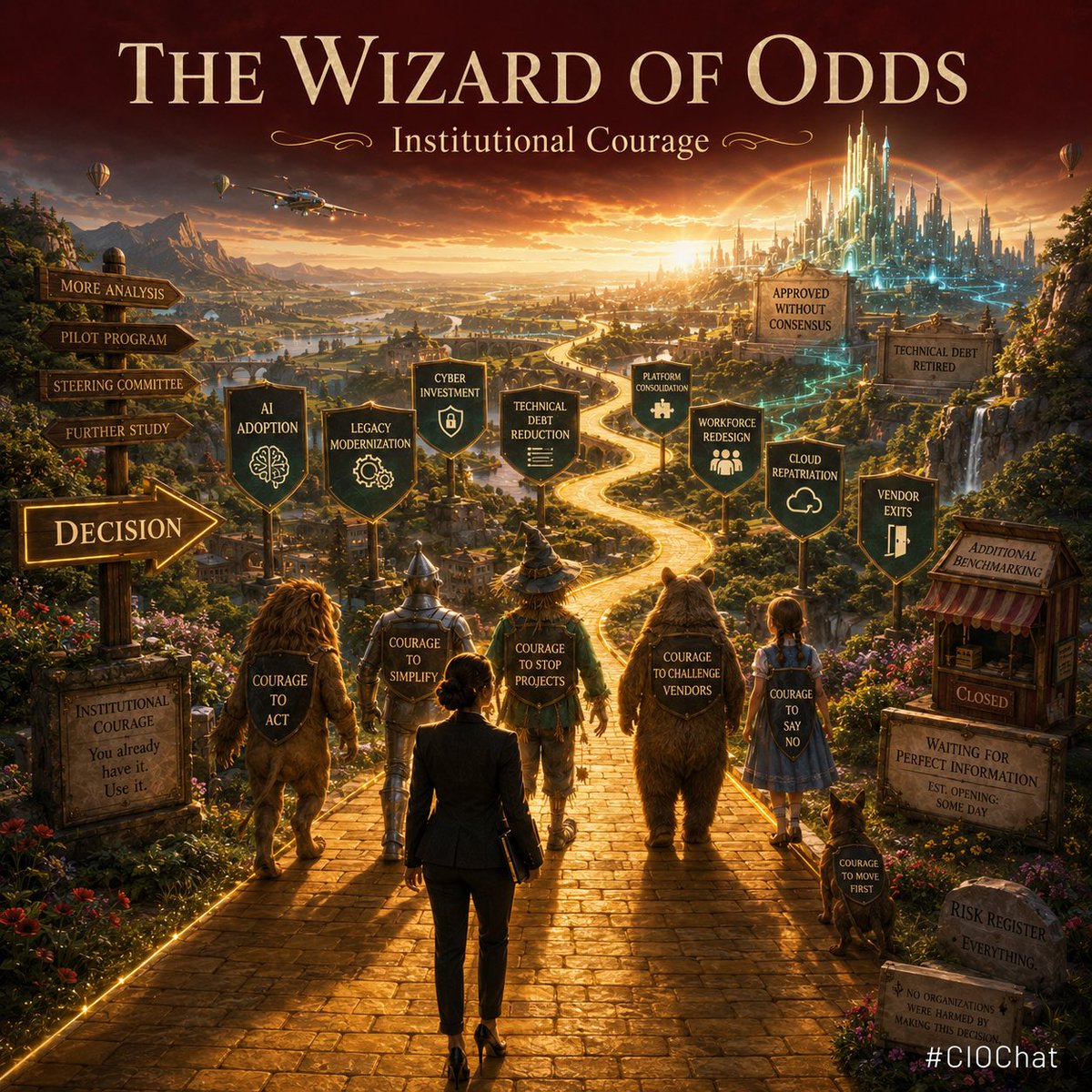
#CIOChat Great chat today with lots of familiar faces. Join us at 2pm ET next Thursday. Topic: Institutional Courage
Hope you enjoy our movie tie-ins to intro next week’s topic.
Please suggest topics and invite your IT colleagues. Every Thursday at 2pm ET.
#BoDs shouldn't be telling management "how." (Noses in, fingers out). But more than ever, Boards should understand enough tech to drive strategic disruption--that might just need some novel technology from an astute #CIO.
#CIOchat
@waynesadin Very interesting, Wayne. The “how” of DT is coming second at last. “What” seems to be the priority. I do see boards are demanding AI transformation to beat their peers, but little these days on “how.” #CIOChat
A3. I agree that 'transformation' has gone from episodic to continuous as the world moves faster and chaos increases.
Funding model = tighter biz alignment
Governance = adaptive rather than static
Architecture = more AI than ever (which means more 'data' than ever)
#CIOchat
#CIOChat Q3: For many CIOs, transformation is no longer a standalone program but a permanent operating condition they must foster + oversee.
Are you evolving funding models, governance, architecture, and operating models for continuous vs. episodic change? If so, how?
A2. #DX is still about changing the way we do business, whether it's using #AI or RPG on an AS/400 :)
AI definitely gives us better tools to transform (+ better tools to optimize).
When I talk to a #BoD "Digital Transformation Committee," I talk about new ways to operate: revenue streams, customer experiences, etc. Tech 'per se' is secondary.
#CIOchat
#CIOChat Q2: Has Digital Transformation really just evolved into mostly AI Transformation. Or is AI part of a larger journey to reinvent the org?
How are your CIO priorities shifting among AI, cyber, resilience, productivity, growth as the latest transformation agenda emerges?
#CIOChat Q1: With global DX spend approaching $4T, many CIOs now ask:
If virtually every initiative is digital today, does “digital transformation” still mean anything?
Has it become business as usual and if so, what replaces it?
A1: Agree it has definitely lost its original meaning & as we tend to say it should be Business Transformation anyway, supported by technology.
#CIOChat
A1. #DigitalTransformation still means changing the way you do business with the help of technology. It's distinct from #DigitalOptimization (using technology to do what you do better, faster, cheaper). They're different regardless of what tech advances happen.
#CIOchat
#CIOChat Q1: With global DX spend approaching $4T, many CIOs now ask:
If virtually every initiative is digital today, does “digital transformation” still mean anything?
Has it become business as usual and if so, what replaces it?
A4. Financial reporting, inventory, sales, regulatory compliance, master data (items, customers, counterparties, sites, employees, etc.) all remain vital.
Which vendors? Those that adapt best (ease of doing business, auditability, etc.)
#ciochat
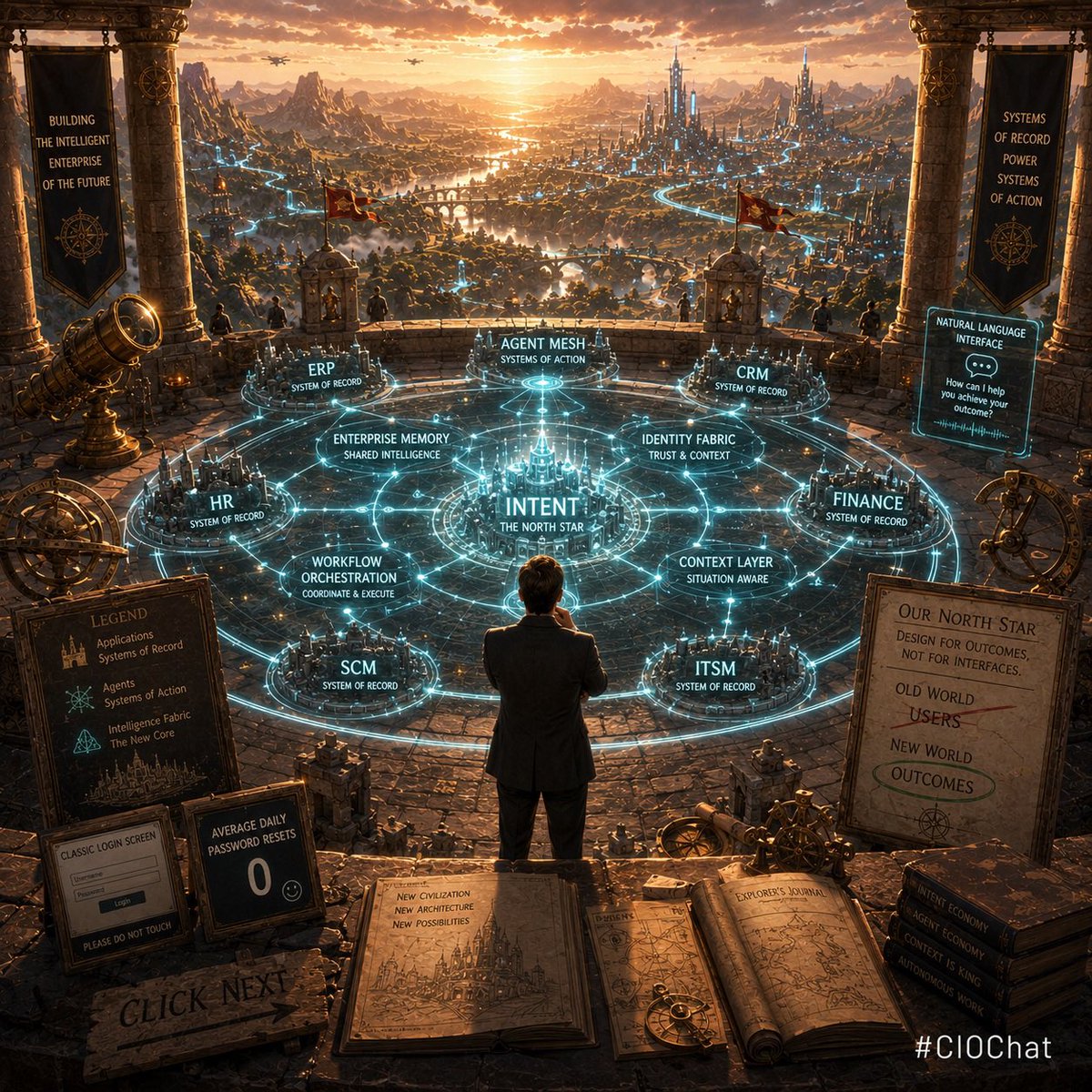
#CIOChat Q4: Imagine your enterprise in 2030. Employees rarely log into apps; agents negotiate, orchestrate, complete work across them most of the time.
Will certain SaaS vendors become indispensable platforms? which become infra, which (would you prefer) disappear entirely?
A3) An actual "control" plane of protective controls is likely to leverage a lot of ideas from zero-trust and default-deny architectures. Observability, etc. will be make-or-break for business, but it can (usually) only tell you what already happened. #TooLate#CIOChat
I'm focused on hiring architects to create high-level connections + "interviewers" to help business SMEs clearly articulate needs. Coders & toolchain techs: not so much.
#ciochat
A2) (biased) I think this may be a new golden age for #EntArch or something close to it. If everybody can suddenly create their own apps, workflows, and integrations cheaply over a weekend with #AI tools; somebody has to keep their eyes on the big picture. #CIOChat
A3. Managers today tell their clerks what they want done, so business intent is distinct from actions (button pushing). Agents are clerks (today), so what's changed?
A deterministic, auditable control plane is needed: #SaaS apps
#ciochat
#CIOChat Q3: If employees increasingly tell AI what outcome they want instead of opening CRM, ERP, HR, or finance apps, what becomes the CIO’s new control plane? Observability platforms, executive IT dashboards, and agents too. Or something else?