@SnassyIcp@dominic_w Yeah, but he's got a point. While for 99% of cases the trade-off he's complaining about is absolutely fine for normal apps, there's still that 1% that needs a better Nakamoto coefficient. Plus, that 1% of cases damages ICP's image among retail investors.
But I can imagine that some apps require to be "electrodes-on-nipples-proof". Do you think nodes shuffling would solve the nakamoto coefficient for $ICP? @Justin_Bons
Good that you pay attention to trade offs. For me that was the strangest point in ICP, that few nodes in known localisations with known owners secure the network. For non critical apps like I'm doing ICP is great, because of interoperability between system parts and security...
ICP is centralized & insecure! Any subnet can be taken down by attacking 4-26 nodes!
@dominic_w correctly points out that there is more to decentralization than node counts
However, a chain is only as strong as its weakest link!
That is the "Nakamoto Coefficient" approach: 🧵
1. The bottom line is that the decentralization of the system cannot be higher than the node count
At least not from the perspective of the Nakamoto Coefficient, as the node count then becomes the lowest possible bar
Your general critique regarding other chains is fair, for example, looking at SOL, its Nakamoto Coefficient is mostly measured as being 19
However, when accounting for stake distribution, the actual number is 12. However, it can never exceed the node count! Or in SOL's case, higher than the stake distribution, because the Nakamoto Coefficient always looks at the lowest possible denominator
That is where my critique against ICP holds water, as it is highly centralized from this perspective. At a similar level to SOL, as a matter of fact. As I am also an advocate for increasing node counts on SOL. I am personally less concerned about stake distributions as they tend to decentralize organically over time
We should be in agreement on this, since as far as I understand, ICP is actually in favor of developing randomized node shuffling, which would absolutely solve this problem in a similar vein to how sharding does as well
2.
This is where we might disagree, as a crypto researcher, it is absolutely possible to find out the "real" numbers
That is exactly what I do professionally. When people attempt to hide things, it tends to leave a big, very noticeable hole. Should it be more accessible to the general public? Absolutely, it should!
However, that does not mean some projects can be fully transparent today
Which is currently not the case for ICP, as we are still waiting for disclosure of the insider addresses from either Dfinity or Arkham Research! That information is still not available to the public today! Despite it being requested by major parties over the years, myself included. A perfect example of the type of bad practices you were talking about
That is an example of a red flag that might be a good reason to keep people away from this project. My critique this time was more focused on the technical aspects, though
In the case of SOL, for example, these numbers are at least transparent & knowable, with no giant holes in the chain analysis like there are in ICP
Furthermore, from this argument's perspective, criticizing another chain also has no bearing on my ICP critique. As ICP & SOL should both improve their decentralization!
3.
To clarify my position some more, I would define decentralization as a measurement of the "distribution of power"
We can agree on this point, as your definition is compatible with mine: "what matters is the number of independent parties involved in consensus"
4.
This is where we radically depart in terms of crypto philosophy & also where you massively depart from what is generally considered to be the basic assumptions most make in blockchain design
That does make ICP very novel, so I will give you that
I fundamentally disagree, the anonymity (permissionlessness) of the system is a key attribute that contributes to the system's security & censorship resistance
A great example of that was the recent OFAC & Tornado Cash sanctions
Most validators complied, as they had to within their legal jurisdiction. However, only because there were a few anonymous validators, those TX's were able to route around the censors
That is a practical example that highlights why this is a critical aspect of a blockchain's design
I would argue that if an ICP subnet is targeted by such regulations, it is far more likely that it will comply, which, from my perspective, would be a bad thing
5.
This is another example of where you radically depart from what is considered general crypto knowledge
Again, that is not a valid argument for why you are wrong, but it is worth noting that, in a crypto context, this is a radical argument. Ofcourse from a traditional perspective, yours is a normal position to take
Your response to my critique is that you are disconnecting the "cost of attack" of stake from the security model, which is, first of all, to agree & bite the bullet. Appreciate that!
While arguing, you replaced it with legal & reputational guarantees
However, that is exactly what fundamentally goes against the crypto ethos
The whole point of crypto is that we rely on crypto economic game theory, not reputation, legal & authoritarian systems
You have basically turned crypto philosophy upside down on its head. It goes against everything we stand for in crypto on the deepest and most fundamental possible level
6.
We clearly must have a different definition of shared security, if a subnet can be taken down by attacking those specific nodes, then security is not shared across all subnets...
Even if some of the verification takes place on the NNS
Again, this can be solved by doing randomized node shuffling! Something I know ICP is working on!
7.
Will again agree with you on the importance of having independent node operators
While completely disagreeing with you that this is not possible on a traditional PoS network. It is the opposite, only on a truly permissionless system at scale can we reach higher levels of decentralization
Effectively placing power in 4-26 operators is always going to be weaker compared to a system with thousands of independent operators
ICP limits the number of operators per subnet. What I am advocating for, "node shuffling," means that each subnet would have the security of all nodes!
So, in my analysis, it would go from 7-40 nodes to 800+ nodes. With a Nakamoto Coefficient closer to 500! (ignoring stake distribution)
Would that not be far better from a decentralization perspective? The great thing about this style of sharding is that it would not lead to any loss in performance either!
The random shuffling just means an attacker cannot target a specific set of nodes; they must target all nodes instead. Clearly, that would be a much harder attack to pull off
8.
Can also agree with you that ETH is not making the right trade-offs in terms of that balancing act
However, ICP takes sacrificing decentralization in the name of efficiency too far. I do not think it is safe; it is dangerous
The trade-off also makes very little sense to me from a design perspective in 2026. As ICP is extremely centralized, yet it still lacks capacity due to how the subnet fragments the usage, breaking up otherwise composable DeFi
This is, ofcourse, the old monolithic vs. modular argument all over again. A debate I have been having since day 1
Conclusion:
The ICP community often claims to be far ahead technologically. From my perspective, that is not the case at all
If anything, ICP is far behind; this is also reflected in the lack of adoption compared to chains like SOL & HYPE
I can respect the novel philosophy; however, the market clear still values decentralization in the traditional sense. Despite all of the shortcomings, you might correctly point out
There are real technological shortcomings, along with serious concerns around the safety of this system, especially if it ever gained serious traction
There are multiple solutions that could absolutely solve the critiques I made here
My motivation for writing this is to set the record straight. Bad design does not bother me, misrepresenting & misleading people around a bad design is where I take issue & spring into action
ICP has a bad design, as it is highly centralized & insecure compared to traditional PoS chains. While we get very little in return in terms of capabilities for that trade-off
However, it would take relatively small changes to make ICP great. That is why I have advocated for ICP to adopt a sharded design closer to what NEAR has. As most of the primitives are already in place to make that happen, it is not a giant leap to go from subnets in a modular design to shards in a monolithic design
Will also praise ICP's governance, as I also did in my original critique, as that might provide the path towards solving these problems
Hope you can all appreciate the role an outside critic can serve for a small cryptocurrency like ICP. The level of toxicity I receive is proportional to the likelihood of positive change from my perspective
So, do not close your minds to change, embrace criticism & do so civilly!
Thank you, Dom, for taking the time to counter my arguments. We might still strongly disagree with each other, but I hope the net result of the discussion can still be a positive influence for ICP as a whole ❤️
As always, I wish the ICP community the best! As I want you to succeed, at the end of the day, we should not care what three-letter acronym pulls us across the finish line! 🔥
https://t.co/s2PtCt0G3i
1/30) ICP has a terrible design: Insecure, low capacity & highly centralized
Worst of all, they are dangerously misleading the public
Despite outlandish claims, ICP can be taken down by attacking a handful of nodes in known data centers!
ICP's modular design is the problem: 🧵
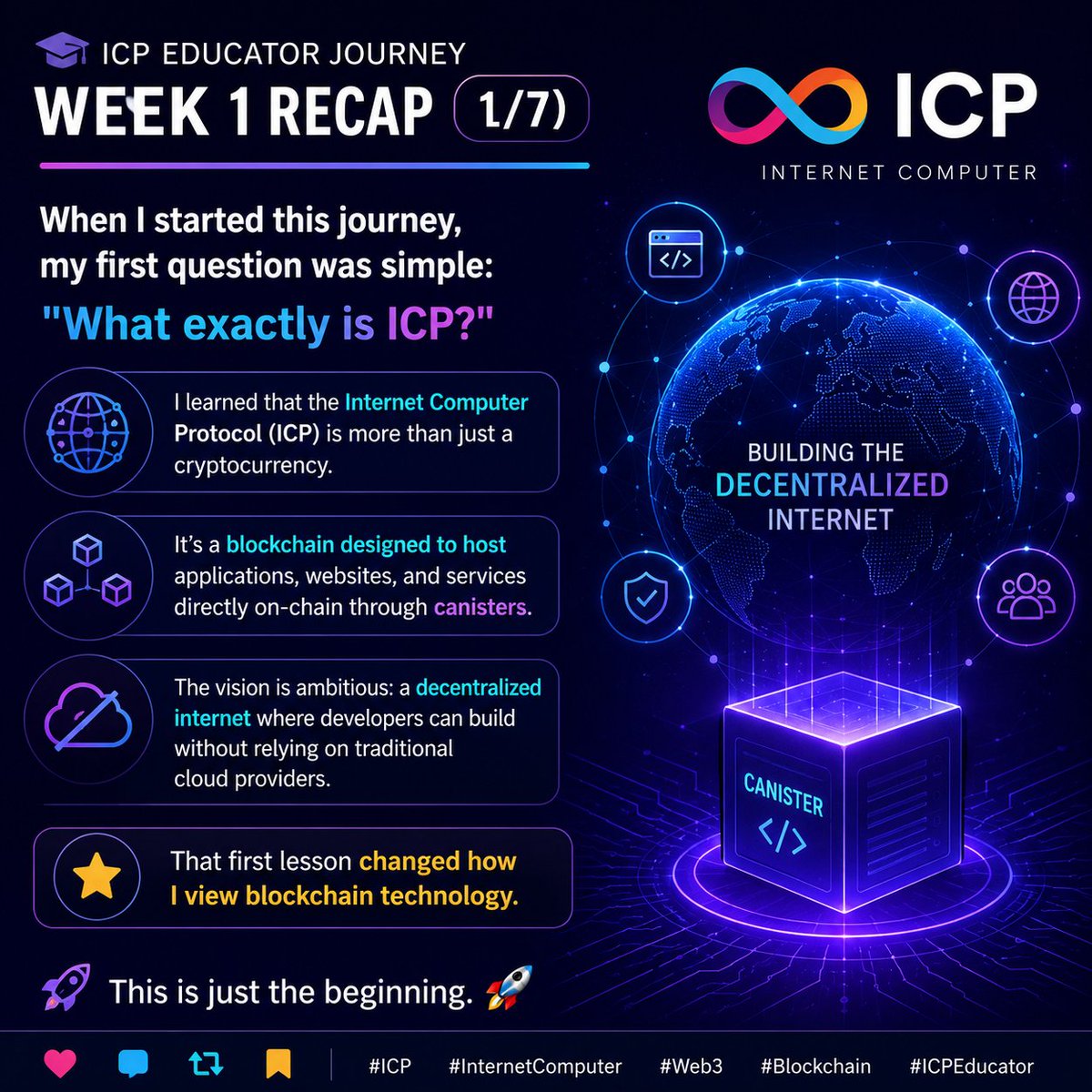
📚 ICP Educator Journey — Week 1 Recap (1/7)
When I started this journey, my first question was simple:
"What exactly is ICP?"
I learned that the Internet Computer Protocol (ICP) is more than just a cryptocurrency. It's a blockchain designed to host applications, websites, and services directly on-chain through canisters.
The vision is ambitious: a decentralized internet where developers can build without relying on traditional cloud providers.
That first lesson changed how I view blockchain technology.
This is just the beginning. 🚀
#ICP #InternetComputer #Web3 #Blockchain #ICPEducator