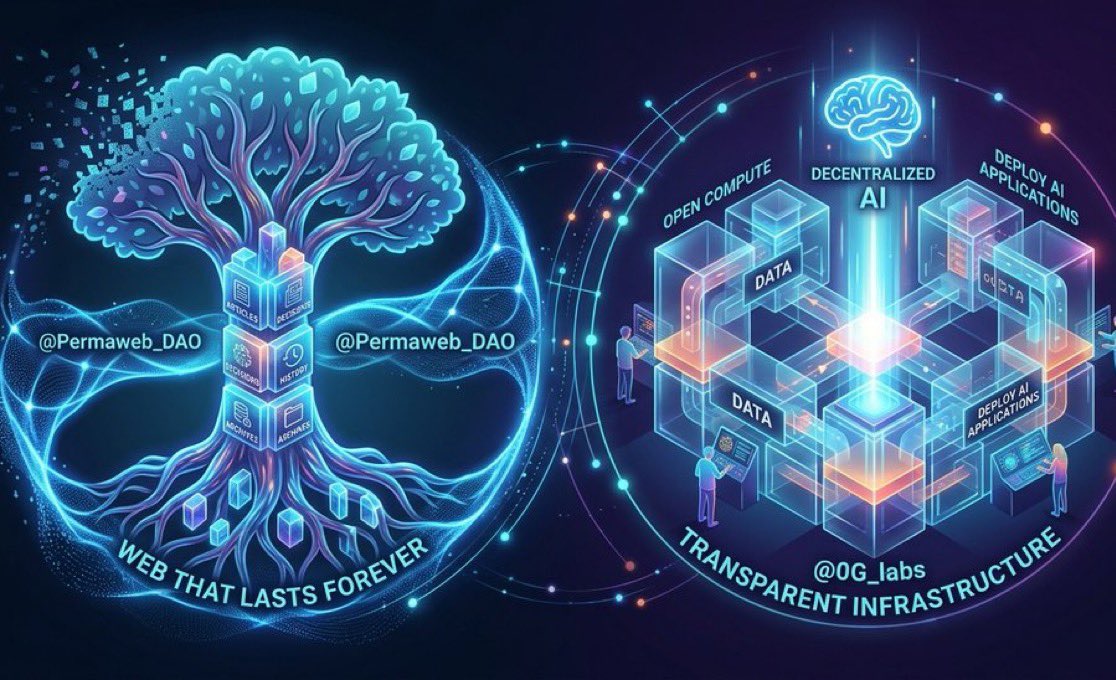
Most people underestimate how much of today’s digital economy is defined by hidden power structures.
Not protocols. Not tokens.
But who controls:
• decision-making
• execution conditions
• capital flow
• information archives
What’s interesting about 0G Labs, LightLink, Dango, and Permacast is that each one quietly redistributes power from centralized actors to protocol layers, but in very different ways.
@0G_labs Labs targets decision power.
Today, AI providers effectively control what is “true” at the output level. Models are opaque, datasets are private, and inference cannot be independently verified. That concentrates power in a few entities. 0G breaks this by making AI reasoning reproducible and verifiable. When anyone can validate how a decision was made, authority shifts from providers to protocols. Intelligence stops being controlled, it becomes auditable.
@LightLinkChain targets execution power.
In most blockchains, power lies with those who can afford to interact, high gas, priority fees, and MEV dynamics skew access. Execution becomes a privilege, not a baseline. By abstracting gas and stabilizing costs, LightLink redistributes access. More participants can act under the same conditions, reducing asymmetry between users.
@dango targets capital power.
Fragmented liquidity creates uneven advantages. Those with better routing, deeper pools, or centralized access extract more value. By concentrating liquidity in a unified order book and enabling margin reuse, Dango levels the playing field. Capital competes in the same arena, with less structural edge given to insiders.
@permacastapp targets information power.
Control over data historically defines influence, what gets stored, what gets deleted, what gets remembered. Centralized platforms act as gatekeepers of history. Permacast removes that control by making content permanent and censorship-resistant. Once published, it becomes part of a shared, immutable record.
So instead of asking what these projects build, look at what they redistribute:
0G → decentralizes decision authority
LightLink → democratizes execution access
Dango → equalizes capital competition
Permacast → neutralizes information control
Power doesn’t disappear.
It just moves.
And here, it’s moving toward protocols.
There’s a deeper layer most people ignore in crypto:
ownership of outcomes vs ownership of infrastructure
You can own tokens, nodes, or apps, but who owns the results produced by the system?
Across 0G Labs, LightLink, Dango, and Permacast, a new pattern emerges: shifting ownership toward outputs, not just rails.
@0G_labs Labs focuses on ownership of intelligence outputs.
In centralized AI, you don’t own the reasoning, you consume it. Outputs are generated, but not verifiable or reproducible independently. With decentralized inference and verifiable datasets, 0G enables users to validate and potentially “own” the logic behind decisions. Intelligence becomes less of a service and more of a shared, inspectable asset.
@LightLinkChain focuses on ownership of interactions.
When users pay unpredictable fees, their ability to interact is constrained. Platforms effectively control participation through cost. By abstracting gas, LightLink allows users and developers to define interaction models themselves. This shifts ownership of engagement from infrastructure providers to application layers.
@dango focuses on ownership of capital efficiency.
In fragmented systems, much of the value leaks through inefficiency, slippage, idle capital, routing costs. Users don’t fully capture the value of their assets. With unified margin and concentrated liquidity, Dango allows participants to extract more value from the same capital. Efficiency becomes something users benefit from directly.
@permacastapp focuses on ownership of data permanence.
In Web2, content exists at the mercy of platforms. You don’t truly own what you publish. Permacast flips this by anchoring content permanently. Once created, it becomes part of a persistent ledger that no single entity can control or erase.
So the shift looks like this:
0G → own the reasoning
LightLink → own the interaction layer
Dango → own capital efficiency
Permacast → own your data forever
Infrastructure used to define value.
Now, outcomes do.
And ownership is moving closer to where value is actually created.
The future of decentralized AI is unfolding through the synergy of 0G_labs, permaweb_DAO, and dango. Together, they are building a scalable, censorship-resistant DeAI stack powered by modular infrastructure, permanent storage, and seamless data availability.
@0G_labs delivers high-performance modular compute and DA layers, enabling trustless AI execution at scale.
@permaweb_DAO ensures immutable data storage on the permaweb, preserving AI models, datasets, and provenance forever.
@dango enhances accessibility with intuitive tooling, bridging users to decentralized intelligence.
This collaboration unlocks verifiable AI, composability, and unstoppable innovation across Web3.
My email got compromised today and I had to change my main email address on INFINI immediately.
I thought it was going to be a whole process.
Well, It wasn't
Took me less than two minutes.
But since a lot of people don't know this option even exists, here's how to do it 👇
↓
· · · · · · · · · · · · · ·
→ Log into your INFINI account
→ Click the account menu at the top right corner of the page
→ Go to [Settings]
❯❯❯
→ Click on your email address
→ That takes you straight to the Profile page where the change happens
· · ·
From there you'll need three things to complete the update:
→ A verification code sent to your current registered email
→ Your new email address + the verification code sent there
→ Your Authenticator code if you have 2FA set up
Enter all three and the change is done. Clean. No back and forth.
◆
Quick things worth knowing before you do this 👇
Make sure you still have access to your current email before starting, you need the verification code from it to proceed.
And if you haven't set up 2FA on your account yet, this is your reminder to do that too.
It adds an extra layer of protection so situations like mine don't become bigger problems than they need to be.
· · · · · · · · · · · · · ·
Account security isn't something you think about until you need it.
@0xinfini making this process this simple is honestly underrated.
❯
here's my referral link to get started on INFINI.
→ https://t.co/8HqmaGMX9J
→ Complete KYC
→ Apply for the INFINI Corporate Card
#infinicard @0xinfini@Christhome
Real‑World Decentralization Depends on Solid Foundations, Not Slogans-
0G Labs – Constructs a high‑throughput, decentralized AI backbone. As models grow larger and data‑intensive, the execution layer must keep up. 0G Labs delivers a modular, always‑available data‑access layer that lets developers concentrate on building new features instead of fighting performance limits, thereby expanding what can be done on‑chain.
Dgrid AI – Addresses the intelligence tier. In an open network the information landscape changes constantly, and static services fall out of sync. Dgrid AI coordinates distributed AI agents so that models can learn and adapt in real time while remaining aligned across all nodes, providing the responsive decision‑making needed for truly open systems.
Permaweb DAO – Supplies durability. Governance logs, datasets and milestone records must stay verifiable and accessible without relying on any central server. By anchoring these items on an immutable ledger, Permaweb DAO removes uncertainty about “what happened and when,” building lasting trust in the system’s history.
LightLink – Eliminates the friction that stalls developers. By abstracting gas fees, simplifying wallet interactions and handling transaction complexity behind the scenes, LightLink lets projects scale quickly and reach a wider audience without the usual cost and usability hurdles.
Combined Architecture
Infrastructure (0G Labs) provides the capacity needed for heavy‑weight AI workloads.
Adaptive intelligence (Dgrid AI) keeps the network’s knowledge synchronized and responsive.
Permanent records (Permaweb DAO) guarantee accountability and an immutable audit trail.
Friction‑free execution (LightLink) ensures developers can focus on product rather than on‑chain logistics.
Removing any of these layers weakens the whole stack; integrating all of them creates a resilient, long‑term environment capable of supporting complex, coordinated digital activity - turning hype into genuine progress.
Ideas don’t fail from lack of creation, but from lack of continuity. When context disappears, progress resets. permacastapp ensures both persist so knowledge can build over time. This enables deeper and more consistent understanding. That’s where lasting value is found.
I have been watching how @wallchain structures engagement around small, daily actions instead of one off hype events.
The Quacks system rewards presence without forcing volume. Harder to design than it looks.
Most platforms optimize for spikes.
Wallchain seems optimized for rhythm.
The difference shows after thirty days, not day one.
The referral layer is interesting. It doesn’t punish late arrivals.
Everyone runs the same loop.
Still observing how participation holds as the pool grows.
If it does, this becomes a model for aligning incentives without noise
What if the next wave of Web3 doesn’t ask for attention, but earns it by redesigning how things quietly work underneath? Not louder products, but sharper primitives. Here’s a look at three systems approaching that shift from entirely different angles.
Imagine publishing without expiry dates. @permacastapp reframes media as something closer to infrastructure than content, AI-assisted, yes, but more importantly permanent by design. Built on permaweb logic, it challenges the idea that platforms should control visibility or lifespan. The interesting layer isn’t just storage, it’s continuity. Content becomes a living artifact, discoverable across time, immune to silent erasure. That turns creators from short-term performers into long-term signal architects.
Dango doesn’t try to teach DeFi, it removes the need to learn it. One interface, multiple actions, zero fragmentation. But beneath that simplicity is a more strategic move: shifting DeFi from protocol-centric to user-intent-centric. Instead of navigating ecosystems, users express outcomes—and @dango routes execution. That abstraction isn’t cosmetic; it’s foundational. Because the real barrier to DeFi isn’t access, it’s cognitive overload. Dango cuts through that.
@0G_labs is building with a different assumption: AI won’t just use blockchains, it will live on them. As a Layer 1 designed for AI-heavy environments, it focuses on enabling computation, coordination, and autonomy at the base layer. That’s a departure from general-purpose chains. If AI agents become economic actors, infrastructure needs to evolve from passive ledgers to responsive environments. OG Labs is leaning into that inevitability early.
Different surfaces, same underlying theme: reduce friction, extend lifespan, and prepare for intelligence that doesn’t wait for permission. Permacastapp, Dango, and OG Labs aren’t chasing trends, they’re aligning with where interaction is heading next.
A DAO can be data-rich and still insight-poor.
Metrics, votes, proposals, all visible, all tracked.
But without context, data doesn’t explain anything.
@Permaweb_DAO adds meaning to that data by preserving the reasoning behind it and connecting it to outcomes in a structured way.
Because information only becomes valuable when it actually informs decisions.
Most AI systems today are designed to connect to intelligence, not to navigate it.
Once integrated, they follow a fixed path, same provider, same logic, same outcome pattern. There’s no sense of direction, just execution.
But intelligence isn’t a single destination.
@dgrid_ai introduces a layer where systems can navigate across options. Different paths can be explored, compared, and chosen based on what the situation actually demands.
That’s a shift in perspective.
From plugging into AI → to operating within an intelligence network.
DANGO TESTNET 🔥
How it works:
Create acc – connect your wallet, claim test tokens, set a username.
Move funds – transfer balance from Spot to Perp.
Trade – start buying and selling on Perp to earn Points
@dango
👉 In short: Sign up → fund Perp → trade → earn Points & NFTs
For some fields like medicine and law, saying they are good enough isn't an option. Because with 0G_labs hardware-level verification, AI logic is executed within an encrypted chip environment. This prevents hallucinations and manipulation, making decentralized AI a reliable
🧵
Mastering the Grid: Why @dgrid_ai Still Matters in Modern Web Apps
In the world of front-end development, we are often spoiled for choice. We have React Tables, Ag-Grid, and specialized charting libraries. However, for those working within the Dojo Toolkit ecosystem or looking
Permacastapp doesn't just archive audio. It makes spoken positions permanently verifiable, turning discourse into a ledger of commitments. Dgrid_ai extends this logic to computation: if inference is unverifiable, what does it mean to trust an output at all?
Dgrid is quietly redefining infrastructure by turning distributed resources into coordinated intelligence. Instead of scaling systems vertically, it composes them horizontally unlocking resilience, efficiency, and autonomy. The real edge isn’t compute, it’s orchestration.
Trust is a huge issue in AI. Outputs are often a black box. @dgrid_ai addresses this with its Proof of Quality system, which verifies AI results and makes them traceable on-chain. That means users don’t just get answers, they get verifiable confidence in those answers.
Truth Must Be Verifiable Across Time
Replay systems within @permacastapp ensure every interaction remains reproducible and auditable. @dgrid_ai advances this with on chain transparency, where decisions, data flow, and outcomes are fully traceable.
Dango is rethinking execution as a continuous state machine rather than a collection of isolated events. In most decentralized environments, every transaction is finalized, but the system itself doesn’t learn or maintain alignment, which leads to inefficiencies as complexity increases. Dango introduces structured execution flows where coordination persists across interactions, allowing ecosystems to retain consistency even as variables change. It’s about turning execution into a stable, evolving layer instead of a reactive one.
DGRID is addressing a fundamental asymmetry in autonomous systems, intelligence scales faster than its verification. As agents begin to interact directly with markets, governance, and protocol infrastructure, even small inaccuracies can cascade into systemic issues. DGRID embeds a Proof of Quality mechanism directly into inference, where outputs are evaluated against verifiable benchmarks before they’re allowed to influence state. This shifts AI from best guess systems into bounded decision frameworks.
OG Labs is rebuilding the concept of intelligence around traceability. Instead of outputs that exist in isolation, it enables full visibility into how decisions are constructed, from intermediate reasoning steps to memory utilization. This creates a form of AI that can be audited not just at the output level, but at every stage of computation. In high stakes environments, this transforms AI from an opaque tool into inspectable infrastructure.
@permacastapp is solving for the accumulation of knowledge in an ecosystem that constantly overwrites itself. As AI generates massive volumes of content and insight, the lack of permanence becomes a bottleneck for progress. By anchoring outputs onto decentralized storage networks like Arweave, Permacast ensures that information remains immutable, time stamped, and globally accessible. Over time, this builds a persistent layer where knowledge compounds instead of being lost to cycles.
Together, these systems outline a more advanced infrastructure model.
What's wild about the market right now is how we are finally moving past isolated crypto apps into a fully interconnected modular AI stack.
If you want to see where the real decentralized intelligence economy is heading in 2026, you have to look at how these three specific protocols are snapping together to build the new internet.
Let’s start with the base layer. You literally can't build high-performance on-chain AI without ridiculous data throughput, which is why OG Labs is such a massive deal. They aren't just a DA layer; they’re building a full decentralized AI Operating System (dAIOS) hitting an insane 50 GB/s. They are making it possible to run verifiable AI directly on-chain with zero performance overhead compared to centralized servers. That kind of scalability is the holy grail for Web3 builders right now.
But data needs processing, and that’s where my attention shifts to DGrid AI. With their official launch of the first decentralized gateway aggregation for AI inference earlier this year, they’ve completely changed the game. Instead of relying on a single provider to process complex models, DGrid pools global compute into a permissionless, trust-minimized network. It ensures that the actual computing power for the AI era belongs to the community, not a mega-corporation.
And what happens to the output of all this decentralized intelligence? It has to live somewhere permanent. Permacast App is quietly solving this by ensuring that content, app states, and AI-generated insights don't just disappear. By anchoring everything to the immutable Permaweb, they guarantee that the data we create today lasts forever without any risk of censorship or server failure.
We are literally watching the plumbing of the sovereign AI internet being laid out in real-time. The tech is verifiable, it's modular, and my conviction in this stack is absolutely massive.
Dgrid reframes infrastructure as intelligence. Instead of static grids, it builds adaptive coordination layers where compute, data, and energy align dynamically. The real edge isn’t throughput it’s orchestration. Systems that self-optimize in real time will define the next phase


![habeeb_taj19252's tweet photo. My email got compromised today and I had to change my main email address on INFINI immediately.
I thought it was going to be a whole process.
Well, It wasn't
Took me less than two minutes.
But since a lot of people don't know this option even exists, here's how to do it 👇
↓
· · · · · · · · · · · · · ·
→ Log into your INFINI account
→ Click the account menu at the top right corner of the page
→ Go to [Settings]
❯❯❯
→ Click on your email address
→ That takes you straight to the Profile page where the change happens
· · ·
From there you'll need three things to complete the update:
→ A verification code sent to your current registered email
→ Your new email address + the verification code sent there
→ Your Authenticator code if you have 2FA set up
Enter all three and the change is done. Clean. No back and forth.
◆
Quick things worth knowing before you do this 👇
Make sure you still have access to your current email before starting, you need the verification code from it to proceed.
And if you haven't set up 2FA on your account yet, this is your reminder to do that too.
It adds an extra layer of protection so situations like mine don't become bigger problems than they need to be.
· · · · · · · · · · · · · ·
Account security isn't something you think about until you need it.
@0xinfini making this process this simple is honestly underrated.
❯
here's my referral link to get started on INFINI.
→ https://t.co/8HqmaGMX9J
→ Complete KYC
→ Apply for the INFINI Corporate Card
#infinicard @0xinfini @Christhome](https://pbs.twimg.com/media/HFKVuN5WAAAkSAs.jpg)