A man invested $53,000 of his family's savings into a dying video game store. Hedge funds laughed. He turned it into $48 MILLION and made Wall Street beg Congress to stop him.
> Keith Gill was a 34 year old financial analyst at a Boston insurance firm in 2019. His salary was ordinary but his conviction was not.
> He believed GameStop, a struggling mall video game retailer trading at $5 a share, was one of the most undervalued companies in America.
> Wall Street disagreed. Hedge funds had shorted the stock so aggressively that more shares were shorted than actually existed. They were certain it was going to zero.
> Gill invested $53,000 of his family's savings and started posting his analysis online under the name DeepFuckingValue on Reddit and Roaring Kitty on YouTube.
> Nobody took him seriously. He kept posting anyway, week after week, with nothing but spreadsheets and conviction.
> In January 2021 retail traders on Reddit's WallStreetBets discovered his posts.
> They started buying. The stock went from $5 to $483 in three weeks. A 9,600% move.
> Hedge funds that shorted the stock lost BILLIONS. One firm alone lost $6.8 BILLIO and had to be bailed out by other hedge funds.
> By January 27 2021 Gill's $53,000 investment was worth $48 MILLION.
> He lost $13 MILLION in a single day when the stock fell. He held anyway, without flinching, without selling a share.
> Robinhood restricted buying of GameStop without warning. Retail traders were furious. Congress summoned Gill to testify.
> He showed up in his Roaring Kitty headband and said three words that became the most quoted phrase in finance that year: "I like the stock."
> His employer fired him and paid a $4 MILLION fine for failing to supervise his trading.
> He went quiet for three years. Then in May 2024 he posted a single image on X. GameStop surged 50% the next morning before he said a word.
> By June 2024 his position was worth $289 MILLION.
> A Hollywood film called Dumb Money was made about the saga, starring Paul Dano. He has never spoken publicly about it.
He invested $53,000 into a stock Wall Street had already written off for dead. Hedge funds lost BILLIONS.
Dear $EBAY Shareholders,
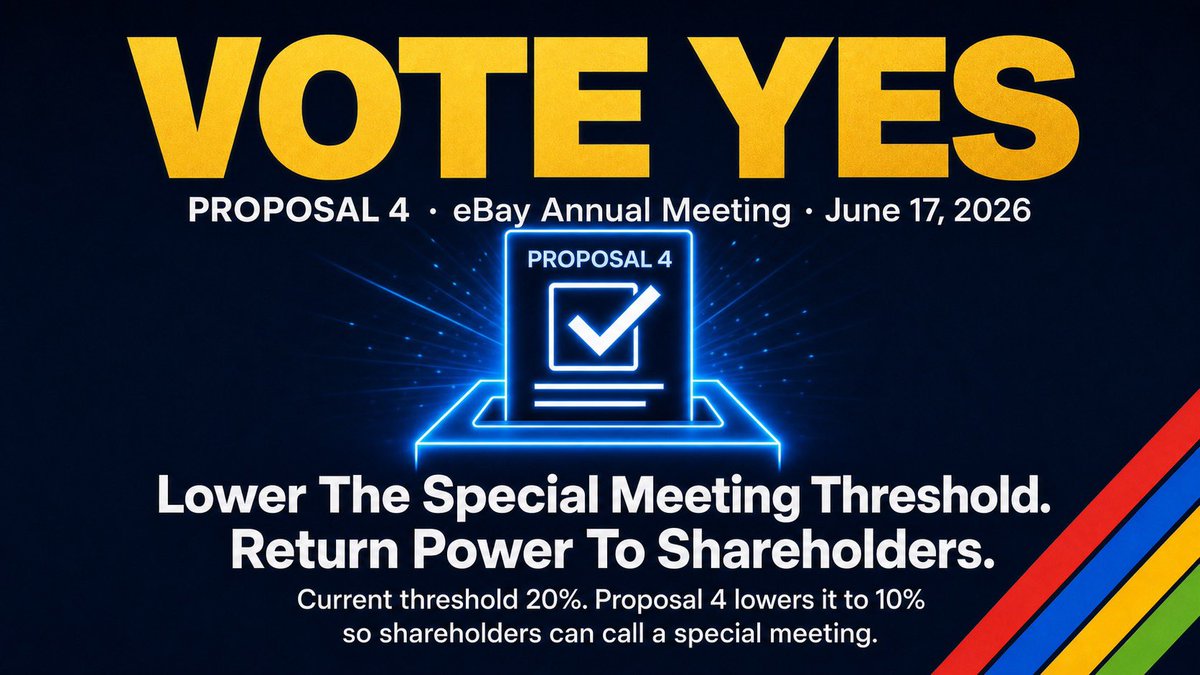
Proposal 4 is about your basic rights.
Right now, it takes 20% of all shares to call a special meeting. Proposal 4 lowers that to 10% so shareholders can act when the board will not.
GameStop and Ryan Cohen now hold about 9% of eBay and have offered $125 per share and a plan to increase EPS for shareholders immediately, which is a 40% premium from when they first bought eBay stock in February and a significant premium to today’s price, valuing the company at an all time high since going public. The board rejected this offer while themselves selling shares at much lower prices and, to my knowledge, no current director has EVER purchased eBay stock on the open market with their own money, only sold what they were given.
If Proposal 4 passes and GameStop reaches 10% ownership, they can call a special meeting and you can vote on who sits on the board and runs this company.
For too long eBay has been run by overpaid executives and serial delegators that have put shareholders and customers last. Vote Yes on Proposal 4 at the eBay annual meeting on June 17, 2026. The board should answer to shareholders and not the other way around. Compensation should not be risk free. There should be accountability for bad decisions that hurt the company financially.
Disclaimer: I am a shareholder of both GameStop and eBay and may benefit if Proposal 4 passes and Ryan Cohen gains greater influence over eBay. This message is for informational and advocacy purposes only. It is not investment advice, a recommendation to buy or sell any security, or a solicitation of proxies. Please review eBay’s official proxy materials and make your own voting and investment decisions.
BREAKING: In new Form 425, GameStop Corp. increases eBay common stock holdings with additional 1,652,819 shares, bringing ownership of auction giant to 9.35%. 🚨 $GME
🚨 GameStop’s latest amended Schedule 13D on eBay contains a development that I think many investors are overlooking.
It’s the HSR condition.
GameStop now reports:
• 827,648 shares owned directly
• 39,046,658 shares underlying Put/Call Pair contracts
• 39,874,306 total referenced shares
• Approximately 9.0% of eBay
But here’s what caught my attention:
The filing states that the Hart-Scott-Rodino (HSR) Act condition was satisfied on June 3, 2026.
Why does that matter?
Prior filings indicated these derivative positions could not be physically settled until the HSR condition was met.
Now that it has been satisfied, the contractual barrier to physical settlement appears to have been removed.
In plain English:
Before June 3rd, GameStop had significant economic exposure to eBay.
After June 3rd, those same contracts appear eligible for physical settlement under their terms.
That’s a different situation.
This is also occurring alongside an active acquisition proposal from GameStop for eBay.
HSR approval is not merger approval.
It is the U.S. antitrust review process that large acquisitions must pass before certain transactions can be completed. Satisfying the HSR condition means a key regulatory hurdle referenced in the derivative agreements has been CLEARED.
But one fact is undeniable:
GameStop’s latest filing shows approximately 39.9 million shares of eBay exposure and confirms the HSR condition tied to physical settlement has been satisfied.
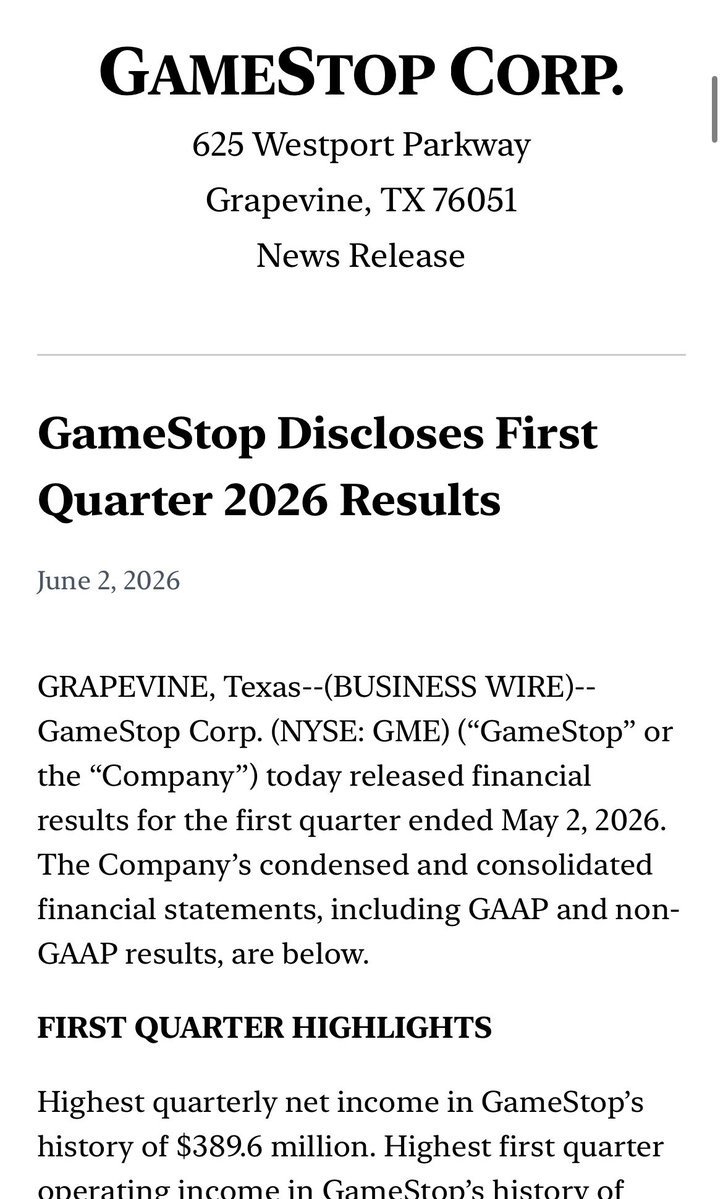
BREAKING: GameStop releases surprise Q1 2026 earnings with highest quarterly net income in GameStop history with $389.6M.
Also a strong beat 0.30 over expected 0.16 $GME 🚨🚨🚨
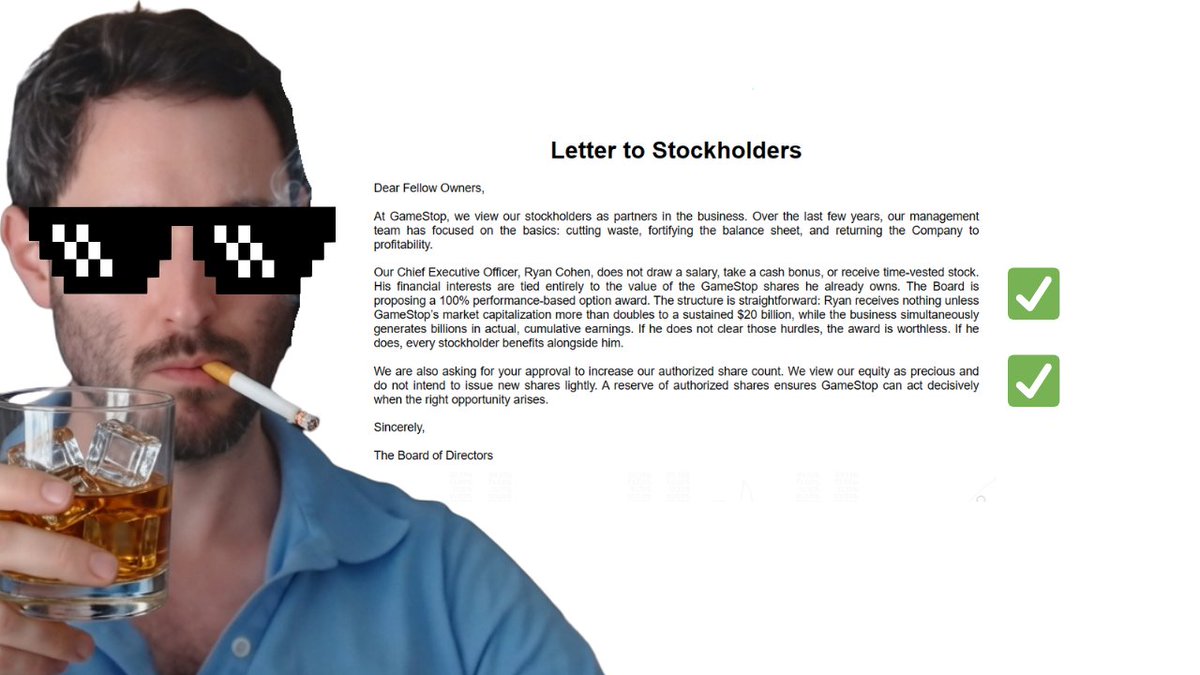
As a proud GameStop Corp. investor and committed shareholder, I am voting YES for increasing the authorized share count and YES for Ryan Cohen's 100% performance-based option award.
My reasoning is simple, Ryan's turned this dead-and-broke retailer in a profitable cash fortress that's on the verge of completing a historic acquisition.
Regardless of whether the eBay deal goes through or NOT, I want the company to have a longer runway and the financial flexibility to swing big at a moments notice.
Not to mention, I support a CEO and leader who takes $0 salary and isn't afraid to go against the archaic corporate groupthink.
$GME
So eBay is willing to pay someone $260,000/year to "shape the voice of eBay’s CEO" in a new job listing titled: Director, CEO Communications.
Why not scrap that waste of money and just let Ryan Cohen speak freely and deliver real shareholder value when $GME acquires it?
You used to sell stuff on eBay.
Maybe an old camera. Maybe Beanie Babies. Maybe a coat that didn't fit.
You paid a small fee. The buyer got the thing. Everyone went home.
That eBay is gone.
The website looks the same. The logo is the same. The 135 million buyers are still there.
But the company isn't really a marketplace anymore.
It is an advertising business with a marketplace attached for distribution.
Last year, sellers paid eBay $2 billion just to make sure their own listings showed up.
Read that again.
The board calls this growth.
A Canadian who runs a video game store called it something else.
Here is what actually happened.
In 2020 the board hired a new CEO. His name is Jamie Iannone. He arrived with a strategy called focused categories.
In plain English, that means leaning into the stuff people pay extra for. Sneakers. Watches. Trading cards. Auto parts.
The everyday seller, the person with the camera and the coat, was no longer the customer.
The customer was now the seller who would pay to be seen.
In 2025 eBay did $80 billion in transactions. They kept $11 billion of that as revenue. Of that $11 billion, $2 billion came from advertising.
Sellers paid them $2 billion to promote listings on a website those sellers already pay fees to use.
That is the growth story.
In the same year, the number of enthusiast buyers, eBay's own term for their best customers, was 16 million.
It was also 16 million the year before.
And the year before that.
And the year before that.
Four years. Zero growth. They mention this on every earnings call without mentioning it.
So what does a company do when growth stops?
It buys back its own stock.
In 2025, eBay returned over $3 billion to shareholders. Most of that was buybacks. In February the board authorized another $2 billion on top.
Buybacks shrink the share count. Earnings per share goes up even when earnings stay flat. The stock price follows.
The stock was $68 a year ago. It is $108 today.
The company did not improve. The denominator got smaller.
Then a man from Canada noticed.
His name is Ryan Cohen. He runs GameStop. He started his career selling pet food online and sold it to PetSmart for $3.35 billion.
He looked at eBay. 135 million buyers. $80 billion in transactions. Real margins. Real cash flow. A board harvesting the business instead of running it.
He bought 5% of the company through derivatives and stock.
Then on May 4, he offered to buy the rest. $125 per share. $56 billion total.
On May 12, the eBay board rejected the bid. They called it not credible.
The math is credible.
What the board means by not credible is we would have to explain why we sold.
Then Cohen went on Piers Morgan.
He said eBay is run by a bunch of losers with perverse financial incentives.
He pointed out that eBay's CEO has been paid $144 million over six years.
He pointed out that he personally takes no salary and has put $128 million of his own money into the company he runs.
You do not have to like Ryan Cohen to notice he is making a point that is hard to argue with.
eBay used to be a place where regular people sold things to other regular people.
Now it is a $48 billion company whose largest growth driver is charging its own sellers to advertise to a buyer base that stopped growing four years ago, while spending billions a year buying its own stock to make the chart go up.
The board calls this strategy.
A video game CEO from Canada called it what it is.
The market is now waiting to see who else agrees.
Plz fix. Thx.
Sent from my iPhone