MON 25 MAR: 2 HR DELAY FOR for all non-mission essential personnel. Contact supervisor regarding your mission element-specific/office-specific operating status. CDC opens @ 0700 for mission essential personnel only; 0830 for all others. 10th Medical Group Services open at 0930.
Looking forward to discussing the developing country debt crisis with the @HudsonInstitute this Thursday, March 21, at noon.
Watch it here: https://t.co/VMAZrHsNwW
We're inviting every member of our community to influence the future of our brand 🩵
As as a part of our upcoming brand refresh, 🫵 YOU 🫵 can vote for the official Oasis Mascot using our confidential voting dApp "voTEE"
Get started below:
https://t.co/hvHVWvg5oU
Dollar General is scamming customers with price tags that don't match what you pay at the register.
Hundreds of thousands of Americans — who rely on discount stores to take care of their families — are being stolen from through these practices.
Learn With Me
I’m often asked how I quickly synthesize information and form opinions. The value, to me, of doing this can be summarized as follows:
- Be more informed about technology, markets and the economy.
- Improve my situational awareness about trends and competitors.
- Have a clearer picture of how a company or sector is doing over another.
- Make better decisions.
I’ve now systematized this into a product that I can share with you, to the extent you are interested.
Read below for more details…
The world is complex and moves at a rapid pace. One day, climate change is all the news; the next day, it's how AI is on the verge of upending everything we know about everything; then we need to become experts in superconductors because some meaningful breakthrough may be at hand.
Meanwhile, the geopolitical chaos in Europe, the Middle East, and Asia seems to be omnipresent and is constantly challenging the existing world order. Finally, we want to know what all of this means for the economy and the companies we work at or are invested in.
It’s hard to make sense of all of this, especially as the incentives of the mainstream media have become increasingly difficult to understand. So how do I form opinions? How do I learn complex topics quickly, usefully, and then fold that into a usable framework?
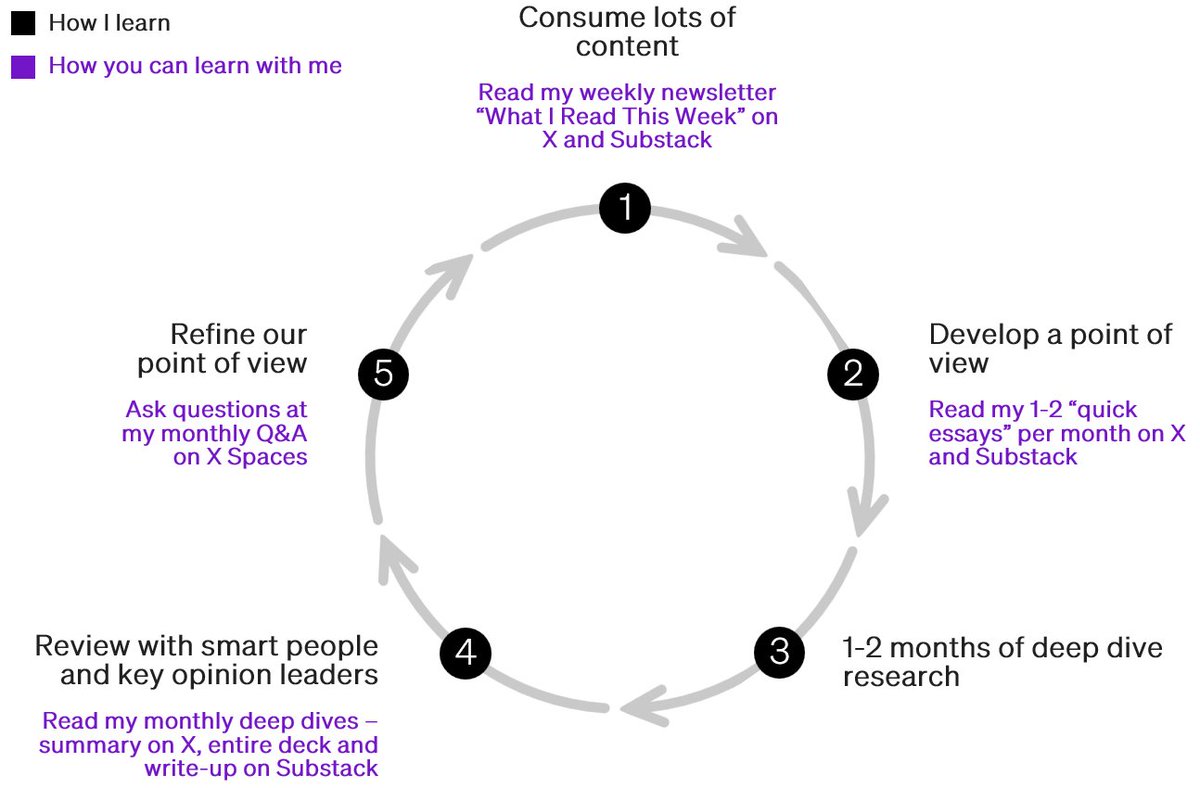
I start with consuming content. Everything from news articles to social media to scientific papers to institutional research to YouTube videos.
Most topics I skim and move onwards from, but for certain topics, where it makes sense, I write a quick 1-2 page essay because I feel it may be important. I do this so I can develop a quick point of view and understand the nuances a little bit better.
When something seems super interesting, I select it for a dive deep with my team, where we allocate at least a month or two to thoroughly understand the key drivers and opportunities, and produce a presentation that captures everything we’ve learned.
We then take our work and review it with a set of smart people and key opinion leaders to challenge and refine our views. Historically, these work products have been very educational to me. I suspect they could be educational to others as well.
So, to this point, I have decided to share more of the work that we do at Social Capital so that if you want to, you can learn along with us.
Here’s the plan:
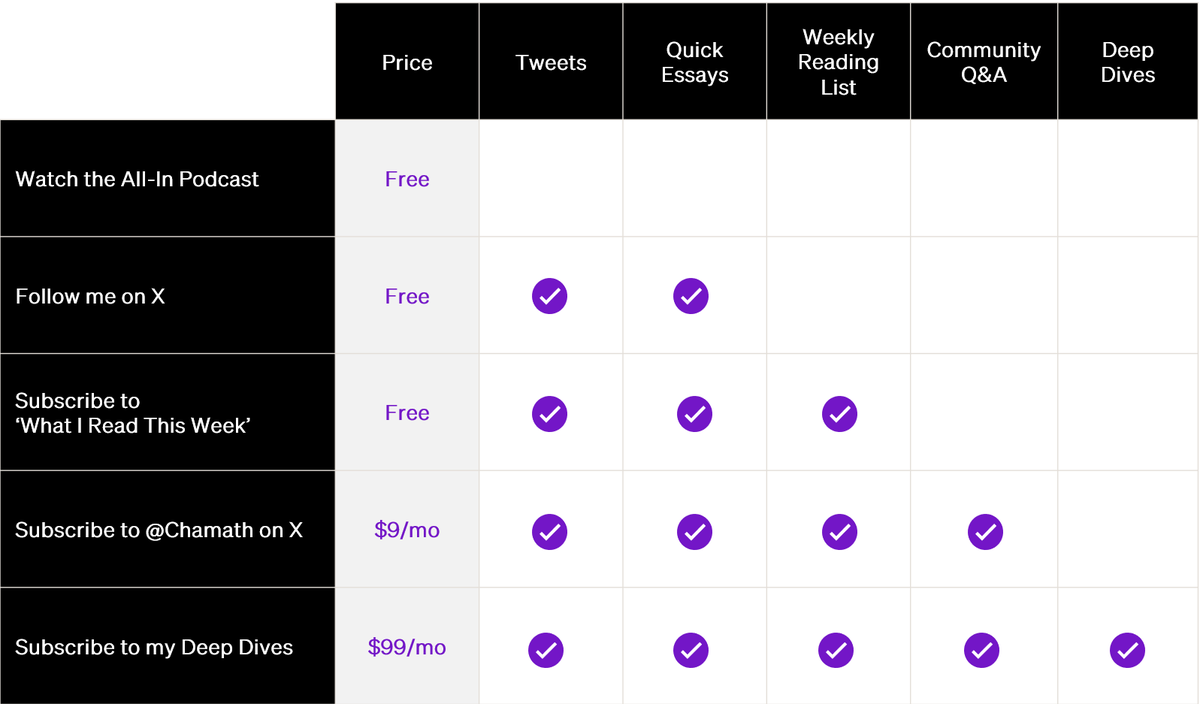
1. I’ll keep posting my daily thoughts and observations on X.
2. I’ll continue to share a summary of the best content that I consumed in the previous week through my weekly newsletter ‘What I Read This Week’.
3. I’ll publish 1-2 quick essays per month on X and on my weekly newsletter ‘What I Read This Week’.
4. Once per month, I’ll host a Spaces to talk about the content we’ve produced, thoughts on the “current thing”, talk to guests and include time for Q&A. This will be the key feature of my Subscription on X. You can subscribe to me on X, and my first Spaces will be in November.
5. Once per month, I will publish a deep dive. This will be a comprehensive slide deck on a topic with an accompanying write-up.
My Deep Dives:
I've structured my deep dives around five primary themes I believe are useful for understanding the world today. These themes will change over time, but it’s important to have a starting point.
1. Deep Tech: I think about “deep tech” as applying science to take things that are scarce and make them abundant, overcoming major scientific and engineering challenges. Such progress often results in significant leaps forward in our capabilities and lays the groundwork for new businesses. It's vital to track these developments to see the potential world in the next decade.
2. Energy Transition: The global energy transition will reallocate trillions in capital expenditure, reorganize U.S. industry, replumb global supply chains, and more. To understand the trajectory of the world and make informed decisions about where to invest your time and efforts, a grasp on energy transition is critical.
3. Healthcare & Life Sciences: Healthcare spending constitutes ~20% of U.S. GDP and shapes the primary demographic shifts influencing economic progress. For example, global GDP diminishes by ~15% due to premature deaths in the working-age population. With new technologies like MRNA and CRISPR, new drugs like GLP1s, and the challenges posed by aging, overweight or sick populations, understanding healthcare and life sciences is as important as it’s ever been.
4. Economic Analysis: In 2021, we saw nearly every business model receive funding. In 2023, capital markets have been much more constrained, and many companies are struggling. Understanding how and why companies receive funding and why certain businesses are valued more than others is important for understanding how technology can be implemented in an economically productive way.
5. Socio-Political Trends: This is the overlay that ties everything together, from the demographic trends that drive consumption habits, to political trends that can act as a headwind or tailwind to economic growth.
I’ll be publishing our first deep dive on December 1st for free, starting with a teardown of the global energy transition. The full content calendar for the next year is outlined below, however, subscribers will be able to comment on what they want to be covered in future months. I’ll make sure to announce next month’s topic in advance so you know exactly what’s coming up.
You should expect beautifully formatted, easy to understand presentations that assume no prior knowledge, with accompanying write-ups that will get you up to speed quickly on each of these topics.
If you are interested, subscribe to my Substack (link in bio) where I will be enabling paid subscriptions in the coming month.
Disclaimer: The views and opinions expressed above are current as of the date of this document and are subject to change without notice. Materials referenced above will be provided for educational purposes only. None of the above will include investment advice, a recommendation or an offer to sell, or a solicitation of an offer to buy, any securities or investment products.
#Polyanskiy: There is no shortcut to a “nuclear zero”. This goal cannot be achieved either by outlawing #NuclearWeapons immediately or by trying to set a timetable for getting rid of them.
🔗https://t.co/P1Cad21YHn
Subscribe to our monthly newsletter: https://t.co/Lrzz3Ipnxr
Connect with the vibrant IC3 community and see what’s happening across our social sites! 🌟
📘 Medium: https://t.co/7M8y8bcjvV
🤝 LinkedIn: https://t.co/JarFce0ImT
📷 Youtube: https://t.co/GoQxNTsmQx
🖥️ Website: https://t.co/WEVTIWDIII
My plan would help create 2 million more affordable homes.
And it would establish a $20 Billion Housing Innovation Fund to help communities build, renovate, and convert properties into places families want to live.
To bring down costs, we have to build, build, build.
A British writer penned the best description of Donald Trump I’ve ever read:
“Why do some British people not like Donald Trump?”
A few things spring to mind. Trump lacks certain qualities which the British traditionally esteem. For instance, he has no class, no charm, no coolness, no credibility, no compassion, no wit, no warmth, no wisdom, no subtlety, no sensitivity, no self-awareness, no humility, no honour and no grace – all qualities, funnily enough, with which his predecessor Mr. Obama was generously blessed. So for us, the stark contrast does rather throw Trump’s limitations into embarrassingly sharp relief.
Plus, we like a laugh. And while Trump may be laughable, he has never once said anything wry, witty or even faintly amusing – not once, ever. I don’t say that rhetorically, I mean it quite literally: not once, not ever. And that fact is particularly disturbing to the British sensibility – for us, to lack humour is almost inhuman. But with Trump, it’s a fact. He doesn’t even seem to understand what a joke is – his idea of a joke is a crass comment, an illiterate insult, a casual act of cruelty.
Trump is a troll. And like all trolls, he is never funny and he never laughs; he only crows or jeers. And scarily, he doesn’t just talk in crude, witless insults – he actually thinks in them. His mind is a simple bot-like algorithm of petty prejudices and knee-jerk nastiness.
There is never any under-layer of irony, complexity, nuance or depth. It’s all surface. Some Americans might see this as refreshingly upfront. Well, we don’t. We see it as having no inner world, no soul. And in Britain we traditionally side with David, not Goliath. All our heroes are plucky underdogs: Robin Hood, Dick Whittington, Oliver Twist. Trump is neither plucky, nor an underdog. He is the exact opposite of that. He’s not even a spoiled rich-boy, or a greedy fat-cat. He’s more a fat white slug. A Jabba the Hutt of privilege.
And worse, he is that most unforgivable of all things to the British: a bully. That is, except when he is among bullies; then he suddenly transforms into a snivelling sidekick instead. There are unspoken rules to this stuff – the Queensberry rules of basic decency – and he breaks them all. He punches downwards – which a gentleman should, would, could never do – and every blow he aims is below the belt. He particularly likes to kick the vulnerable or voiceless – and he kicks them when they are down.
So the fact that a significant minority – perhaps a third – of Americans look at what he does, listen to what he says, and then think ‘Yeah, he seems like my kind of guy’ is a matter of some confusion and no little distress to British people, given that:
• Americans are supposed to be nicer than us, and mostly are.
• You don’t need a particularly keen eye for detail to spot a few flaws in the man.
This last point is what especially confuses and dismays British people, and many other people too; his faults seem pretty bloody hard to miss. After all, it’s impossible to read a single tweet, or hear him speak a sentence or two, without staring deep into the abyss. He turns being artless into an art form; he is a Picasso of pettiness; a Shakespeare of shit. His faults are fractal: even his flaws have flaws, and so on ad infinitum.
God knows there have always been stupid people in the world, and plenty of nasty people too. But rarely has stupidity been so nasty, or nastiness so stupid. He makes Nixon look trustworthy and George W look smart. In fact, if Frankenstein decided to make a monster assembled entirely from human flaws – he would make a Trump.
And a remorseful Doctor Frankenstein would clutch out big clumpfuls of hair and scream in anguish: ‘My God… what… have… I… created?' If being a twat was a TV show, Trump would be the boxed set.”
-Nate White
Quelle paix voulons-nous en Europe ? Celle de la victoire de la liberté ou celle de la capitulation devant Poutine ? Le Président de la République a raison : la Russie ne peut ni ne doit gagner.
@PaalMind@minu_coin Something is cooking in the $PAAL Labs 👀
Register here ⤵️
🔗 https://t.co/qfeKdSnFlp
Only those who register in the next 48 hours will be included.
60m $RUNE was burned from the Standby Reserve, creating 20m RUNE ($140m) in space for lending collateral.
There is now room for ~2000 #Bitcoin or 36k ETH in THORChain lending. No liquidations, no interest.
Details on Medium: https://t.co/yLCdz13oyL