احتمالاً وقتشه با قبرستان PDFهامون خداحافظی کنیم!
من فکر میکردم مدیریت دانش پژوهشی یعنی:
۴۰۰ تا مقاله PDF،
چند هزار بوکمارک،
یک پوشه پر از فایلهای بینام،
و Ctrl+F که هیچوقت اون جملهای رو که دنبالش هستی پیدا نمیکنه!
ولی آینده پژوهش ظاهراً چیز دیگهایه.
تصور کن یک Research Agent داشته باشی که:
→ 🧠 یک فایل ME.md از علایق، تخصص، پروژهها و سؤالات پژوهشی تو میسازه.
→ 📥 مقالات رو وارد صف پردازش میکنی؛ هیچ مقالهای گم نمیشه و وضعیت مطالعه هرکدوم مشخصه.
→ 🔬 هر مقاله رو به خلاصه، ادعاهای اصلی، روش تحقیق، دادهها و محدودیتها تبدیل میکنه.
→ 🔗 ارتباط مقالههای جدید با پژوهشهای قبلی رو پیدا میکنه؛ حتی تناقضها و شکافهای پژوهشی رو.
→ 🛠️ با Skillهایی مثل Paper-to-Brief، Research Search و Talk-to-Notes میتونی با کل آرشیو علمی خودت مکالمه کنی.
→ ⏰ با Routineهای زمانبندیشده، هر روز دانش جدید وارد حافظه پژوهشیات میشه.
و مهمتر از همه:
INDEX.md فقط یک فهرست مقاله نیست؛ نقشهای از دانشی میشه که بهمرور ساختهای.
دیگه مسئله این نیست که چند هزار مقاله ذخیره کردی.
مسئله اینه که از بین اونها چقدر دانش قابل استفاده، قابل استناد و قابل بازیابی ساختهای.
Save the paper. Extract the knowledge. Connect the dots. Build your own research brain.
بهنظرم نسل بعدی ابزارهای پژوهشی، کتابخانههای بزرگتر نیستند؛ مغزهای پژوهشی هوشمندتری هستند که با تو رشد میکنند. 🧠🚀
A quadric surface is the zero set of a second-degree polynomial in x, y and z. Up to rotation and translation, nine standard forms cover every genuine curved one.
The names come from the slices. A level plane z = h cuts ellipses from the ellipsoid, the elliptic paraboloid, the cone, both hyperboloids and the elliptic cylinder, hyperbolas from the hyperbolic paraboloid and cylinder, and pairs of lines from the parabolic cylinder.
The middle row is one equation, x²/a² + y²/b² − z²/c² = k. At k = 1 every slice is an ellipse, at k = 0 they shrink to the apex, and at k = −1 there are none for |z| < c.
Made a web app for GCSE and middle school biology on how oxygen travels from the air into the body’s cells: breathing, gas exchange, circulation and respiration, each with a demo, an exercise and check questions.
Built with Opus 5.5 using Three.js.
https://t.co/ZIVPUpikcI
Every second, you move about 230 kilometers through the galaxy. And you never feel it. We picture the solar system like a clock: planets circling a Sun that stays put. But the Sun does not stay put. It is racing around the center of the Milky Way at about 230 km/s (828,000 km/h)
50 legendary internet rabbit holes you can spend hours exploring👇
1. https://t.co/Rnm6xvS34p — Watch the world via live satellite imagery
2. https://t.co/fPF1bZUxOb — See every plane currently in the sky
3. https://t.co/dnkKR1xnDO — Track all ships at sea in real time
4. https://t.co/scWGSM1150 — Live map of winds and storms
5. https://t.co/3JN6V1PuGW — Watch lightning strikes hitting Earth in real time
6. https://t.co/2HwLWJ4SlE — Live list of recent earthquakes
7. https://t.co/FrcwfRO9UL — Ocean cables carrying the internet
8. https://t.co/JbhMm7KDOp — Watch forests disappear from space
9. https://t.co/FFHGerfWeg — The world's statistics, second by second
10. https://t.co/AQDwQOOtew — Current number of tweets and searches being posted
11. https://t.co/8GY9w6bVVy — Compare the true sizes of countries
12. https://t.co/R29agPW3KI — Maps from centuries ago
13. https://t.co/5cA9slZRHP — Archive of 150,000 historical maps
14. https://t.co/m2lp9UK7pK — World map drawn by volunteers
15. https://t.co/oo9iJrxCSm — Look out the window of a random person around the world
16. https://t.co/8pdmEFYw9y — Virtual walks through cities
17. https://t.co/0SSIxpDcMI — Teleport to a random spot on Earth
18. https://t.co/Fp4C6IrpBI — Catalog of the world's strangest places
19. https://t.co/gPyElwHxNX — Interactive knowledge experiences
20. https://t.co/zf9f8quJcW — Scale journey from atom to universe (Updated HTML5 link)
21. https://t.co/a9V16MN8gg — Explore the solar system in 3D
22. https://t.co/0m2nYHDqG1 — Real sky map in your browser
23. https://t.co/wfbSVapqJW — NASA's astronomy picture of the day
24. https://t.co/PnrH0tVHDQ — NASA's entire visual archive, free
25. https://t.co/tvFDCHdR3F — Visual articles told through data
26. https://t.co/7wkPtTPLDh — The state of the world with real data
27. https://t.co/nuJBsjniXT — What we mistakenly think we know about the world
28. https://t.co/AFIzL5x8OR — Visualizing complex data
29. https://t.co/0RrS3c2Zx2 — World Bank's open data
30. https://t.co/dDeFYvZPOo — Turkey's official statistics database
31. https://t.co/7o82rjIOvw — Archive of millions of books, films, and software
32. https://t.co/hSlNyaVFy2 — 70,000 free books whose copyrights have expired
33. https://t.co/AMiFzHhpIM — Record of every book in the world
34. https://t.co/Qzm14VWuDC — U.S. Library of Congress digital archive
35. https://t.co/byvU6Bmszt — Europe's cultural heritage archive
36. https://t.co/ku3rqFXhAB — America's digital library collection
37. https://t.co/6lYixDs6Mn — Tour museums from home
38. https://t.co/U0RNH1kQ0H — Download artworks in high resolution
39. https://t.co/MAFoAmmaZp — Archive of 250,000 artworks
40. https://t.co/5mu1vAv6VE — Forgotten visual treasures of history
41. https://t.co/tDg0loBP02 — Free archive of culture and education
42. https://t.co/imo0QcFIFh — Met Museum's open collection
43. https://t.co/RkSQ3kJSsw — Family tree of music genres
44. https://t.co/Ln6sYsCCoo — Pick a country and decade to listen to that era
45. https://t.co/zJlsJk8zwR — Turn Wikipedia edits into audio
46. https://t.co/72xSpNBdOZ — Random knowledge well
47. https://t.co/2HUpBR2O2Q — Time, sunrises, and sky events
48. https://t.co/KXNaMOLCQN — Live stream of science news
49. https://t.co/3nExl6BcHH — Free preprints of scientific papers
50. https://t.co/jw7KxeILfA — Visualize data with live code
Save this. You’ll definitely need some of these later. 🔖
Follow @The_techAI for more useful websites, AI tools & tech resources.
The rocket’s fins emerge from motions that extend around the whole curve. Each Fourier harmonic contributes a repeating oscillation; even a small corner takes many frequencies working together.
One rotating chain reconstructs the horizontal coordinate, the other the vertical. Their guides meet at the pen. As the count rises from 1 to 100 harmonics per coordinate, an ellipse becomes an increasingly accurate rocket outline.
50 legendary internet rabbit holes you can spend hours exploring 👇🏼
1. https://t.co/EcjlHR7ZxB — Watch the world via live satellite imagery
2. https://t.co/jMKbxnmhK7 — See every plane currently in the sky
3. https://t.co/etV46CtFeS — Track all ships at sea in real time
4. https://t.co/SEqzlLnznT — Live map of winds and storms
5. https://t.co/FevkYXk88f — Watch lightning strikes hitting Earth in real time
6. https://t.co/HCalw8WPM0 — Live list of recent earthquakes
7. https://t.co/fucAoo0Xco — Ocean cables carrying the internet
8. https://t.co/rR5XpGu8DA — Watch forests disappear from space
9. https://t.co/DFexDetESk — The world's statistics, second by second
10. https://t.co/7IPc5kRUUA — Current number of tweets and searches being posted
11. https://t.co/JrSpfW0PBf — Compare the true sizes of countries
12. https://t.co/ImaK3DdFKe — Maps from centuries ago
13. https://t.co/cVNyrKr1vD — Archive of 150,000 historical maps
14. https://t.co/IadozUCM8W — World map drawn by volunteers
15. https://t.co/YQfW72rv6M — Look out the window of a random person around the world
16. https://t.co/NBjRT5AL4B — Virtual walks through cities
17. https://t.co/YxrvhoneU4 — Teleport to a random spot on Earth
18. https://t.co/KU6Db4QxFp — Catalog of the world's strangest places
19. https://t.co/bHjzcx56Sq — Interactive knowledge experiences
20. https://t.co/W1X0E8N6LW — Scale journey from atom to universe (Updated HTML5 link)
21. https://t.co/Uy6384fIKc — Explore the solar system in 3D
22. https://t.co/2XRE0BLrBt — Real sky map in your browser
23. https://t.co/efMk3X8WQW — NASA's astronomy picture of the day
24. https://t.co/8HkspSwOw4 — NASA's entire visual archive, free
25. https://t.co/3CQspQX4qA — Visual articles told through data
26. https://t.co/6fyKy4SaNB — The state of the world with real data
27. https://t.co/9EDAPp7PrC — What we mistakenly think we know about the world
28. https://t.co/bHT1FYeIUb — Visualizing complex data
29. https://t.co/Koh1JPoJKu — World Bank's open data
30. https://t.co/bIq9X1yIFs — Turkey's official statistics database
31. https://t.co/SojPChoErP — Archive of millions of books, films, and software
32. https://t.co/lXqXkA3WXd — 70,000 free books whose copyrights have expired
33. https://t.co/ULxsiendsq — Record of every book in the world
34. https://t.co/6n4KW3idVm — U.S. Library of Congress digital archive
35. https://t.co/HmvQJtWufj — Europe's cultural heritage archive
36. https://t.co/JtmRRtFoam — America's digital library collection
37. https://t.co/Hh5RwbyXqM — Tour museums from home
38. https://t.co/Ja4aECJKOC — Download artworks in high resolution
39. https://t.co/Cn5ngEaMLR — Archive of 250,000 artworks
40. https://t.co/XycSjDxNHW — Forgotten visual treasures of history
41. https://t.co/4iYkh1rcCy — Free archive of culture and education
42. https://t.co/R6bUdHyF9f — Met Museum's open collection
43. https://t.co/4jnZ7hxKdd — Family tree of music genres
44. https://t.co/1ZGdX2D1yw — Pick a country and decade to listen to that era
45. https://t.co/URZBBpUFSY — Turn Wikipedia edits into audio
46. https://t.co/ZoaB9Hg5BZ — Random knowledge well
47. https://t.co/PhXatvvmuD — Time, sunrises, and sky events
48. https://t.co/fQRqh7x2uX — Live stream of science news
49. https://t.co/AaxWivgaY1 — Free preprints of scientific papers
50. https://t.co/AZZtL0uBwV — Visualize data with live code
Save this list. You’ll probably come back to a few of these later. 🔖
Follow @stevencoder9 for more useful websites, AI tools & tech resources.
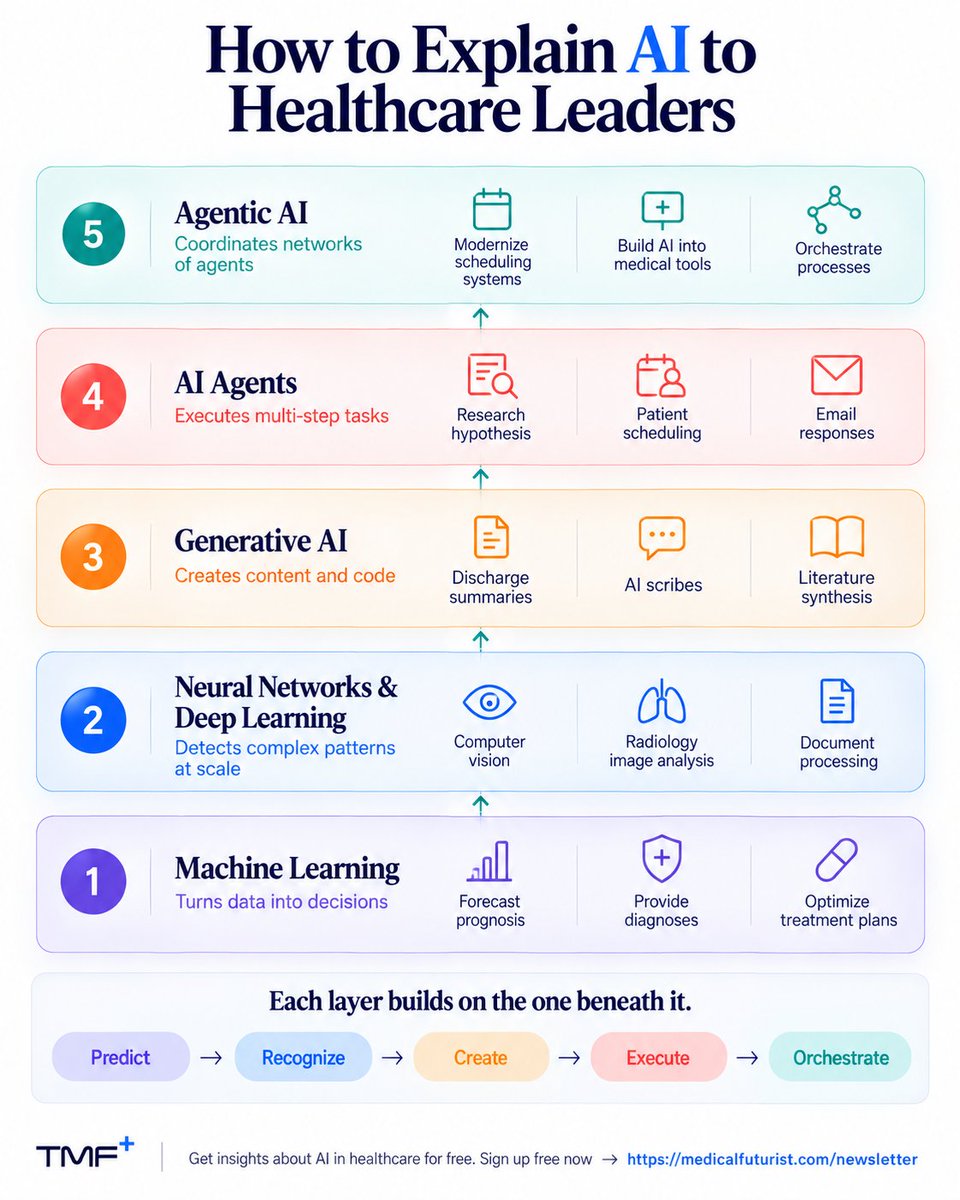
How to explain the major levels of AI to healthcare leaders?
I always look for new ways in terms of videos, papers, and infographics to make it easier for everyone in healthcare to understand enough about this breakthrough technology.
Here is a brief overview of how the different layers of AI in healthcare is built upon each other.
Machine learning methods - neural networks - generative AI - AI agents - and agentic AI.
Here is what is possible on each level.
𝗠𝗼𝘀𝘁 𝗽𝗲𝗼𝗽𝗹𝗲 𝘁𝗵𝗶𝗻𝗸 𝗔𝗜 = 𝗖𝗵𝗮𝘁𝗚𝗣𝗧.
Not even close.
ChatGPT is what you see.
The real AI revolution is the massive ecosystem being built underneath it.
This AI Stack Map captures 100+ tools powering modern AI applications.
𝗧𝗵𝗲 𝗺𝗼𝗱𝗲𝗿𝗻 𝗔𝗜 𝘀𝘁𝗮𝗰𝗸 𝗹𝗼𝗼𝗸𝘀 𝘀𝗼𝗺𝗲𝘁𝗵𝗶𝗻𝗴 𝗹𝗶𝗸𝗲 𝘁𝗵𝗶𝘀:
LLMs → OpenAI, Claude, Gemini, Llama, Mistral
Agentic AI → LangGraph, CrewAI, AutoGen, CAMEL, Agno
RAG → LangChain, LlamaIndex, Haystack, GraphRAG
Embeddings → OpenAI, Voyage, Cohere, BGE
MCP → Connecting models with tools, data and systems
AI Security → Guardrails, Presidio, Lakera, Prompt Security
Observability & Evals → LangSmith, Langfuse, Phoenix, Ragas
Memory → Redis, Mem0, Zep, Neo4j, Chroma
Agent Frameworks → OpenAI SDK, Semantic Kernel, Google ADK, Bedrock
Automation → n8n, Zapier, Make, Airflow, Prefect
Vector Databases → Pinecone, Weaviate, Qdrant, Milvus, pgvector
But here’s the part that matters more than the logos.
𝗧𝗵𝗶𝘀 𝗶𝘀 𝗻𝗼𝘁 𝗮 𝘀𝗵𝗼𝗽𝗽𝗶𝗻𝗴 𝗹𝗶𝘀𝘁.
It’s a dependency graph.
Your RAG is only as good as your retrieval + embeddings.
Your agent is only as reliable as its tools + evaluations + guardrails.
Your memory is useless if you can’t observe when context becomes stale or wrong.
Your MCP layer becomes dangerous if permissions and governance are an afterthought.
And a “best-in-class” stack can still become a terrible production system.
Why?
Because AI systems rarely fail only inside one component.
𝗧𝗵𝗲𝘆 𝗳𝗮𝗶𝗹 𝗮𝘁 𝘁𝗵𝗲 𝗵𝗮𝗻𝗱𝗼𝗳𝗳𝘀.
Model → Retrieval
Retrieval → Context
Context → Agent
Agent → Tool
Tool → Memory
Memory → Evaluation
That’s where latency compounds, context gets lost, permissions leak, hallucinations propagate and reliability starts falling apart.
𝗧𝗵𝗲 𝗿𝗲𝗮𝗹 𝗺𝗼𝗮𝘁 𝗶𝘀𝗻’𝘁 𝗵𝗮𝘃𝗶𝗻𝗴 𝗺𝗼𝗿𝗲 𝗔𝗜 𝘁𝗼𝗼𝗹𝘀.
It’s designing how they work together.
A stack map tells you 𝗪𝗛𝗔𝗧 exists.
Production engineering decides 𝗛𝗢𝗪 it all survives contact with reality.
Which tool in your AI stack has become indispensable?
Save this map for your next AI build.
Repost it for someone designing an AI architecture.
#AI #ArtificialIntelligence #GenAI
AI engineering is no longer just about knowing how to use an LLM.
The model is only one piece of the system.
Once you start building AI applications that actually need to work in production, the stack gets much bigger:
→ LLMs for reasoning and generation
→ RAG for grounding responses in your data
→ Embeddings + Vector DBs for semantic search
→ Agent frameworks for tool use and orchestration
→ MCP for connecting agents with external systems
→ Memory for maintaining context across interactions
→ Observability for understanding what went wrong
→ Security for protecting models, data and tools
→ Automation for turning workflows into actual actions
And then there are dozens of tools competing within each layer.
That's probably the most confusing part of learning AI engineering today.
You don't need to learn every tool in this ecosystem.
You need to understand what problem each layer solves - and then go deep on the tools that fit the systems you're building.
The shift from experimenting with an AI model to building a production-ready AI system is much bigger than most tutorials make it look.
This ecosystem map is a pretty useful reference for understanding what's happening beyond the LLM itself.
📌 Save this if you're exploring AI Engineering.
Un presidente peruano se reunió en secreto con un empresario chino. Fue filmado. El Congreso lo destituyó. Pero el problema va mucho más allá del 'Chifagate'. Valeria cuenta la historia.
🚨 BREAKING: NotebookLM can now act like a personal research assistant for free.
Upload any article, PDF, video, or document and use these 10 prompts to extract everything that matters in minutes: