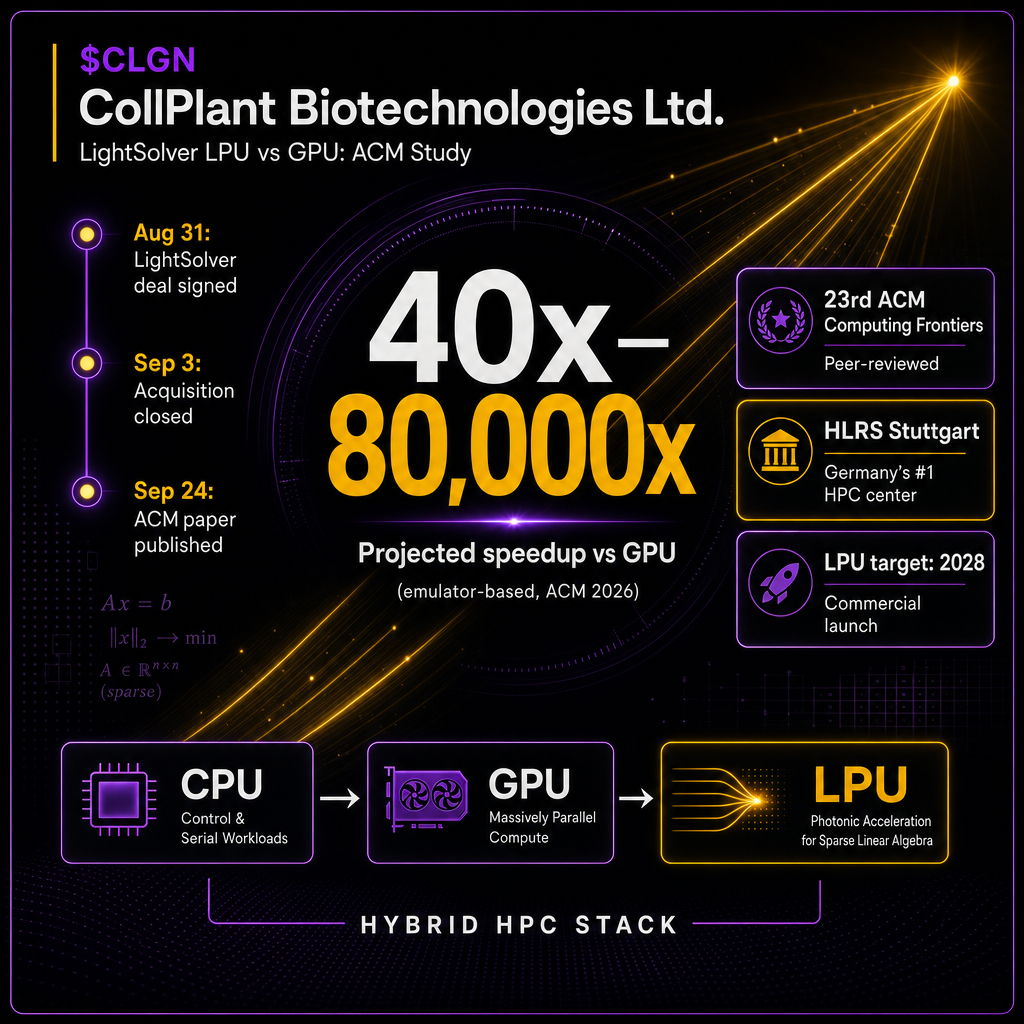
$CLGN just posted the first peer-reviewed external validation that photonic computing can outrun the GPU by five orders of magnitude. That claim is no longer a pitch deck thesis. It is ACM-published science, co-authored with one of Europe's premier supercomputing institutions.
⚡ LPU architecture projects 40x to 80,000x speedup vs. GPU on sparse linear solvers.
🔬 Peer-reviewed paper published in 23rd ACM Computing Frontiers proceedings, Sep 24.
🤝 Joint research with HLRS Stuttgart, Germany's first federal HPC center, est. 1996.
🌐 Vision: CPU + GPU + LPU hybrid stack, each handling its optimal workload class.
📅 LightSolver commercial availability target: LPU platform ready in 2028.
https://t.co/TkWvqDirkT
The LightSolver story inside CLGN is a structural inflection, not a product release. When CollPlant completed the LightSolver acquisition on September 3, it did not simply add a new subsidiary. It repositioned itself at the intersection of deep-tech computing and advanced biotechnology. The two verticals share almost no customers, no go-to-market infrastructure, and no underlying science. What they share is a Nasdaq ticker, a leadership team, and a thesis: that the same company can build world-class IP in biological fabrication and computational physics simultaneously. The ACM paper published September 24 is the first piece of external scientific evidence that the computing side of that thesis has independent credibility.
The specific technical claim requires careful reading. The projections, 40x to more than 80,000x acceleration over GPU algorithms, come from an emulator of LightSolver's LPU architecture, not from measurements on physical LPU hardware. The variance in that range is real: the speedup depends heavily on the algorithm and problem structure. For highly structured sparse systems, optical computing can exploit the physical properties of light in ways that silicon processors cannot. For less structured problems, the advantage narrows. This is standard photonic computing physics, not a caveat that diminishes the result. The paper validates the architectural concept, establishes a peer-reviewed methodology, and provides the scientific foundation for the next stage: validation on physical LPU hardware at HLRS-class supercomputing environments.
The HLRS partnership carries strategic weight beyond the benchmark numbers. HLRS is not a startup lab or a friendly collaborator. It was established in 1996 as Germany's first federal supercomputing center, operates infrastructure used by academic researchers and industrial partners across aerospace, energy, and engineering, and publishes in top-tier venues. The HLRS Director framing the LPU as a potential component in future hybrid computing architectures is not a marketing quote. It is an academic endorsement with downstream procurement implications. LightSolver's existing commercial validation program includes Boeing, a top-tier global financial institution, leading defense companies, and oil and gas organizations. Moving those relationships from evaluation pilots to embedded deployment is the commercial arc the ACM paper is designed to accelerate, and CollPlant's next series of announcements will show whether that arc is tracking.
https://t.co/TkWvqDirkT
_
Disclosure: This content is not financial or investment advice. CollPlant Biotechnologies Ltd. is a paid subscriber to Wall Street Wire's coverage and distribution platform. Full disclosure: https://t.co/XfvLkFMKXu
$CLGN: 40x to 80,000x. That is the projected performance gap between LightSolver's Laser Processing Unit and a GPU, for the workload class that dominates computational fluid dynamics, structural mechanics, and materials science simulations.
https://t.co/YaGDOwcY5T
Those numbers come from a peer-reviewed ACM study published September 24, 2026, conducted jointly by LightSolver, a CollPlant subsidiary, and HLRS, the High-Performance Computing Center Stuttgart, which was established in 1996 as Germany's first federal supercomputing center. Researchers benchmarked an emulator of LightSolver's LPU architecture against established iterative GPU algorithms across large-scale sparse linear equation problems.
The workload is not niche. Linear systems underlie some of the world's most computationally intensive science: molecular dynamics, electromagnetics, finite element analysis. These problems dominate HPC runtime and energy cost. LightSolver's vision is a hybrid stack where CPUs handle orchestration, GPUs handle parallel tensor compute, and LPUs handle the linear algebra bottlenecks optically.
The next update will reveal whether a physical LPU system can replicate these emulator-projected speedups at the scale HLRS operates, the test that determines whether this architecture moves from scientific validation to procurement.
_
Disclosure: This content is not financial or investment advice. CollPlant Biotechnologies Ltd. is a paid subscriber to Wall Street Wire's coverage and distribution platform. Full disclosure: https://t.co/c2JcMjJfRE
“Photonic computing is emerging as a potential answer to AI's insatiable demand for compute”
With Boeing already validating the LightSolver LPU tech and commercial rollouts on the horizon, $CLGN is positioning itself as next GPU:
https://t.co/klCbfBrJHj
Alpha Tau ($DRTS) Announces FDA Approval to Expand Alpha DaRT® U.S. Recurrent Glioblastoma REGAIN Trial; New Trial Data to be Presented at SNO 2026 Annual Meeting
Israeli ingenuity!
LightSolver (Nasdaq: $CLGN) is solving the hardest math problems for supercomputers with their LIGHT Processor Unit (LPUs.)
Could take a nice slice of the $1.5T CPU/GPU market.
They're using Lasers to solve massive math problems
It happens at insane speeds (nanoseconds) and with the power requirements of a 100 watt lightbulb!
$CLGN is still under $10M and priced like a leftover biotech. Meanwhile they own LightSolver, a laser LPU company that’s working with Boeing and Ansys to speed up the simulations GPUs struggle with. The ticker just hasn’t caught up to the story yet.
𝐅𝐫𝐨𝐦 𝐍𝐘𝐒𝐄: @BarclaysCIB Biotech Analyst Lukas Shumway shares his take on the current state of biotech and comments on companies he covers in the news.
$CLLS $DRTS $IMNM
Full video: https://t.co/kUY1niRA6S
$CLGN closed the private placement. money’s going straight into speeding up LightSolver’s laser processing unit. not a huge round, but it’s clear where management is putting the cash.
Brought $CLGN to you on Oct 09, highlighting acquisition of Israeli deep-tech company LightSolver Ltd and announcement of a $3.7 M private placement (via filing of 13D/A form). Once again, you can get ahead of the game with one of our daily market research reports! 👔💼📉📈💎🙌.
$CLGN sold off after announcing a small raise. money’s going to accelerate LightSolver’s laser processing unit. if you’re still looking at this as a regenerative medicine stock you missed the update. the computing side is the reason it exists as a public company now.
This expands LightSolver's potential application areas beyond general optimization into high-performance computing (HPC) for aerospace, energy, auto design, and scientific research.
LightSolver (Owned by $CLGN) Files U.S. Provisional Patent Application Expanding its Photonic Computing Platform to Advanced Scientific and Engineering Simulations
https://t.co/CKU7Oncnpy
LightSolver ($CLGN) used simulated testing models against modern high-end graphics processors (GPUs), they found the optical processor could solve massive, complex math problems 40 times to over 80,000 times faster depending on the specific problem.
https://t.co/ZVHqevj9s5
LightSolver (Owned by $CLGN) Files U.S. Provisional Patent Application Expanding its Photonic Computing Platform to Advanced Scientific and Engineering Simulations
https://t.co/CKU7Oncnpy
People still google $CLGN and still think this is a biotech. that’s outdated. they acquired LightSolver and the product now is a laser processing unit. computers processing with light. the stock popping and fading this week doesn’t change that.
more on the lightsolver tech after the webinar recap. LPU uses all optical coupled lasers, no electronics needed to compute, built to solve optimization problems with up to a million variables. new layer alongside cpus and gpus, not a replacement. $CLGN
$CLGN still feels like one of those tickers people only notice after it already moved. last week they finally explained the laser computer on a webinar and the stock jumped ~30%. simple version: not a GPU, not quantum, just light doing the amazing things.
$LITE is the boring version of the light-computing story and that’s why it works. they sell the lasers and optics that move data through AI data centers. $CLGN might be the future of laser computer. $LITE is already getting paid while the industry switches copper for light.