You will never see other races and people answer our indigenous names. It’s only Africans who love giving their children foreign names. That’s mental colonialism.
Muammar Gaddafi gave up his nuclear program in 2003.
He negotiated. He complied. He handed over the centrifuges and the documentation and accepted international inspectors and did everything the West said a responsible leader should do.
He believed the deal.
He believed that compliance would produce security.
In 2011, NATO bombed his country for seven months.
Hillary Clinton, upon hearing of his death, after he had been captured, sodomized with a bayonet, and killed by a mob, appeared on camera and laughed:
"We came, we saw, he died."
Kim Jong-un watched this.
The Iranian leadership watched this.
Every government on Earth that was considering what compliance with Western demands actually produces watched this.
Gaddafi is the lesson.
Not the lesson the West wants to teach.
The lesson history actually teaches.
The empire does not reward disarmament.
It schedules it.
Half of England is in drought after record-breaking heatwaves, yet most of our media want to talk about the "problem" of refugees whilst giving airtime to absurd & dehumanising policies from Reform UK.
Politicians who scapegoat refugees and migrants have no interest in making your life better.
If they really cared, they would take on corporations holding this country to ransom.
They would end the daylight robbery of privatisation.
And they would tackle the real cause of society's problems: a grotesquely unequal economy that sucks wealth away from the majority to an elite few.
Gary Linker
“It did not matter to me losing my job”
“What mattered to me was losing my dignity."
It's quite unbelievable that anyone should be worried about calling out a genocide.
Well, your forebears should have thought of that before they went around the world colonizing the lands of Mohammeds, Khans, and Patels.
Enjoy your racism!
"Brave men do not gather by thousands to torture and murder a single individual, so gagged and bound he cannot make even feeble resistance or defense." Ida B. Wells
The Arab slavery of black Africans was the worst genocide that ever happened to Africa. They took not only North Africa, they took resources and sold over 100 million blacks.
The biggest slave rebellion was carried out by enslaved black Muslims against Arabs in Zanj, modern day Iraq.
It is theocratic colonialism and manipulation for Arabs to act like victims while they loot and destroy Africa for over 1300 years.
People who enslaved you for over 1000 years, will not treat you well in 2026.
How many Arab Muslims came out to speak out against the killings of black Muslims of Darfur??? None!!!
How many Fulani Muslims came out to sympathise with the Yoruba Muslims being slaughtered in Kwara state? None!
But the same people are telling you that Islamic brotherhood is superior to Pan Yorubanism?
An average Arab supremacist sees blacks as tools of power and leverage. They see a people that can be manipulated using religion as a weapon of expansionism.
This is Arabization not Islamization.
Think Yoruba First!
Maybe you should focus on the lack of democracy in the UAE and your country’s support for a genocidal militia in Sudan, and let European democracies do their own thing.
Sheesh, these Emirati ‘influencers’ and their racist, Islamophobia-inciting BS.
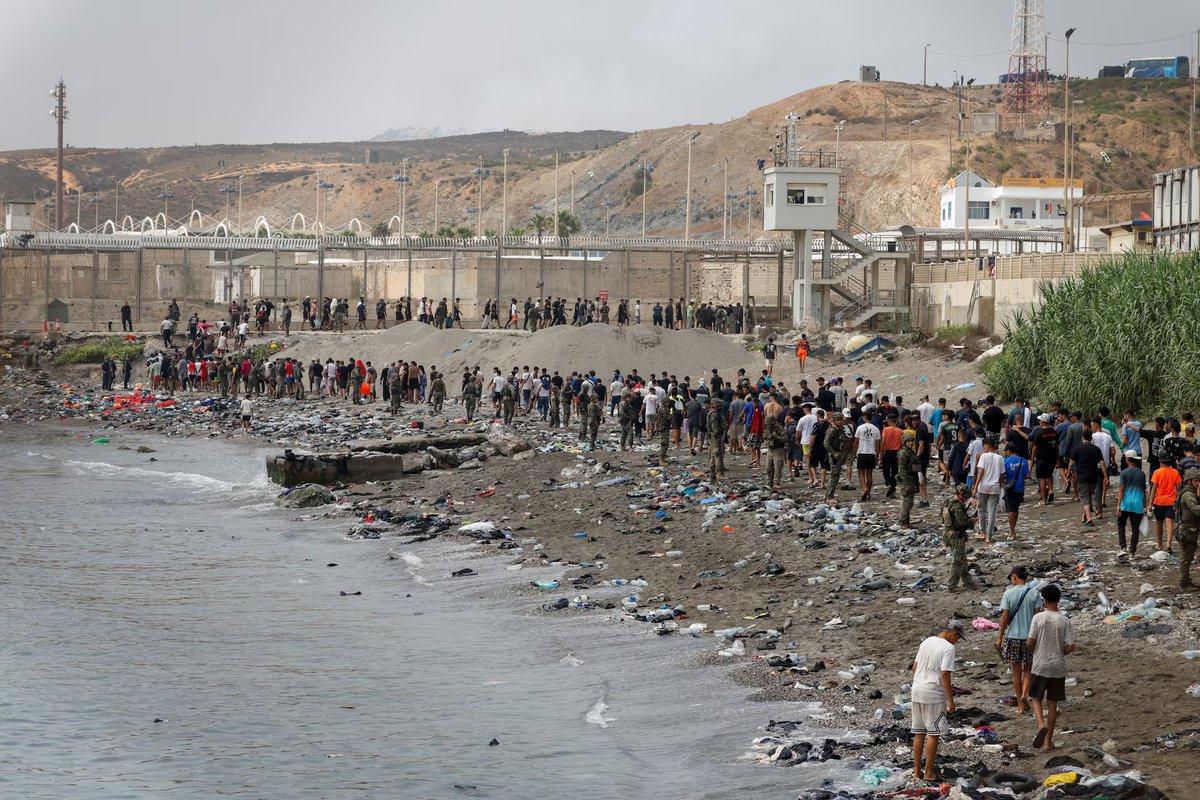
I crossed the Sahara Desert with migrants about a decade ago. Those in the video who crossed into Ceuta from Morocco neither looked like migrants (no luggage) nor did they behave like migrants (went back home with no protest). They looked like a rent-a-mob from Morocco's al-karyan, engineered to cross over and create a diplomatic crisis for Spain? Why? Well, ask the Israeli government, whose Moroccan partner is ever ready to create an embarrassment for the @sanchezcastejon government as a consequence of its position on the genocide of the Palestinians. Remember when the Moroccan King did the same thing in 2021 when the Spanish government arranged for medical care of Brahim Ghali (leader of @Polisario_).
For more than two decades, the Congo Free State was not a Belgian colony. It was the personal possession of King Leopold II of Belgium. From 1885 to 1908, he controlled an enormous region in Central Africa as his own private enterprise, using its people and natural resources to generate immense wealth through the extraction of rubber and ivory.
As the global demand for rubber exploded during the late nineteenth century, so did the brutality of Leopold's regime. Congolese communities were forced to meet impossible rubber quotas under the threat of violence. Those who failed to produce enough rubber often faced severe punishment. Soldiers working for the colonial force, known as the Force Publique, burned villages, took women and children hostage, carried out executions, and mutilated victims by cutting off hands or other limbs as a form of terror and punishment. These acts were documented by missionaries, journalists, and international investigators, helping expose one of the greatest humanitarian disasters of the colonial era.
The true number of people who died during Leopold's rule remains debated by historians because reliable census records did not exist. However, scholars widely agree that millions of Congolese died from a combination of killings, forced labor, starvation, disease, and the collapse of local communities. Estimates often range from several million to around ten million, while some accounts have suggested even higher figures. Regardless of the exact number, the scale of suffering was catastrophic and permanently changed the demographic and social fabric of the Congo.
International outrage eventually forced Belgium to remove the territory from Leopold's personal control in 1908, transforming it into the Belgian Congo. Although some of the worst abuses were reduced, colonial rule continued for decades, and the economic system remained largely focused on extracting African resources for European benefit.
The atrocities committed in the Congo deserve to be remembered alongside other crimes against humanity. Learning about the Holocaust is essential, and so is understanding the history of colonial violence in Africa. History is not a competition of tragedies. Expanding our knowledge allows us to recognize the experiences of people whose stories have too often been overlooked.
If you love our content and would like to support the page, you can buy us a coffee here: https://t.co/K1AhtZuOFs or tap Link in Bio
Here is what they were actually afraid of.
Not Vietnamese communism.
Vietnam is a communist country today and American corporations are operating there happily, making shoes and electronics, and nobody in Washington is having a crisis about it.
What they were afraid of in 1954 was the example.
They called it "the domino theory."
If Vietnam goes, then Laos, then Cambodia, then Thailand, then all of Asia falls.
This was the public explanation.
But the dominoes they were actually afraid of weren't countries on a map.
The dominoes were ideas.
If Vietnam could successfully nationalize its resources, write its own economic policy, choose its own political system, and survive, then every other country in the world would see that it was possible.
Every country in Latin America that was thinking about land reform.
Every country in Africa that was thinking about nationalizing its oil.
Every country in Asia that was thinking about breaking from the dollar system.
They were afraid that Vietnam would prove that the American empire had limits.
That its power could be defied.
That there was a price for the defiance but the price might be worth paying.
They were right to be afraid.
Because that's exactly what Vietnam proved.
And more than seventy years later, that proof is still in circulation.
Every country that resists American sanctions, every country that refuses to flip its government on Washington's timeline, every country that says "no" and means it, is drawing, consciously or not, on the example Vietnam set.
The dominoes they were afraid of are still falling.
They just took longer and fell in a different direction than they expected.
The word "barbarism" has a specific history.
It comes from the Greek barbaros, a term the ancient Greeks used for people who didn't speak Greek.
Literally: people who make sounds like "bar bar bar."
People whose language is noise rather than speech. People who are, by definition of their unintelligibility, less than fully civilized.
Western power inherited this word and put it to work.
The people resisting colonization in Africa were "barbaric."
The Zulus who fought British expansion were "barbaric."
The Vietnamese who fought French colonial rule and American imperialism were "barbaric."
The Algerians who fought French occupation were "barbaric."
The Iraqis who fought the 2003 invasion were "barbaric."
The British who looted and burned the Summer Palace in Beijing were "restoring order."
The French who used systematic torture and collective punishment in Algeria were "maintaining security."
The Americans who dropped napalm on Vietnamese villages were "pacifying the countryside."
The pattern does not require individual malice.
It requires a structure of language that assigns the category of violence to the people defending themselves and assigns the category of governance to the people attacking them.
Once you see this structure, you cannot unsee it.
And once you unsee it, once you accept the language of the powerful as the natural language of reality, you experience slaughter as background noise.
That is exactly what it was designed to produce.
The British left famine in every country they administered long enough.
Ireland. India. Bengal. East Africa.
The Bengal famine of 1943.
Three million people.
Dead from starvation while India was under British administration, while India was producing food that was being exported, while Winston Churchill, who is on the British five-pound note, said the famine was the Indians' own fault for "breeding like rabbits" and blocked international aid shipments from reaching the subcontinent.
Three million people.
Churchill has a statue in Parliament Square.
There is no memorial in London to the Bengal famine.
There is no memorial in London to the Irish famine, caused in significant part by the continuation of food exports from a starving country because the market required it.
There is no memorial to the victims of British-administered famines anywhere in Britain that carries the weight and specificity of the crime.
What Britain has, instead, is a Churchill War Rooms museum where you can buy a Churchill bobblehead in the gift shop.
This is not forgetting.
Forgetting is passive.
This is the active, maintained, institutionally supported decision that certain deaths count as history and others count as the unfortunate background against which great men made great decisions.
The man who blocked aid to a starving country is the great man.
The three million are the background.