Inside Nitro, a documentary.
Not a keynote. The founders, fellows, and ideas behind Nitro Seoul, in their own words, what it actually means to build with AI as a co-founder, investor and as a dev.
"The moment you do something the same way twice, you're already behind." - @simonkim_nft
Sovereign agent finance starts with local money, compliance, and trust.
As AI agents move from copilots to economic actors, the harder questions arrive: What financial rails do agents need? How should KRW stablecoins, identity, and compliance work in a local market? And what does machine-native payment infrastructure look like in practice?
Join us for Episode 17 of AI on AIR podcast with @hashed_official’s @harryhojinkim, CEO of Hashed Open Finance.
Our founders @ChiZhangData and @scottshics will sit down with Hojin to explore Korea’s role in shaping sovereign agent finance, from KRW stablecoins and regulated financial rails to machine payments and institutional trust.
📍 Live on Kite’s X and LinkedIn
📅 June 10
🕐 19:00 PST
📌 Sovereign Agent Finance: KRW Stablecoins, Compliance, and Machine Payments
We’ll discuss:
• Why KRW stablecoin infrastructure matters for AI agents
• What Korea’s payment, banking, and regulatory environment makes possible
• How compliance and identity need to evolve for agent wallets
• Where machine-native payments and x402-style flows fit
• Why institutional trust is core to the agent economy
Set your reminder and join us live. Before agents can transact at scale, they need sovereign, compliant, and verifiable financial rails. 🪁
1. The Institutional Unlock - EastPoint:Seoul 2026, September 28th
One of the clearer signals that Korea is becoming an institutional digital asset market is showing up in the country's mainstream business press.
This is the shift EastPoint:Seoul 2026 opens the year with. "The Institutional Unlock — From Regulation to Capital Inflow" is the first of five themes shaping this year's program, framing how regulation, banking infrastructure, and institutional capital are converging to define the next phase of digital assets, in Korea and globally.
The Korea Economic Daily's preview of the event, titled around exactly that frame, walks through the structural transition underway: capital and infrastructure shifting from individual investors and exchanges toward banks, brokerages, and asset managers, with digital assets being absorbed into the regulated financial stack rather than remaining adjacent to it.
The piece outlines several of the dynamics defining this shift:
- Following the U.S. SEC's approval of spot Bitcoin ETFs, global asset managers including BlackRock and Fidelity have entered the market, moving the conversation from portfolio diversification to balance-sheet treatment.
- Traditional financial assets are being brought on-chain at scale. The competitive question has shifted from which token wins to which institution can connect its book to the global on-chain network.
- Won-pegged stablecoins are entering domestic policy debate, and Security Token Offerings (STO) are being formally structured into Korean capital markets.
- On the domestic side, KB Kookmin Bank, Shinhan Bank, and NH Investment & Securities sit at the centre of the rails being built. Globally, Mastercard, PayPal Ventures, and SMBC Nikko Securities are participants whose presence reflects how those rails now interconnect.
EastPoint:Seoul 2026 returns on September 28, 2026 at the Westin Seoul Parnas, bringing together policymakers, regulators, institutional leaders, and global Web3 builders for curated dialogue, closed-door roundtables, and direct engagement around exactly these shifts.
Co-hosted by @hashed_official, @bloomingbit_io, and @hankyungmedia. The remaining four themes will be introduced in the weeks ahead.
Read the full preview
ENG: https://t.co/IbvKBTWat6
KR: https://t.co/hat0bhsRpH
JP: https://t.co/UFHW6FN8lO
.@ProtocolCamp and EKRAF coming together to support the next generation of builders across Southeast Asia.
A meaningful moment with @harryhojinkim at SEABW 2026 as collaboration around Web3 education, infrastructure, and innovation continues to grow across the region.
Big announcement: Hashed Global Management Limited (HGML), an entity within Hashed(@hashed_official) group, has received its Financial Services Permission (FSP) from the Financial Services Regulatory Authority (FSRA) of ADGM (@ADGlobalMarket).
With a regulated presence in Abu Dhabi, we look forward to deepening connections between Korean and Asian innovation ecosystems and the broader UAE & GCC ecosystem.
Grateful for the trust and partnership of the ADGM team as we take this step forward.
https://t.co/5rTNzkXRai
AI agents, tokenized markets, and digital settlement are no longer parallel conversations.
@hashed_official and @ADGlobalMarket – ADGM, Abu Dhabi's leading, award-winning, International Financial Centre – have published a joint policy report synthesizing discussions from the Web3 Leaders Roundtable at @ADFinanceWeek. The report was co-authored by ADGM Emerging Tech and Hashed Open Research, Hashed's research think tank.
The roundtable brought together senior participants from @ADGlobalMarket, @DMCCAuthority, @BlackRock, @The_DTCC, @FTI_US, @circle, @Consensys, @SolanaFndn, @NEARProtocol, @AvaLabs, @dfinity, @Grayscale, @StoryProtocol, @tether, @FalconXGlobal, @dbsbank, @LaserDigital_, @EntEthAlliance, @jito_sol, @GSR_io, @GoKiteAI, @Sharplink, @9BlocksCap, and @openmind_agi, alongside representatives from ADIA, the European Commission, the Government of Liechtenstein, Further Ventures, and Brevan Howard Digital, to examine two core questions shaping the next phase of digital asset adoption: what infrastructure an AI-native economy will require, and what policy barriers still stand in the way of institutional scale.
Hosted by ADGM's Dmitry Fedotov and Hashed's @simonkim_nft, with framing remarks and moderation from @HenriArslanian (Nine Blocks Capital), @baekkyoumkim (Hashed).
The broader implication is that institutional adoption is no longer a question of whether demand is coming, but whether policy and infrastructure can keep pace with it.
Read the full report:
https://t.co/r4yAbCLhfQ
News Coverage:
https://t.co/GSH8TVyJMs
The current market environment is doing something important, filtering for signal.
At ETHCapital Seoul, Adrian Li (@adrianmcli) @ethereumfndn and Wooster Han (@Wooster_Han92) @hashed_official reflected on how the shift is unfolding:
With retail noise subsiding, institutions, governments, and builders are becoming the most visible participants, and they do not operate on retail sentiment cycles.
Ethereum’s strongest product-market fit today is increasingly on the capital side.
One of the more important shifts in digital assets right now is how quickly Korea is becoming an institutional market.
EastPoint:Seoul returns on September 28, 2026, bringing together a curated group of policymakers, institutions, investors, and builders to discuss where that shift is heading — and what it means in practice.
For projects and institutions looking at Korea, this is where curated conversations, targeted meetings, and direct engagement with policymakers come together.
Korea is emerging as one of the most important markets to watch in digital assets, with institutional interest rising and regulatory momentum becoming increasingly visible. EastPoint:Seoul 2026 is built for global projects, investors, and institutions looking to understand that shift early — and engage the right people around it.
Co-hosted by @hashed_official and @bloomingbit_io, the event brings together leaders across policy, finance, digital assets, and AI for conversations that go beyond headline themes and toward practical outcomes.
This year’s agenda includes:
— Stablecoins and digital capital markets
— Institutional digital asset management
— Real-world asset tokenization
— Autonomous AI economies
What sets EastPoint:Seoul apart is not only the agenda, but the composition of the room. Participants are thoughtfully screened by the hosts to ensure a highly relevant set of conversations across projects, institutions, and policymakers. This extends into curated business meetings and closed-door roundtables designed to support direct engagement, stronger alignment, and tangible outcomes beyond the event.
Last year, EastPoint:Seoul brought together 503 attendees, 63 speakers, 50+ business meetings, and 40+ closed-door roundtables, with participation from Former Acting CFTC Chair Caroline Pham @CarolineDPham, White House digital asset officials @HarryYJung, and bipartisan lawmakers from Korea.
As Korea’s market continues to evolve, EastPoint:Seoul aims to be a place where meaningful conversations turn into real alignment, real relationships, and real outcomes.
Details → https://t.co/bDpqYYczIC
Last September, 500 leaders from finance, policy, academia, and the digital asset industry gathered for eight hours of closed-door roundtables on stablecoin reserve requirements, regulatory frameworks, and institutional settlement rails.
Much of the discussion stayed behind closed doors.
This report brings together the key themes that emerged — many of which are now becoming more relevant across the market.
The synthesis ↓
https://t.co/345bAKyHOC
In 2026, the conversation around digital assets has shifted from "if" to "how."
Thailand is delivering a clear answer.
🔹 Crypto ETFs approved in principle
🔹 Digital assets recognized for regulated futures trading
🔹 Baht-backed stablecoins in live testing
🔹 Capital gains exemptions through 2029
🔹 Tourism sandbox integrating crypto payments into a $60B+ sector
Live policy. Live infrastructure. Live economic experiments at the national scale.
Thailand is no longer a market to watch. It is a blueprint in progress, and Bangkok is where that conversation continues.
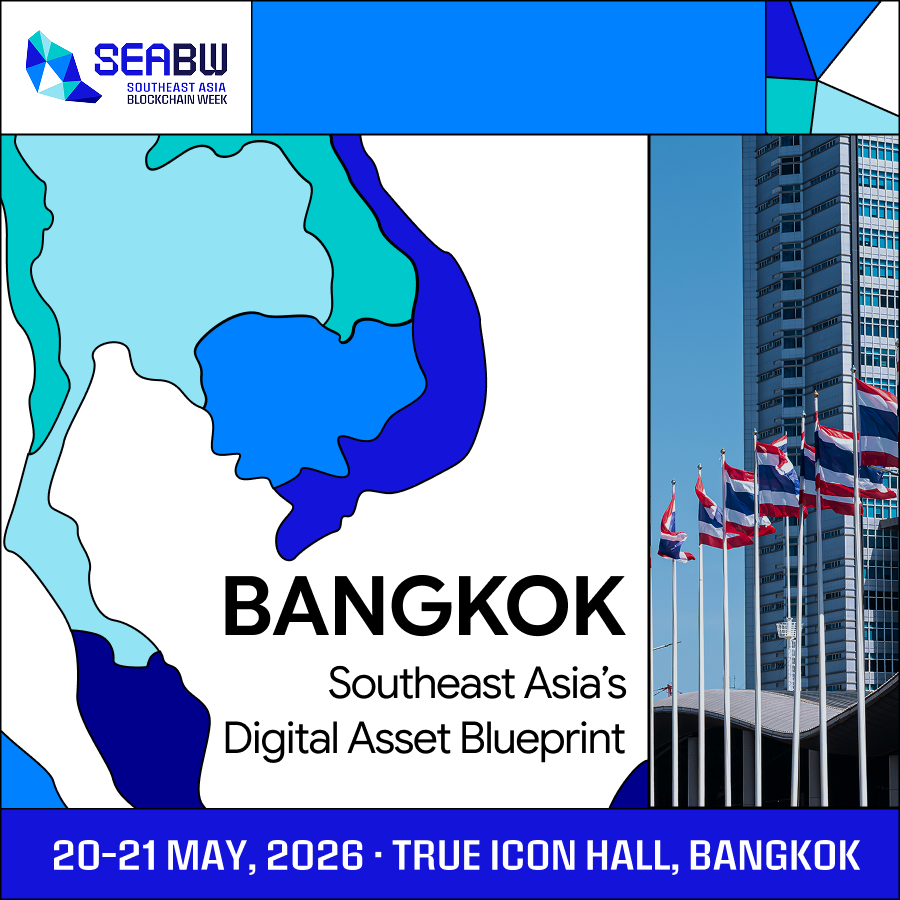
May 20–21. True Icon Hall, Bangkok. #SEABW2026
🎟️ Secure your spot → https://t.co/R8NPqdO4Aa
Speaker Spotlight — ETHCapital Seoul
Wooster Han (@wooster_han92), Head of Communications @hashed_official
Leading strategic communications across Hashed, with experience across ecosystem programming and editorial at the intersection of institutions, policy, and community.
At ETHCapital Seoul, Wooster will be doing a deep-dive on Ethereum Today, speaking on Ethereum’s intrinsic value (ETHVal).
Catch him in Seoul → https://t.co/K3zKhDq04C
What does a leading Web3 VC look for before making an investment?
@Wooster_Han92, Head of Communications at @hashed_official, breaks down his journey and how the team approaches conviction in the space.
1:10 - What Is Hashed
2:40 - Wooster’s Background
4:44 - The Most Standout Part Of His Journey
8:32 - How They Build Conviction Before Investing
13:30 - His Favorite Part Of The Journey
Watch the full conversation below!
Can You Steal a Crypto Project's Value by Stealing Its Code?
Someone on Twitter claimed you can replicate 80% of any crypto project with vibe coding. Fair enough. Forking Bitcoin or copying Uniswap's contracts is a few GitHub clicks away. But copying code and copying value are completely different things.
Let's be honest: crypto has real problems. Too many projects are just a token stapled to a pitch deck. Governance is concentrated, rug pulls are common, and low-effort forks have burned trust across the board. But that's actually the point. Easy replication is a filter. The projects that survive it have built something the code doesn't contain.
This keeps happening throughout history. Bitcoin Cash forked from Bitcoin's code in 2017 and promised faster transactions. Its market cap fell below 1% of the original. Bitcoin SV, Gold, Diamond followed. Same result for Ethereum as well.
Look across crypto today. Uniswap's AMM code has been copied dozens of times, but nobody replicated the liquidity depth. Aave is open source, yet billions in deposits and hundreds of integrations aren't in the codebase. Chainlink's oracle tech is forkable; its status as an industry standard isn't. Polymarket's mechanism is simple, but the price discovery from tens of thousands of traders can't be downloaded. None of these won on code. They won because their networks hit a tipping point.
Think of Wikipedia. Open source software, freely copyable content. Many have cloned the whole database. None replaced it. Nearly 300,000 monthly active editors catch errors within minutes. Copy the data and all you get is a snapshot that falls behind every day.
The longer something survives, the longer it tends to keep surviving. Bitcoin has lasted 16 years through death notices, forks, and regulation. That track record builds trust, trust draws users, users strengthen security. You can't fork that loop. IBM paid $34 billion for Red Hat not for code anyone could copy, but for decades of enterprise trust.
Here's the paradox. As vibe coding makes replication easier, code becomes worth less and networks become worth more. If anyone can clone a project in an hour, the only things left that can't be copied are community, developer commitment, user habits, and time-tested trust.
Saying you can replicate 80% of crypto is really just admitting the most important 20% is untouchable. Code is bone. Network is the living body. Copy the skeleton all you want. Without blood running through it, it's just a specimen on a shelf.
Excited to be in Denver on Feb 18 for Innovate Denver by @TheTieIO. I’ll be speaking on the panel: “Crypto VCs Have Scale, Liquid Funds Do Not. What Are the Implications and Can This Change?”
Looking forward to the conversations—see you there.
Korea’s next economic infrastructure will be programmable — and it should be built with KRW and the AI era in mind.
KRW is more than a currency. It’s a coordination layer for the Korean economy.
And as value moves onchain and AI agents begin to transact on our behalf, the rails we build today will shape what becomes possible tomorrow.
Korea is now entering a more concrete phase of digital finance—where stablecoins and onchain settlement are becoming real infrastructure questions, not just experiments. The next step is making sure this new layer can scale with regulatory realities, institutional requirements, and long-term national competitiveness. That’s why we’re proposing Maroo — a sovereign blockchain standard designed for Korea’s KRW-denominated digital economy and the coming wave of AI agent–driven commerce.
Maroo is designed to be:
- KRW-native — stablecoin-first rails with KRW-denominated gas
- Open + regulated by design — innovation and compliance can coexist
- Programmably compliant — rules can evolve without breaking the system
- Private, but verifiable — prove legitimacy without exposing personal data
- AI-native — accounts that support safe agent-driven transactions
We believe the next chapter won’t just be about apps.
It will be about standards, infrastructure, and trust.