June 1, 1933: The "Fund of German Trade and Industry" is created, a huge slush fund administered by Martin Bormann in the Führer's name. The regime used the funds to compensate SA Stormtroopers who committed street violence, subsize the SS, and enrich Nazi party officials.
I have watched this three times. Both the fear and pride, as a parent, are some of the most relatable things I’ve seen on television in a looooong time. Kudos to @danorlovsky7 and his wife for facing headwinds and raising a good kid.
Madden Orlovsky had a heartfelt message for his family and friends in honor of World Autism Awareness Day 🥹
This was a special moment for all of us at ESPN. Thanks, Madden and @danorlovsky7 ❤️
So, let me get this straight.
Trump is now simultaneously claiming that he has won the war, is currently winning the war, needs help to win the war, and doesn't need help to win the war. All to destroy the nuclear program he claims he already destroyed last year.
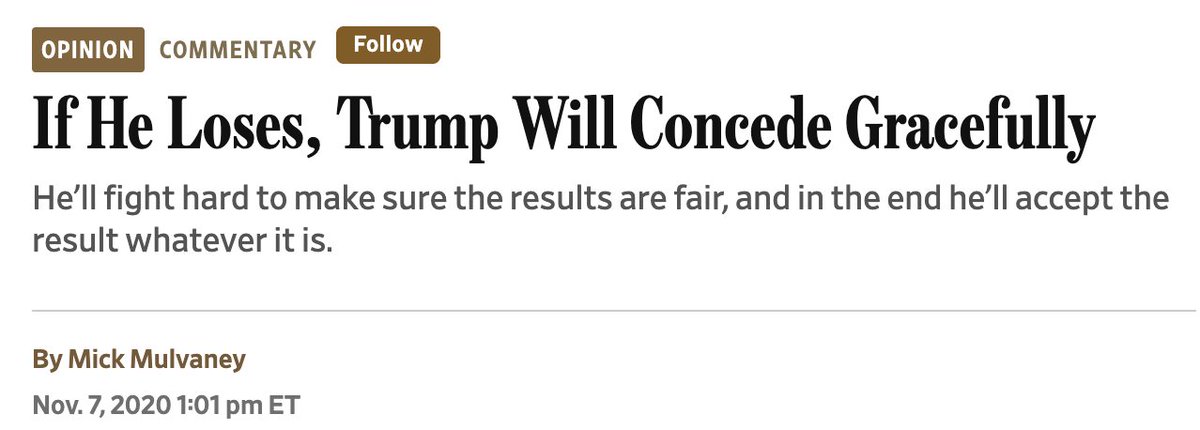
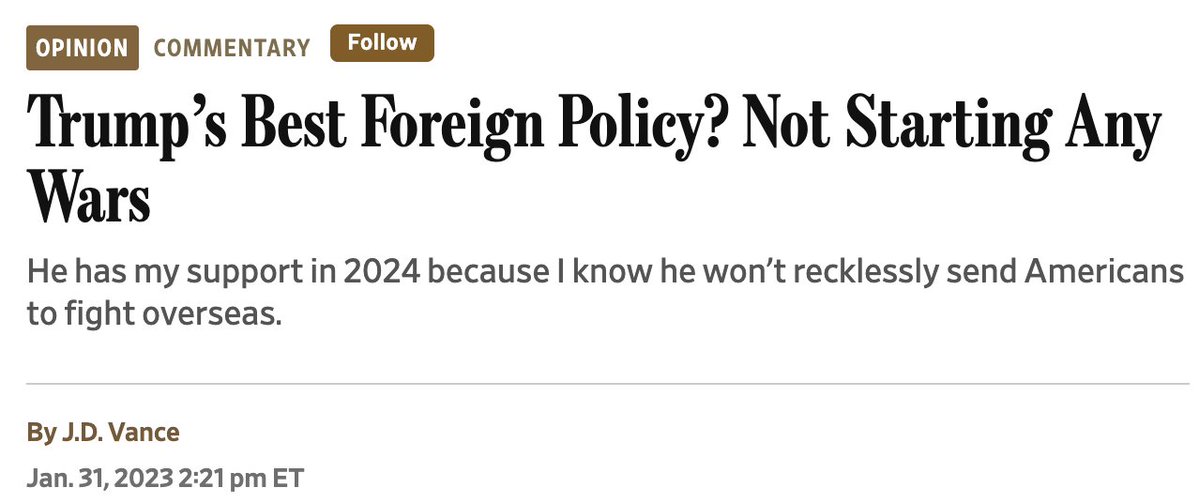
Worst @WSJ op-ed of the Trump era? Choose your fighter.
@JDVance: Trump's Best Foreign Policy? Not Starting Any Wars.
@MickMulvaney: If He Loses, Trump Will Concede Gracefully
This video should unsettle anyone who takes the United States seriously as a nation.
Because it exposes something dangerous: the trivialization of the world's most consequential office. It shows how carelessly the power, credibility, and accumulated moral authority of a superpower can be squandered for a few seconds of viral attention.
In any other major democracy, this behavior from a head of state would trigger a constitutional crisis. Paris would burn. Berlin would convene emergency sessions. In the Nordic countries, resignation would follow within hours. Across functioning democracies, the public, institutions, and political class would recognize this for what it is: an assault on the dignity of the state itself. Leaders are not free to perform as entertainers without consequence. National honor is not personal property, it's held in trust.
But the United States is not just another country with a provocateur in charge. It is the linchpin of global order. It maintains formal alliances and security guarantees with forty to fifty nations. It underwrites the financial architecture, trade systems, and diplomatic frameworks that billions of people depend on daily. When the American president speaks—or posts—it doesn't land as satire, meme, or personal whim. It reads as a signal about what the country is becoming.
American power has never relied solely on carrier strike groups or economic output. It has rested on something more fragile and more valuable: trust. The belief that beneath domestic turbulence lies institutional seriousness, predictability, and a baseline commitment to dignity. That belief is now disintegrating in real time.
Millions of American companies operate globally. They negotiate multibillion-dollar contracts in environments where reputation is currency. Boardrooms in Frankfurt, Singapore, and Dubai aren't debating whether a post was clever—they're asking whether the United States remains a reliable partner. Whether agreements signed today will be honored tomorrow. Whether American leadership has devolved from institutional to purely theatrical.
Consider tourism, which sustains millions of American jobs—airlines, hotels, restaurants, museums, entire regional economies. Soft power isn't an abstraction. It materializes in flight bookings, conference locations, study-abroad programs, and decades of accumulated goodwill. A quiet, decentralized boycott doesn't require government action—only a collective sense that a nation no longer respects itself.
Now picture this image being studied by foreign ministers, central bank governors, defense strategists, and sovereign wealth fund managers. Picture them asking a coldly rational question: How do we write binding thirty-year agreements with a country whose public face will be this, relentlessly, for years to come? How do we plan for the long term when the tone is impulsive, mocking, and unbound by the gravity of office?
This is where the real calculus begins. Trillions in foreign capital depend on confidence that America is stable, credible, and rule-governed. That confidence is now being traded for what, exactly? Applause from an online mob? A dopamine rush from manufactured outrage? Content designed to dominate the news cycle rather than serve the national interest?
Every serious nation eventually confronts this choice: burn long-term credibility for short-term spectacle, or safeguard the reputation previous generations bled to build. The United States spent eighty years constructing an image of reliability, restraint, and leadership under pressure. That image wasn't born from perfection—it came from a visible commitment to standards that transcended impulse.
This isn't a partisan issue. Europeans who value democratic norms recognize something ominously familiar here. Americans—Democrat and Republican alike—who believe in responsibility and restraint should see it too. Power attracts scrutiny. Leadership demands discipline. A superpower cannot behave like a reality TV contestant without paying a price.
The presidency is not a personal broadcast channel. It's a symbol carried on behalf of 330 million people and countless international partners who never voted but whose lives are shaped by American decisions anyway. Every post either reinforces or erodes the idea that America can be counted on when it matters most.
So the question is no longer whether this is offensive. The question is whether this is who America chooses to be: a nation that trades a century of hard-won reputation for viral moments. A country that replaces statecraft with content creation. A republic governed like a season of reality television.
History offers a harsh lesson here. Great powers don't fall because enemies mock them. They collapse when they begin mocking themselves—publicly, proudly, and without grasping the cost until it's far too late.
Stay connected,
Follow Gandalv @Microinteracti1
If you need a pick-me-up today just remember the worst people with the most power went to bed last night praying for riots in Minneapolis to take the smoke off the way they gunned down Alex Pretti and woke up disappointed.
Okay so,
1) an American citizen exercises his First Amendment right to peaceably assemble and his Second Amendment right to bear arms, out of apparent concern that a tyrannical federal government is violating basic protections afforded under the Constitution
2) after coming to the aid of an unarmed woman who's been shoved to the ground by a masked federal agent, the citizen -- impaired by pepper spray, holding nothing but a cell phone -- is dragged to the ground by a group of other masked agents
3) during the scuffle, shortly after one masked agent removes the weapon from the restrained citizen's person, several other masked agents open fire, unloading 10 shots from close range and killing the unarmed citizen
4) despite video evidence, a spokesman for the federal government says the citizen approached agents with a gun, provoked a violent confrontation, and planned to "massacre" law enforcement
You really want to defend this? Go ahead. Just know, you look like an absolute fool.
The US is now doing the kind of things we used to make fun of banana republics for doing when I was a kid.
I know not all the people who supported this man are idiots. Is there a point where the non-idiots say "enough is enough?"
@sweinand You’re objectively right over time, but I’d be curious to know how that pans out in a market such as ours (i.e concerns of bear market ahead). Though this question may be further evidence for the psychology aspect. Merry Xmas, pal.
@dddaniel88 Access. Prestige. Travel with the team. When $20M is the equivalent to 1,000 for schmucks like us, it’s entertainment. 4% on a billion dollars is $40 Mil.
@theficouple How do you manage your rentals while traveling? I’m thinking things like maintenance requests or, god forbid, emergencies like plumbing issues, etc?
Eight years ago I wrote a piece that went semi-viral (for me) arguing that the US was becoming a third-world nation (think Brazil, Venezuela, or Nigeria), a part of the world I was very familiar with.
I charted a four-stage sequence of dysfunction that defined the politics and social structure of these countries, in order of deterioration:
Extreme inequality. There exists an elite minority that assumes control of almost everything: politics, business, and most importantly, cultural norms. While they are much wealthier, the more defining feature is they are almost entirely removed from the majority of the country, both physically and in their worldview (what is right versus what is wrong). They are the guardian class that doesn't understand the plebes they are making the rules (written and unwritten) for.
If this persists for enough time, it leads to:
No compromise. Because this wealthy minority and the much poorer majority have two entirely separate realities (given their physical, economic, and cultural differences), the end up with two different set of facts, and so each side develops fundamentally different worldviews. Consequently, the other side comes to be seen as lesser, immoral, subhuman people. Bending to find a middle ground with them becomes akin to breaking a sacred rule. The other side is the Devil, and you don't make a deal with the Devil.
This leads to:
Corruption. Power flips, in dramatic fashion, between these two groups. Whichever group ends up in power, either the wealthy elite or the poorer mob, they begin eroding whatever checks on their power were in place before, and so the strength and impact of the government grows, and being in office becomes a vehicle to gain wealth for your group and extract revenge on the other group. Politics becomes about sheer power only, and building a functional society becomes a distant second to enriching your friends and harming your enemies.
This naturally leads to:
Cynicism. As things break down, everybody ends up giving up and focusing on just themselves and their immediate family, with little if any regard for the laws, and certainly not for the greater good of the nation. In this environment the elites take their money offshore, and paying taxes becomes something only the dumb do. Citizenship is simply an obligation and burden that must be navigated, not something to be proud of. As they say in Latin America, you end up with a hotel mentality toward citizenship. You are only checked in temporarily.
This brings about complete dysfunction. It makes everything—economy, politics, roads, bridges, police, schools—secondary and so they decay. Those who can leave do, making it worse.
Escalating political violence is part of this sequence, increasing the further down a society falls, and hastening the decline. It usually really starts up in stage two, because the other side is seen as "lesser humans," and really takes off in stage three, when politics becomes a vehicle for revenge.
Where are we now in the US? When I originally wrote this I thought we had entered stage two (No compromise), and now, eight years later, it's pretty clear we are through that and are at incipient stage three (corruption).
Predicting is a fools game, but it's hard to get too optimistic about the immediate future of the US, although it's worth pointing out this process can reverse (look at much of Asia) and a downward trajectory isn't immediate, or fated.
The US has immense advantages relative to a Brazil or Nigeria. We are far more robust, given our economic depth and breadth, as well as our history of stability. But that's not a guarantee of anything.
Empires come and go, and we are currently the world's greatest empire, maybe the greatest the world has ever seen, and staying at that apogee isn't a given. It requires constant work, and that requires some compromise, and that's really hard to do once you are in this downward cycle. (read Toynbee!)
Having said all that, I'm still a grudging optimist, because for the last five years I’ve seen, and heard, how much the rest of the world admires the US.
For all our problems, we really are the shining city on a hill, a place of unbounded opportunity, wealth, and freedom. We wouldn’t really go and just throw that all away. Right?
At this extraordinarily dangerous moment it is a comfort to remember that a weekend talk show co-host who recently quit drinking is running the military.
Sen, Ted Cruz: "I can also assure you that were this a Republican president, a Republican Attorney General, and a Republican IRS that were targeting Democrats, I at least would speak out just as vigorously against it because if we are going to respect rule of law, the apparatus of the federal government cannot and should not be used as a partisan tool to bludgeon your enemies."