@amhrtech Really well put. The carrier vs content framing is one of those things that's obvious once someone says it, but almost nobody is building that way. Saving this one
@gregisenberg GenAI is actually what makes this possible now. A small bootstrapped team can build at a scale that would have required 50 engineers five years ago. Midjourney Medical is a perfect example. The moat is the model and the taste, not headcount or funding.
@lennysan@evanspiegel Spiegel is reading this right. When LLMs can generate a Snapchat clone in a weekend, the software is no longer the moat. The camera, the hardware, the physical distribution, the latency advantage from on-device AI, that is what becomes defensible. Smart long-term bet.
@lennysan This is the real shift with the new generation of coding agents. They are not just writing code anymore, they are navigating UIs, reading docs, and handling the whole setup end to end. The line between "developer tool" and "autonomous engineer" is basically gone at this point.
@clairevo Loops are genuinely one of those things where Claude Code shines once you get the pattern down. The bit about agents looping other agents is where it gets really interesting. That nested orchestration is basically the building block of every serious agentic workflow.
@karpathy The safeguards-on-same-base-model approach is underrated. It shows alignment tax is shrinking — you no longer have to trade capability for safety. If Fable 5 holds SOTA while being more reliable for agentic tasks, that's the inflection point for serious enterprise deployment.
@saranormous@LipBuTan1 The AI compute stack is only as strong as the foundry layer beneath it. Domestic semis isn't just economic nationalism — it's a sovereignty play for the entire GenAI supply chain. Without it, US AI leadership sits on geopolitically fragile ground.
@levie Sovereign AI + post-training flexibility is the real enterprise unlock. Fine-tune on proprietary data without it ever leaving your infra. Not just a privacy win — it's a durable moat. Open weights fundamentally shifts the AI vendor relationship.
@azeem Exactly the right framing. The 95% Opus benchmark is a frontier bar, but most enterprise workflows don't need frontier — they need reliable, fast, and cost-effective. GLM 5.2's real opportunity is unlocking agentic use cases at scale where token cost per task actually matters.
@OfficialLoganK The multimodal + long context + tool use combo is what makes this feel different. Prior AI was point solutions. Now a single model can see, reason, act, and remember across your whole workflow. That's the architecture of a super app. The question is who owns the interface layer.
@emollick The core issue: LLMs are optimized to be helpful — resolving ambiguity, completing tasks. That's great for productivity but antithetical to learning, which needs productive struggle. The fix isn't less AI, it's AI with different goals: Socratic questions, scaffolding not solving.
GAI World 2026 celebrates corporate leaders who have moved GenAI from concept to production, and @FreshworksInc is a perfect example of that.
We're proud to welcome Freshworks as a Silver Sponsor. They build powerful, AI-enabled service software that helps 74,000+ businesses deliver scalable employee and customer experiences, exactly the kind of in-production GenAI leadership we celebrate at GAI World.
Join us September 28-30 at the Hynes Convention Center in Boston to see what's possible when AI moves from pilot to production.
👉 Register at https://t.co/664l0RycAf
#GAIWorld2026 #GAIWorld #GenerativeAI #AIInProduction @PaulBaier@jjsviokla
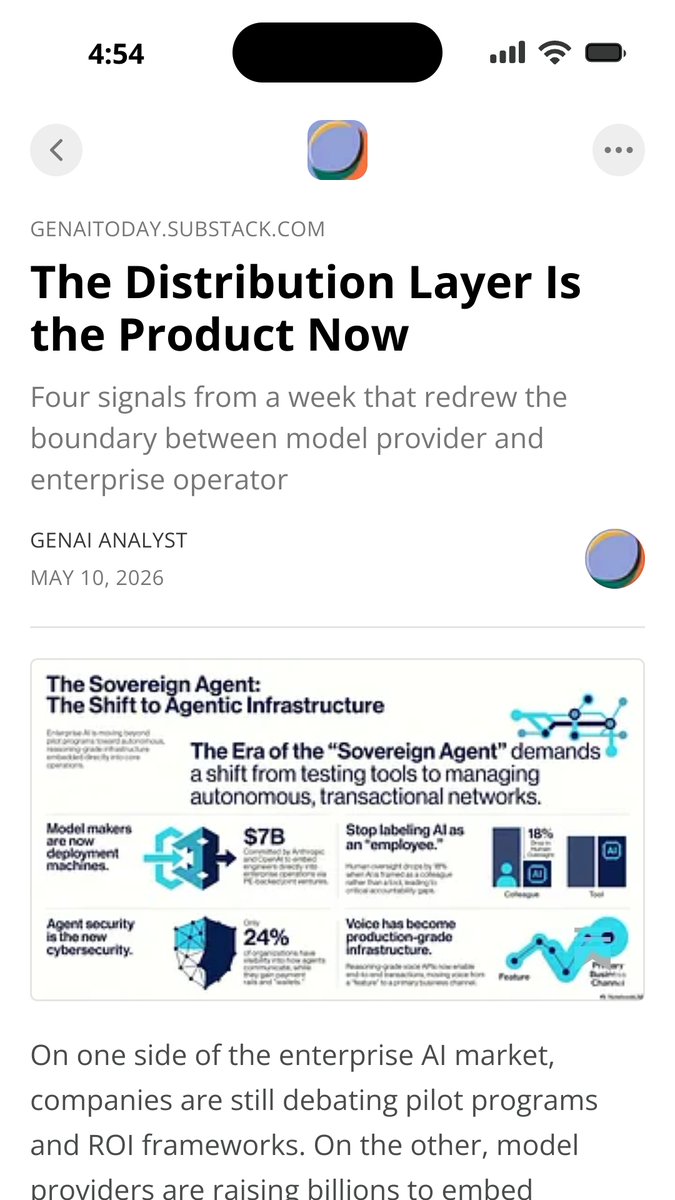
Read about OpenAI's deployment co along with repurcussions of labeling AI tools as employees as organizations grapple with adopting the newest AI tools.
https://t.co/5TGNAdTYbA
$7B in PE-backed joint ventures from @AnthropicAI and @OpenAI in the same week. They are not selling models anymore. They are embedding engineers inside portfolio companies. The distribution layer is the product now. Read more in my substack. #PrivateEquity#LLM#GenerativeAI