🚨 Today in @Nature, we report GEMINI—a genetically encoded intracellular memory device that writes cellular dynamics into tree-ring-like fluorescent patterns within cytoplasmic protein assemblies.[1/n]
https://t.co/eVchPCiK6f
🤔
“Here we present evidence that eukaryotic circular RNAs (circRNAs) can serve as templates for 3' to 5' backward translation (BT), yielding polypeptides with distinct sequence and structural features not found in canonical proteomes.”
https://t.co/0e8pUWPUh7
Our scMicro-C paper is out in @NatureGenet! Huge thanks to the reviewers for their valuable insights, to @XieSunney for unwavering support, and to fantastic collaborators @JiankunZhang21 & @tanlongzhi. Thrilled to share this work!
Very excited to share our work on high-resolution single-cell Micro-C, which is on bioRxiv now. Here we reveal that cohesin-mediated loop extrusion participates in transcription with kilobase-resolution single-cell 3D structures. https://t.co/NabmuTnh1p
🔥🔥🔥OUR NEW PREPRINT: Slowing and reversing aging? Nature does it, here we show how! Age deceleration and reversal gene patterns in dauer diapause. Huge congrats to Kristy Totska, João Barata, Walter Sandt and @Meyer_DH https://t.co/mrMcV6vBZ0
Introducing RAEFISH, our lab's new flagship image-based spatial transcriptomics technology that simultaneously enables single-molecule spatial resolution and whole-genome level coverage of long and short, endogenous and engineered RNA species in cell cultures and intact tissues.
We are excited to report the discovery of TIGRs, a widely-occurring RNA-guided system found in bacteria and their viruses. TIGRs consist of a peculiar repeat region which is transcribed into RNA and processed into multiple guide RNAs to direct TIGR-associated proteins to their DNA targets. https://t.co/ketXqFVQqw
Did you know cancer cells can be electrically active, just like neurons? This electrical activity plays a key role in tumor progression. Excited to share my first postdoc paper at @TheCrick (and first paper from @LiGroup_Crick), published in @Nature!
https://t.co/bqekzffnG0
New #preprint from our lab at @IMBA_Vienna !
How do DNA breaks locate homology sites in the vast space of the human genome? We show how #cohesin guides homology search for faithful repair!
Read more 👉 https://t.co/ouPmrddhPr
Follow along for key insights! 🧵1/12
Thrilled to introduce a new single-cell 3D genome analysis tool to our toolkit! Our high-throughput droplet Hi-C (dscHi-C) and dscHi-C-multiome methods use droplet microfluidics to generate tens of thousands of single-cell Hi-C profiles with high sensitivity in a single batch.
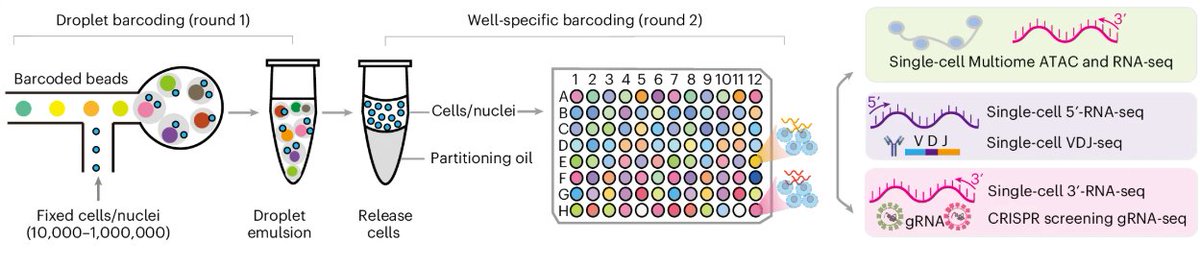
.@LanJiangBoston and colleagues developed droplet-based UDA-seq by incorporating a post-indexing step into two-round combinatorial indexing, enhancing throughput for large-scale single-cell analysis.
https://t.co/j4XFlSKtXA




![DingchangLin's tweet photo. 🚨 Today in @Nature, we report GEMINI—a genetically encoded intracellular memory device that writes cellular dynamics into tree-ring-like fluorescent patterns within cytoplasmic protein assemblies.[1/n]
https://t.co/eVchPCiK6f https://t.co/KPmYKFgnZt](https://pbs.twimg.com/media/HCgxFtcWkAAoaPS.jpg)