We are encouraged by the changes to the OpenAI board. We believe this is a first essential step on a path to more stable, well-informed, and effective governance. Sam, Greg, and I have talked and agreed they have a key role to play along with the OAI leadership team in ensuring OAI continues to thrive and build on its mission. We look forward to building on our strong partnership and delivering the value of this next generation of AI to our customers and partners.
GPTs are a new way for anyone to create a tailored version of ChatGPT to be more helpful in their daily life, at specific tasks, at work, or at home — and then share that creation with others. No code required. https://t.co/SPV4TcMiQw
What the hell is an ampersand and why does it look like that?!
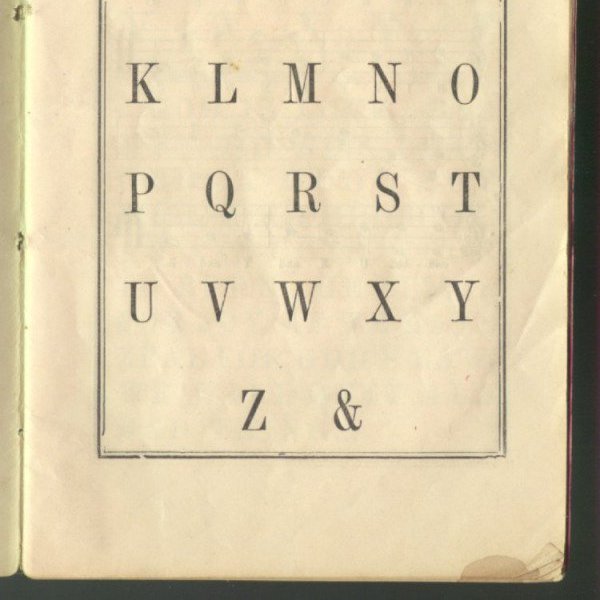
The first thing you need to know is that "&" used to be the 27th letter of the alphabet...
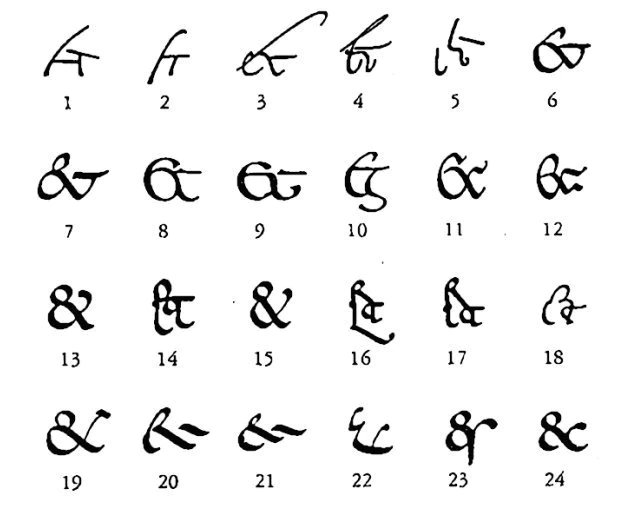
But there are three parts to this story. And the first begins over two thousand years ago in Ancient Rome with a single word: et. It's the Latin for "and". At some point Roman scribes started combining the two letters of et into a single symbol, which was the ancestor of our modern &.
The earliest example of the "et" symbol is actually from graffiti in Pompeii. In any case, it did not disappear with the fall of the Roman Empire.
Latin survived as the language of the Catholic Church and of scholarship in Medieval Europe. Scribes during the Dark Ages continued to use the & symbol. It evolved down the centuries, in places losing any semblance of the letters e and t whatsoever.
The second part of the story is that during the 18th and 19th centuries, as education and the teaching of literacy spread, & was added to the end of the alphabet as a sort of 27th letter.
On a related note, although "et cetera" is now usually just abbreviated as etc., for a long time it was instead abbreviated as "&c". The & was for et and the c for cetera.
The third and final part of the story is about how the alphabet was taught to children — and how it was read out loud.
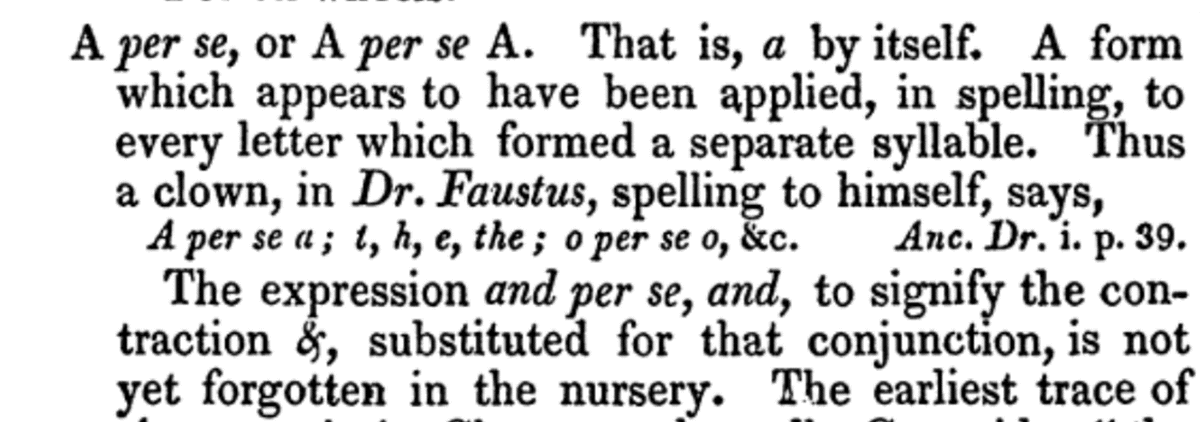
As this 1822 Glossary of Words and Phrases explains, it had been normal during the Renaissance, when speaking the alphabet, to add "per se" before any letter which could also be a word on its own — "per se" means "by itself" in Latin.
Take the letter A, which can also be a word of its own. When reading out the alphabet people would say "A, per se A, B, C, D, E, F, G, H, I, per se I..." and so on. O was also considered a word of its own.
Which means, when people got to the end of the alphabet, with & being the 27th letter, they would say: "S, T, U, V, W, X, Y, Z, and per se &."
When this old way of reading the alphabet was taught to children in the 18th century and they were reciting it aloud, they would garble "and per se " into what eventually became... ampersand.
A Dictionary of Slang and Colloquial English from 1905 relates some of the many other pronunciations school children apparently came up with:
"Ampersand. The sign &; ampersand. Variants: Ann Passy Ann; anpasty; andpassy; anparse; apersie; per-se; ampassy; am-passy-ana; ampene-and; ampus-and; ampsyand; ampazad; amsiam; ampus-end; apperse-and; empersiand; amperzed; and zumzy-zan."
Well, of all the many pronunciations that might have stuck, it was "ampersand" which came to be accepted and is now the official name for &... rather than zumzy-zan. So, from hurried Roman scribes to unruly school children, that's where "&" came from.
Picasso kicked off his Blue Period after the death of a friend, bolstering a belief that grief inspires great art.
It turns out the opposite appears to be true. This paper studies 12,000 works of art and finds that bereaved artists make less important & fewer pieces of art.
We need new technical breakthroughs to steer and control AI systems much smarter than us.
Our new Superalignment team aims to solve this problem within 4 years, and we’re dedicating 20% of the compute we've secured to date towards this problem.
Join us! https://t.co/cfJMctmFNj
Exciting to see this incredible partnership evolve between @Microsoft x @starheroes_game. #Blockchain based gaming is becoming incredibly important in paving the road to #web3 + delivering on a truly innovative vision for #nextgen#gaming https://t.co/cB0vegZNl2
It can be difficult trying to figure out how to get started and move fast on a specific business or technology problem.🤔
@XBudd explains how #IBMGarage helps businesses around the world 🌎 get started and unstuck to truly innovate and transform.
https://t.co/h9nK8WtBk6
At the Internet Archive, this is how we digitize #78 rpm records.
Our partner @georgeblood_lp has perfected this technique, digitizing with 4 different styli at once.
We put as much effort into capturing the #metadata as we do digitizing the music.
If you're looking to drive a faster pace of #innovation, IBM Garage may be able to help. It's a great space that has allowed us to co-create with our clients. Hope you will check it out -- https://t.co/j9QEcTZ0mK
Could not be more excited for 4 full days of talks, workshops, & mindshares! Join me @LavaCon to catch my talk on Building/Scaling Successful Design Practices!
Learn more + register: https://t.co/xVa2mtJW4o (use #TeamBudd for $100 off!)
#designconference#deisgnthinking#UX
with the start of the Fall semester, couldn’t help but look back on my own incredible experiences @Cornell — came across this great short clip and had to share! #cornell#infosci
Today marks a significant milestone in IBM’s collaboration with several global banks joining our growing ecosystem of financial institutions, adopting IBM Cloud for Financial Services: https://t.co/1DTLPtlJXW