Can a virtual cell suggest a drug worth testing in real human tissue?
UNAGI models disease-linked cellular states from single-cell transcriptomics, then simulates drug perturbations. In this 20 June 2025 study, researchers tested its predictions in human precision-cut lung slices exposed to a pro-fibrotic cocktail.
Nifedipine and nintedanib shifted measured cellular profiles toward the control state. For the top 100 treatment-responsive genes, predicted versus measured expression gave adjusted R² values of 0.889 and 0.898, respectively.
The useful workflow: learn disease states → rank perturbations → test human tissue → compare molecular responses.
The boundary matters: these are ex vivo molecular readouts, not demonstrated clinical benefit or evidence that nifedipine treats pulmonary fibrosis. Performance on selected genes also does not establish general prediction accuracy.
Zheng et al., Nature Biomedical Engineering. 2025 JIF: 26.3.
https://t.co/TX15wJxGss
Image 1: Zheng et al., Nature Biomedical Engineering, Fig. 6, unchanged; same DOI. CC BY 4.0: https://t.co/5FI8oXuMt7
Image 2: original AI-generated concept illustration.
Can AI find a better conductor than copper? This large search is useful partly because its answer is: not here.
A 20 October 2026 study screened ~2.8 million ordered inorganic compounds, combining machine-learning estimates of electronic transport and electron–phonon coupling with symbolic regression. It then applied detailed first-principles transport calculations to 52 selected systems.
At 300 K, leading candidates including Be₂IrPt and LiBePt₂ approached aluminum-like conductivity in the scalar-relativistic calculations. None surpassed silver, gold or copper. Including spin–orbit coupling lowered Be₂IrPt's prediction from 38.02 to 34.96 million S/m.
Method worth saving: cheap screening should end with explicit scattering calculations—not just a ranking of fast electrons. Relativistic effects also deserve a check when heavy elements dominate.
Boundary: these are computational candidates, not newly synthesized or experimentally validated conductors. Ideal-crystal predictions do not establish manufacturability or real-device performance.
npj Computational Materials — 2025 JIF: 13.1.
Paper: https://t.co/DnX67v9Tuy
Image 1: da Silva et al., npj Computational Materials, Fig. 1, DOI above. CC BY 4.0: https://t.co/5FI8oXuMt7 — unchanged.
Image 2: AI-generated concept illustration; not experimental data.
Which drug pairs deserve the next experiment?
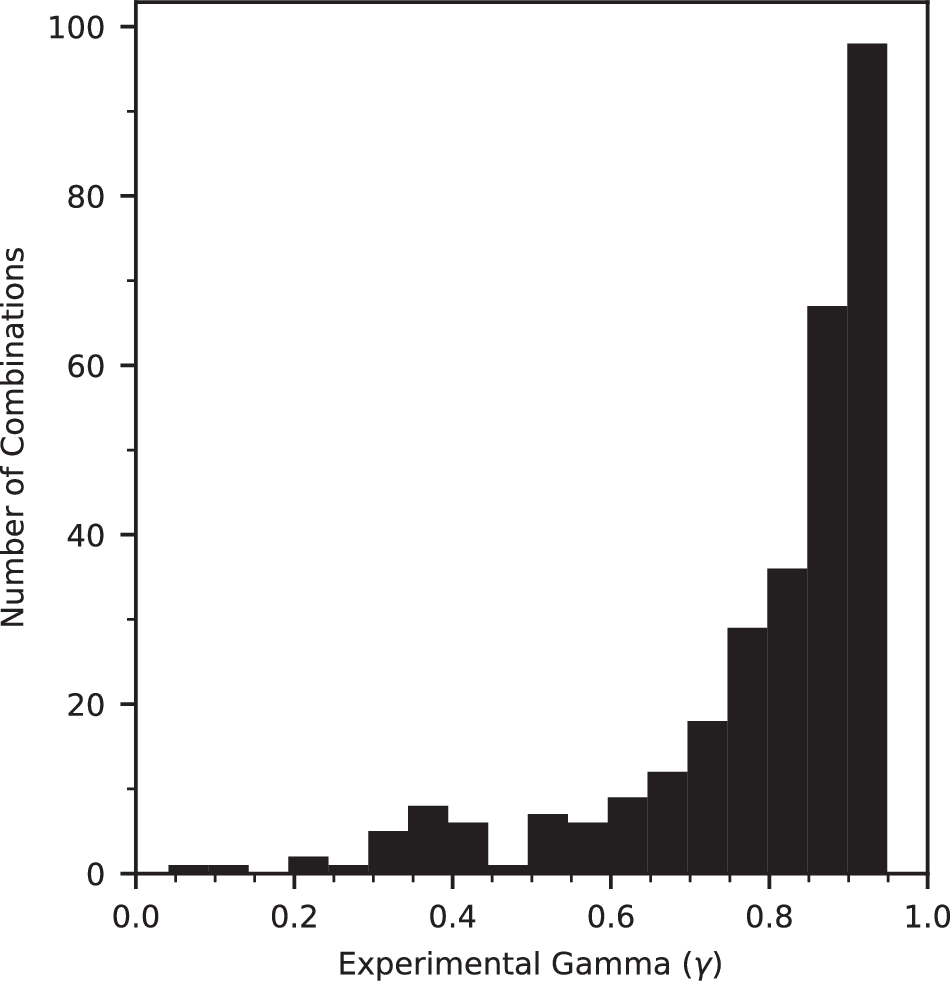
A pancreatic-cancer study trained machine-learning models on 496 tested combinations, then ranked roughly 1.6 million candidate pairs. Of 88 distinct nominated pairs, 51 met the study's synergy criterion in PANC-1 cells: gamma <0.95, measured using duplicate 10×10 dose matrices and 72-hour viability assays.
A useful reading rule: distinguish prospective hits from the complete dataset. The paper's 307 synergistic combinations include 256 training-set pairs plus 51 new validation hits. Figure 5 shows that many lie near the cutoff; only 26 have gamma <0.5.
This is experimental prioritization in one cell line, not evidence of safe or effective treatment in patients.
Pourmousa et al., “AI-driven discovery of synergistic drug combinations against pancreatic cancer.” Nature Communications, 29 April 2025. JIF 18.1 (2025).
https://t.co/QhjNoFHc9H
Image 1: Pourmousa et al., Nature Communications, Fig. 5, unchanged; same DOI. CC BY 4.0: https://t.co/5FI8oXvkiF
Image 2: original AI-generated concept illustration.
A headline energy density means little without the electric field that produced it.
In this 10 June 2024 study, generative learning guided five candidate compositions for high-entropy ceramic dielectric films. The best, C-3, reached 156 J/cm³ at 5,104 kV/cm in an approximately 160-nm film.
The method combined phase-field insights, generative sampling and regression-based ranking, then checked candidates through synthesis and electrical measurements. Annealing conditions were also optimized, so “five compositions” should not be mistaken for just five measurements.
The useful comparison: C-3 also survived 100,000 charge–discharge cycles, but at a lower 2,000 kV/cm, with energy density around 33.36 J/cm³ and efficiency around 77%.
Save this rule: compare peak performance and endurance at matched test conditions. These thin-film results do not establish bulk-capacitor performance or industrial-scale reliability.
Nature Communications | 2025 JIF: 18.1.
Paper: https://t.co/RB0GwHAuFk
Image 1: Wei Li et al., Nature Communications, Fig. 4, same DOI; unchanged. CC BY 4.0: https://t.co/5FI8oXvkiF
Image 2: original AI-generated concept illustration, not experimental evidence.
Can AI preserve a drug's pharmacophore while changing its scaffold?
TransPharmer combines pharmacophore fingerprints with a transformer. After computational filtering and synthesis-related modifications, three of four tested candidates inhibited PLK1 below 1 µM. IIP0943 reached 5.1 ± 1.7 nM in an ADP-Glo kinase assay (20 µM ATP, 25°C), and 0.22 ± 0.003 µM in HCT116 cell-viability assays after 24-hour treatment.
The useful checkpoint: separate enzyme potency, cellular activity and structural evidence. Figure 6 includes docking predictions, not an experimentally solved IIP0943 complex. Four selected compounds are a small validation set; patient benefit remains untested.
Xie et al., “Accelerating discovery of bioactive ligands with pharmacophore-informed generative models.” Nature Communications, 10 March 2025. JIF 18.1 (2025).
https://t.co/GxE5QqmTBy
Image 1: Xie et al., Nature Communications, Fig. 6, unchanged; same DOI. CC BY 4.0: https://t.co/5FI8oXvkiF
Image 2: original AI-generated concept illustration.
What if a synthesis algorithm rewarded each new crystal family instead of repeatedly finding the easiest one?
In this 25 November 2025 study, AIRES combined robotic synthesis, image recognition and single-crystal X-ray diffraction. Ten successful linkers yielded 11 zinc–imidazolate framework crystals across seven topologies.
The useful design choice: after a linker succeeds, redirect experiments toward unexplored linkers. A random-forest model ranks crystallization probabilities; batch selection avoids redundant bets.
The speed claim needs context: replaying an experimentally measured dataset, the algorithm needed about 700 selections versus 1,400 for random search to recover the successful linkers. This was a dataset-replay benchmark, not two prospective laboratory campaigns.
Save this distinction: verified crystal structures establish discovery; replay benchmarks estimate search efficiency. Neither establishes useful device performance.
Nature Synthesis | 2025 JIF: 22.7.
Paper: https://t.co/XpDuufi4eM
Image 1: Zichao Rong et al., Nature Synthesis, Fig. 4, same DOI; unchanged. CC BY 4.0: https://t.co/5FI8oXvkiF
Image 2: original AI-generated concept illustration, not experimental evidence.
Can AI design receptor selectivity, not just a plausible molecule?
A 2024 study put DRAGONFLY’s generated molecules through synthesis and experiments. Compound 1 activated PPARγ and PPARδ in cell-based reporter assays, with EC50 values of 1.5 and 0.24 µM. Compound 2 selectively activated PPARγ at 2.3 µM. A crystal structure confirmed compound 1’s binding pose.
The useful lesson: judge generative chemistry with a chain of evidence: synthesis, functional activity, direct binding, selectivity, then structure.
Important limits: the generator excluded PPAR-family proteins from training, but ranking still used known-ligand activity data. Synthesis was difficult; these are preclinical molecules, with no demonstrated patient benefit.
Atz et al., “Prospective de novo drug design with deep interactome learning.” Nature Communications, 22 Apr 2024. JIF 18.1 (2025).
https://t.co/zR1wD9BN42
Image 1: Atz et al., Nature Communications, Fig. 6, unchanged; same DOI. CC BY 4.0: https://t.co/5FI8oXuMt7
Image 2: original AI-generated concept illustration.
A better catalyst can depend as much on operating conditions as on composition.
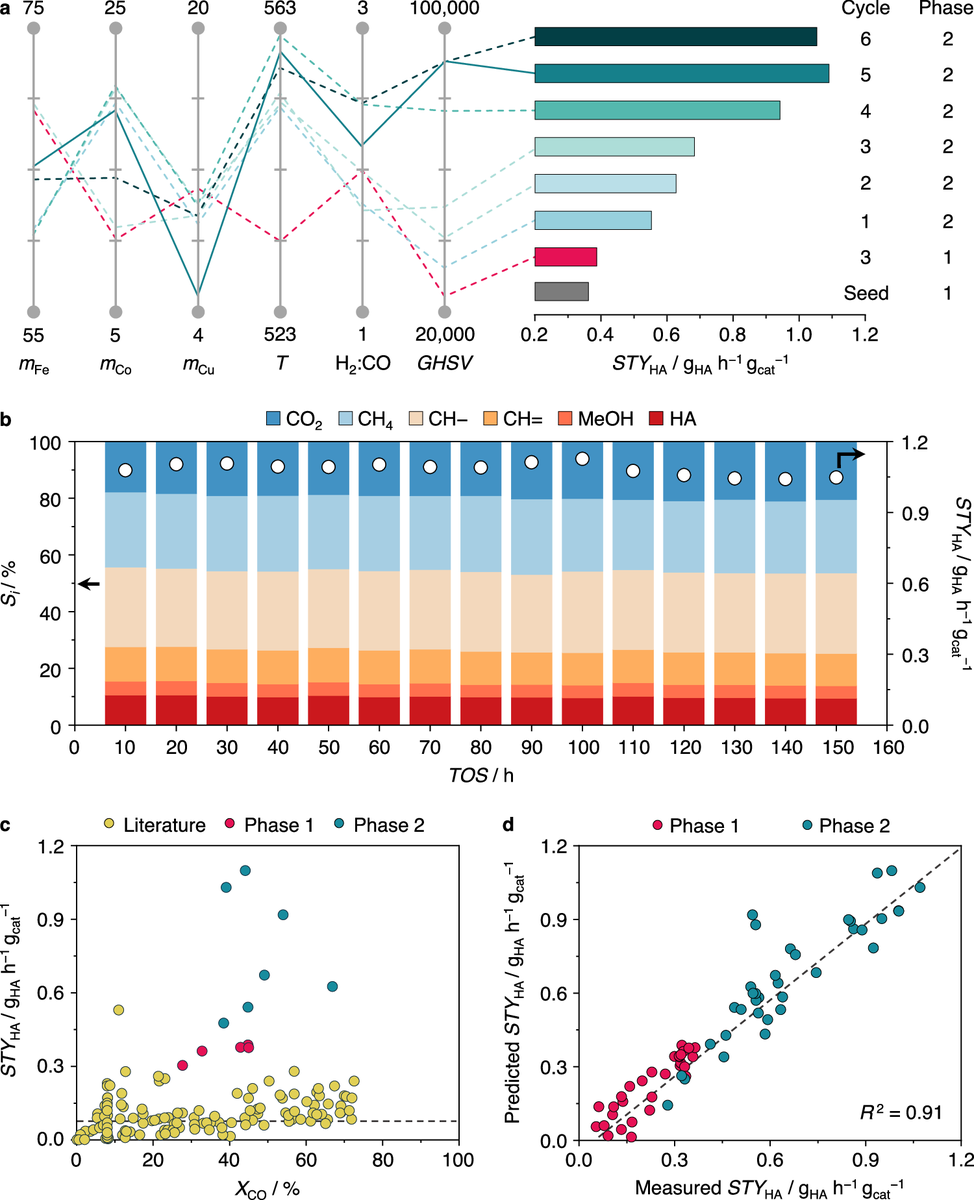
In this 11 July 2024 study, active learning jointly optimized Fe–Co–Cu–Zr catalysts and reaction settings for making higher alcohols from syngas.
Fe65Co19Cu5Zr11 reached 1.1 grams of higher alcohols per hour per gram of catalyst at 551 K, 50 bar, H₂:CO = 2.2 and a gas hourly space velocity of 90,000 cm³ h⁻¹ gcat⁻¹. A 150-hour run maintained productivity ≥1 g h⁻¹ gcat⁻¹ and CO conversion ≥40%.
The practical takeaway: optimize the material and its operating window together. Gaussian-process predictions and Bayesian optimization proposed experiments; humans still selected candidates.
The limitation matters: high productivity did not remove the trade-off with unwanted CO₂ and methane. This was laboratory catalysis, not a demonstrated commercial process or a zero-carbon claim.
Nature Communications | 2025 JIF: 18.1.
Paper: https://t.co/HvOMRzx0sc
Image 1: Manu Suvarna et al., Nature Communications, Fig. 4, same DOI; unchanged. CC BY 4.0: https://t.co/5FI8oXuMt7
Image 2: original AI-generated concept illustration, not experimental evidence.
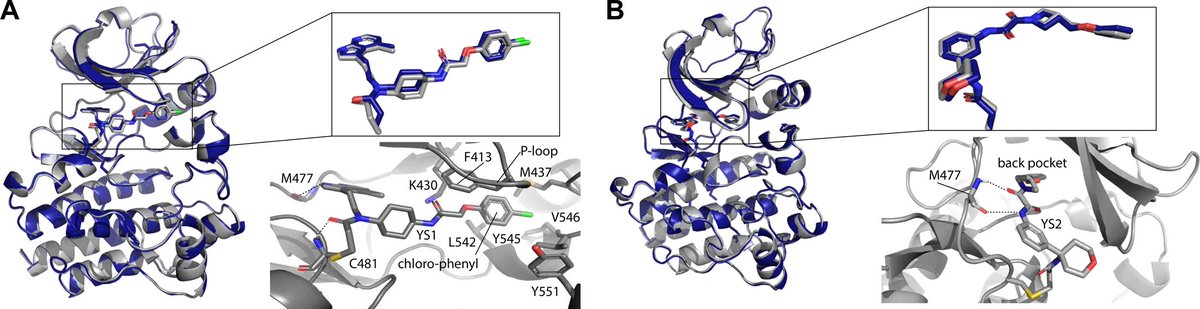
An AI-predicted binding pose survived an X-ray reality check.
AlphaFold3 helped researchers discover YS1, a new covalent inhibitor of the cancer-relevant kinase BTK. From roughly 906,000 screened molecules, 13 were synthesized. YS1 inhibited purified BTK with an IC50 of 30 nM in an assay containing 20 µM ATP, and also inhibited BTK signaling in Mino cells.
Its crystallographic binding pose matched the prediction within 0.50 Å ligand RMSD.
A useful screening lesson: evaluate enrichment, then test binding, function and selectivity. An attractive predicted pose alone cannot establish a drug’s activity.
Limits: this is preclinical discovery, not a demonstrated cancer treatment. The prospective campaign studied one kinase; broad target generalization remains unproven.
Shamir et al., “Discovery of Covalent Ligands with AlphaFold3.” JACS, 20 Mar 2026. JIF 16.6 (2025).
https://t.co/kudgkaevcK
Image 1: Shamir et al., JACS, Fig. 4, unchanged; same DOI. CC BY 4.0: https://t.co/5FI8oXuMt7
Image 2: original AI-generated concept illustration.
An AI-designed alloy still needs to survive the furnace.
In this 14 July 2024 study, transfer learning helped design ICSX2, a nickel-based single-crystal superalloy that lasted 176 hours before creep rupture at 1200°C under 80 MPa.
The team fine-tuned a physically constrained neural network for scarce ultrahigh-temperature data, then tested two proposed alloys. Adjusting the molybdenum/tantalum ratio guided the search.
The revealing detail: ICSX2 exceeded its 163-hour prediction, but ICSX1 lasted only 93 hours against a predicted 176. Save this evaluation rule: report the misses alongside the winning material, especially when extrapolating beyond training conditions.
This is laboratory creep validation, not evidence of qualified engine-blade service. Experiments and first-principles calculations linked performance to strengthened γ/γ′ interfaces.
npj Computational Materials | 2025 JIF: 13.1.
Paper: https://t.co/UiXXoUwC9X
Image 1: Fan Yang et al., npj Computational Materials, Fig. 6, same DOI; unchanged. CC BY 4.0: https://t.co/5FI8oXuMt7
Image 2: original AI-generated concept illustration, not experimental evidence.
Venom proteins can hide promising antibiotic starting points.
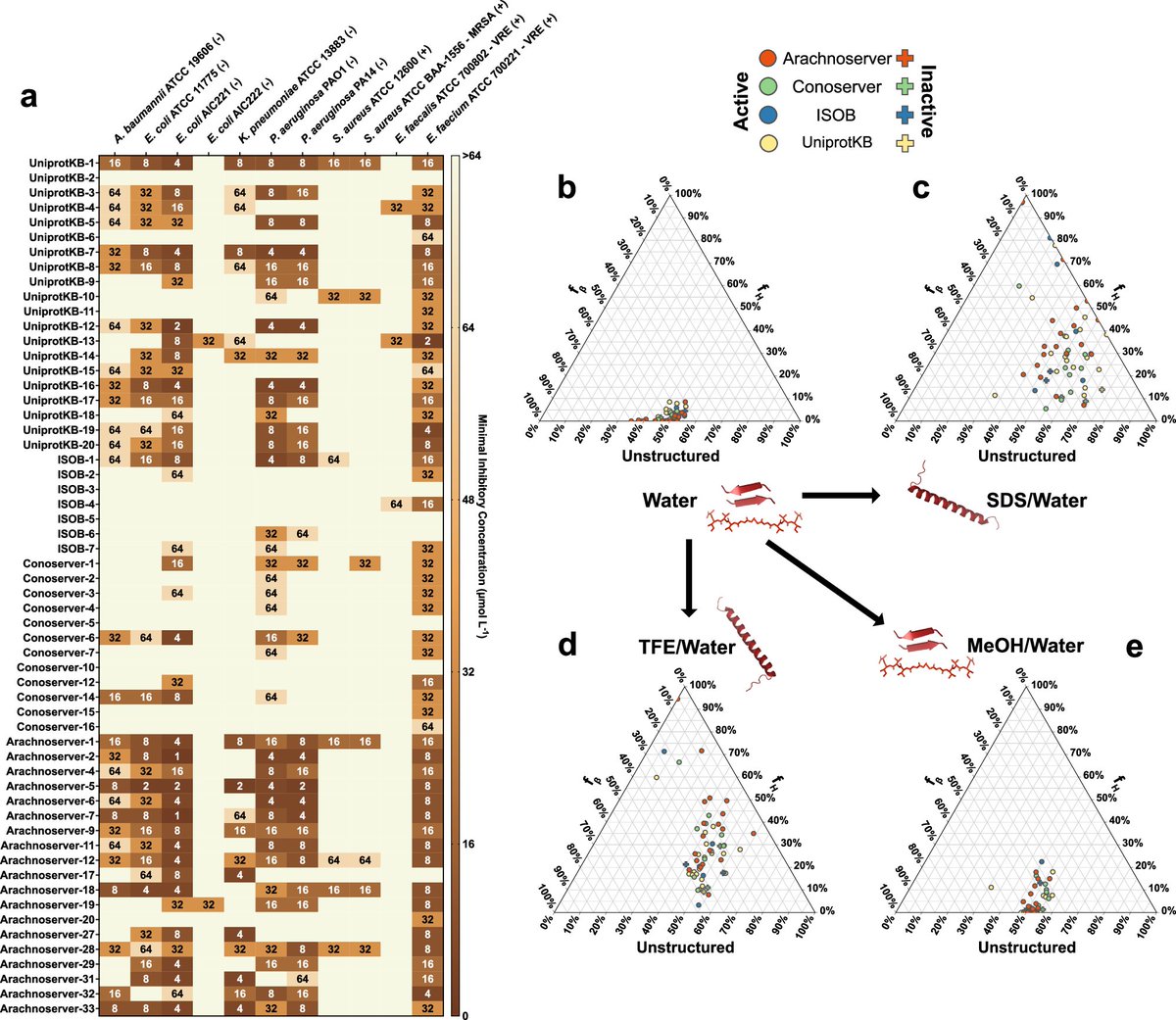
A 2025 study worth revisiting: Guan et al. used APEX deep learning to prioritize peptide fragments from 16,123 venom proteins. Of 58 selected peptides synthesized and tested, 53 inhibited at least one bacterial strain.
The experiments matter more than the search-space headline. Testing covered 11 bacterial strains; growth was measured after 24 hours at 37°C. Selected leads also reduced bacterial burden in a mouse skin-infection model following topical treatment.
My screening checklist: separate computational candidates, tested hits and animal evidence. Pair antibacterial potency with mammalian-cell toxicity and hemolysis measurements before choosing leads.
Important limits: the tested set was highly selected; some peptides were cytotoxic. Potential ion-channel effects still need experimental assessment. These are preclinical leads, with no demonstrated human efficacy or systemic safety.
Published 12 July 2025, Nature Communications (2025 JIF: 18.1).
https://t.co/Gpka9zJ1zw
Image 1: Guan et al., Fig. 2, DOI above. Uncropped and unaltered. CC BY 4.0: https://t.co/5FI8oXuMt7
Image 2: AI-generated concept illustration, not microscopy.
Can an AI agent turn a paper’s procedure into real laboratory actions?
A March 2026 study tested an X-ray nanoprobe and robotic polymer-film station.
For a PEDOT:PSS film workflow, agents retrieved previously reported coating conditions of 90°C and 1 mm/s, then planned and executed the sequence of substrate handling, pipetting and blade coating.
The system requested human approval before execution. Its contribution is instrument orchestration, not discovery of a new polymer or a newly optimized recipe.
Human corrections stored as reusable memory improved task execution. But feedback did not reliably fix weak visual reasoning, and models still produced invalid commands or sequencing errors.
My deployment checklist: restrict available actions, review generated code, retain human approval and test long action sequences separately from simple tool calls. Disclose supervision and failure modes.
Vriza et al., 6 Mar 2026. npj Computational Materials (2025 JIF: 13.1).
https://t.co/QSPz3iwOw0
Image 1: authors’ Fig. 4, unchanged. CC BY 4.0: https://t.co/5FI8oXuMt7
Image 2: AI-generated concept illustration, not an experimental photograph.
Where you close a peptide ring can decide whether synthesis works.
CycloPepper tackles this practical bottleneck in peptide-drug development. Pan et al. trained a support-vector classifier on 306 experimentally tested linear precursors, spanning 2–14 residues, including failed cyclizations.
With automated on-resin synthesis using DAN resin, 64 of 74 validation predictions matched LC-MS outcomes. That 86% describes prediction agreement, not an 86% product yield or drug-discovery success rate.
The useful lesson: record the exact linear precursor and reaction conditions. Rotating the same cyclic sequence changes the closure site and can change the outcome. Negative experiments belong in the training set.
This is a synthesis-feasibility method within the tested chemistry. It does not establish binding, therapeutic efficacy or generalization to arbitrary peptide chemistry.
Published 14 Feb 2026, Nature Communications (2025 JIF: 18.1).
https://t.co/33kiosyGSv
Image 1: Pan et al., Fig. 4, DOI above. Uncropped and unaltered. CC BY 4.0: https://t.co/5FI8oXuMt7
Image 2: AI-generated concept illustration, not experimental evidence.