Arrived in Seoul for #ICML2026! 🇰🇷
I’ll be around July 7–10 and presenting our poster, “Knowing Isn’t Understanding,” on proactive AI agents with epistemic and behavioral grounding 🧠
📍#COEX, Hall A, Poster #506
🕒Thu, July 9, 5:00–6:45 PM KST
Would love to connect!
Excited to share that I’ll be presenting our position paper, “Knowing Isn’t Understanding,” at #ICML2026 in Seoul!
What would it take for AI to become a true
partner in how we think and discover, rather than simply a more autonomous tool? 🤖
We envision epistemic partnership: proactive agents that navigate epistemic incompleteness, surface unknown unknowns, and calibrate how strongly they act based on what they can legitimately understand.
Grateful to have worked on this with @ikiran013 and @chirag_shah. Looking forward to great conversations!
@uwcse@uw_ischool@icmlconf
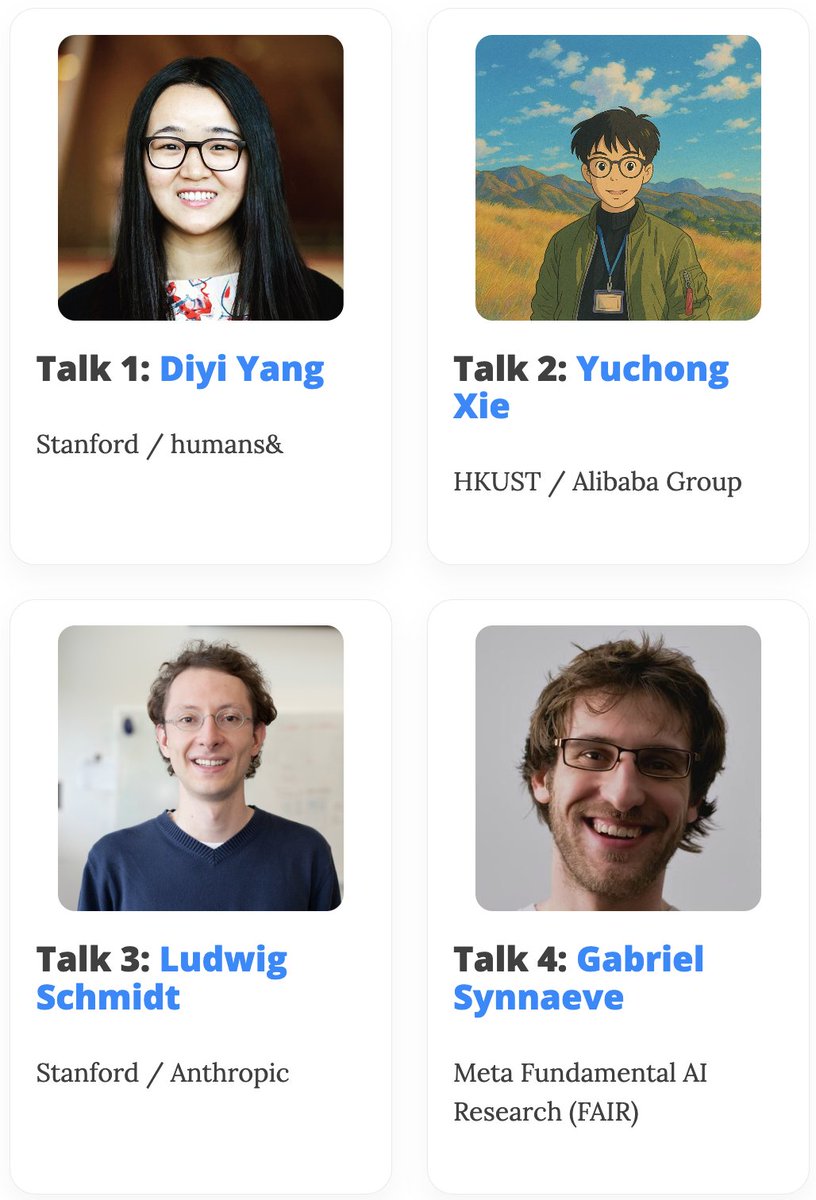
Welcome to the new edition of DL4C at #icmlconf this year! with the theme "Towards Human-Centered Coding Agents"
Check out our amazing line of speakers: Diyi, Yuchong, Ludwig, and Gabriel 🎤
This Friday (July 10) at 📍HALL B2
Excited to share that I’ll be presenting our position paper, “Knowing Isn’t Understanding,” at #ICML2026 in Seoul!
What would it take for AI to become a true
partner in how we think and discover, rather than simply a more autonomous tool? 🤖
We envision epistemic partnership: proactive agents that navigate epistemic incompleteness, surface unknown unknowns, and calibrate how strongly they act based on what they can legitimately understand.
Grateful to have worked on this with @ikiran013 and @chirag_shah. Looking forward to great conversations!
@uwcse@uw_ischool@icmlconf
Come check out our RLxF workshop this Friday at ICML2026! 🇰🇷
We have fantastic speakers and panels on RL from world feedback: moving beyond human preferences toward signals grounded in real-world outcomes.
📍Fri Jul 10, 8 AM–5 PM KST
Grand Ballroom 101–102
Come say hi! 👋
I'll be presenting today our work on proactive agents #ACL2026NLP
📍 Coronado
📷 Session 3: Oral/Posters/Demos B
📷 Poster Session B🪧
Beyond, would love to chat more about proactive agents, knowledge gaps, personalization, and meaningful human-AI collaboration 📷🪧🌱🤝
If you’re coming to #ICML2026 🇰🇷, this Seoul Guide might be All You Need!
I’ve lived in Seoul for 20+ years and curated this all-in-one guide: Top 5 must-visits, 100+ recs with Google Maps, practical local tips, and more.
Check it out: https://t.co/AdN1sHMg1I
DMs are open and happy to give more details!
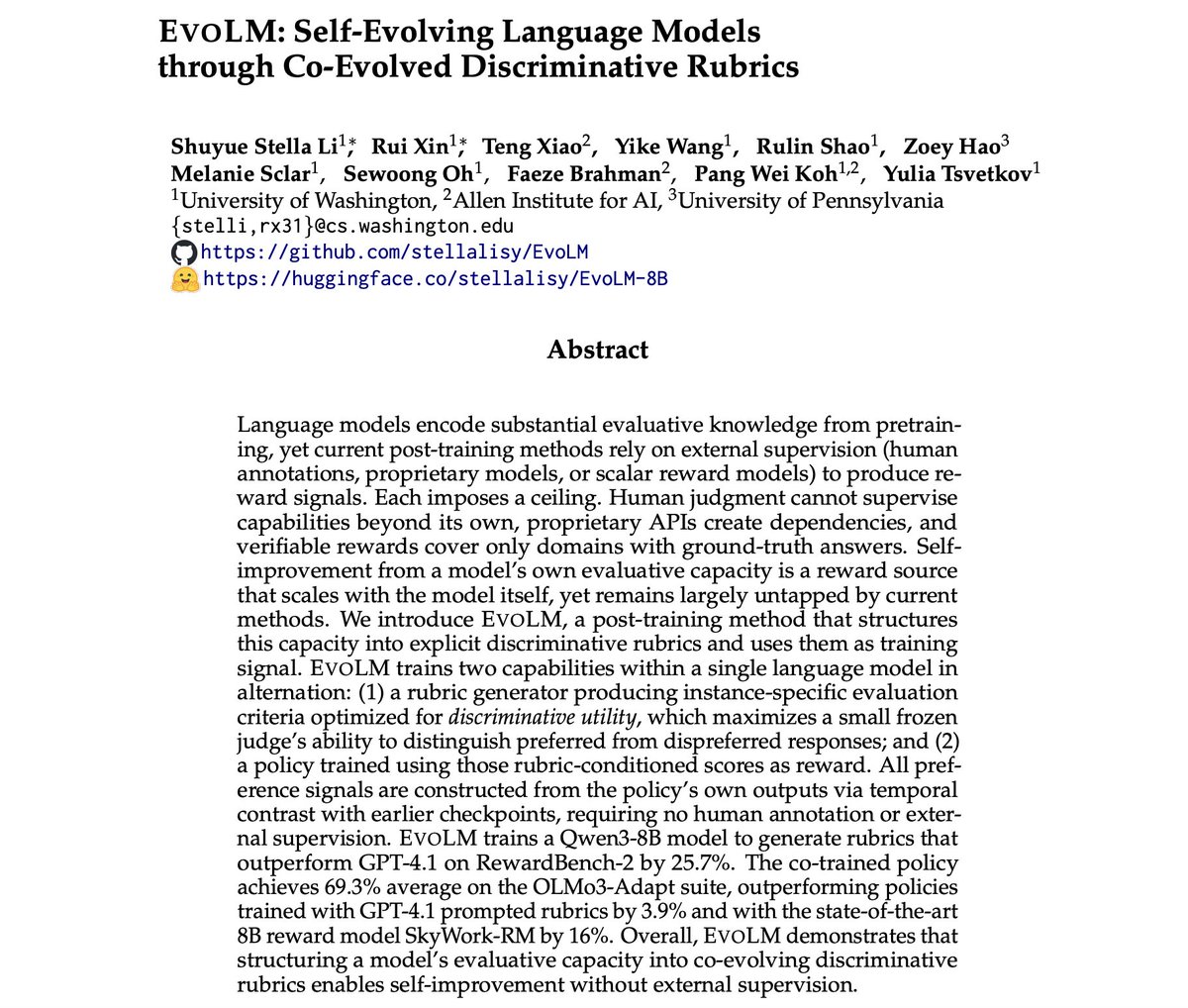
LMs can learn from human labels, training data, and stronger teachers. But what happens when all of these run out when the model is already at the frontier and there is no stronger external source to learn from❓
In EvoLM, we extract the model's own evaluative knowledge into rubrics, and use them to improve its own generation🔁
This enables self-improvement with no external signals‼️
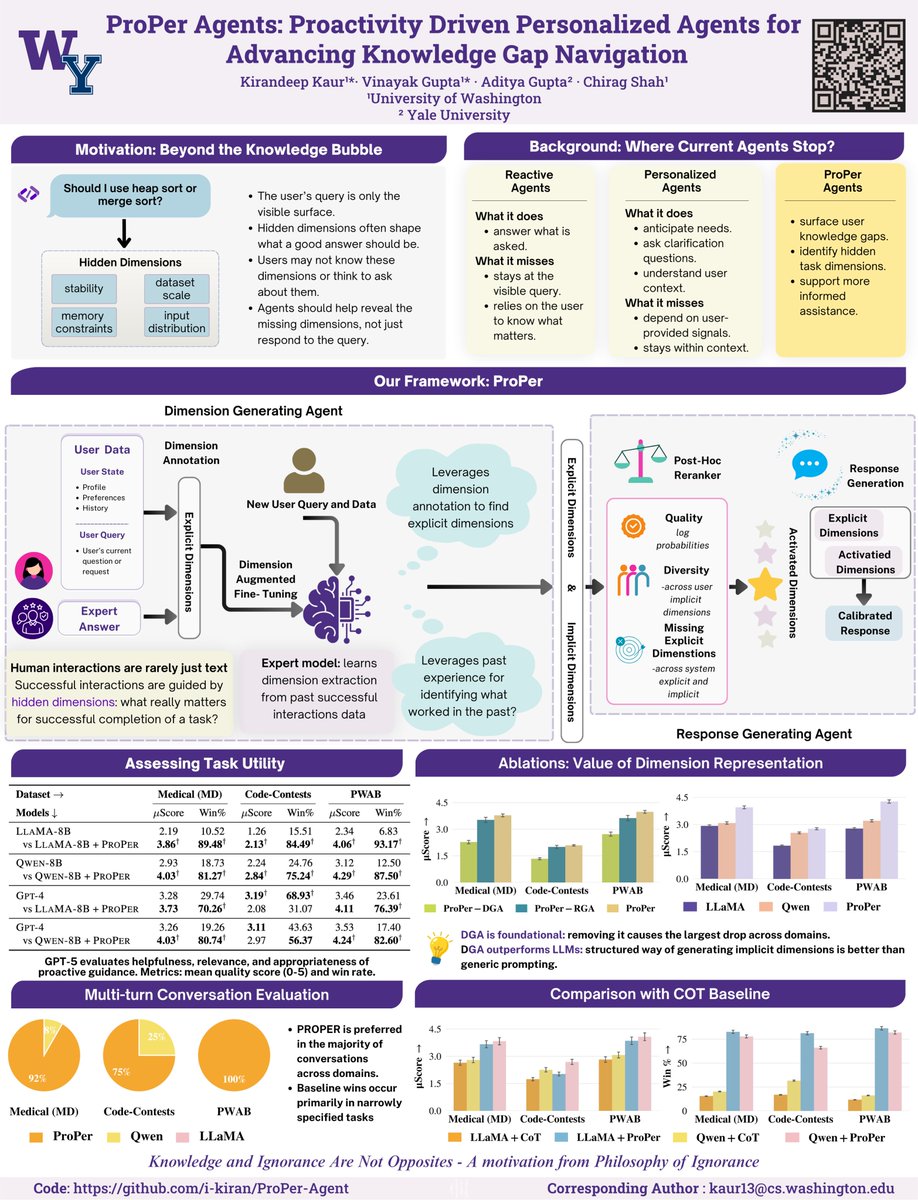
I’ll be attending #ACL2026 for the first time and presenting our work on PROPER Agents 🤖✨
Please come visit our poster if you’re around!
📍 Coronado
🗓️ Sun, July 5
⏰ 14:00–15:30
🧾 Session 3: Oral/Posters/Demos B
🪧 Poster Session B
Would love to chat about proactive agents, knowledge gaps, personalization, and meaningful human-AI collaboration 🌱🤝
🥹⋆꙳•❅*‧ ☃️‧*❆ ₊⋆ 𝑨 𝒍𝒊𝒕𝒕𝒍𝒆 𝑨𝑪𝑳 𝒔𝒕𝒐𝒓𝒚…
Had so much fun last Christmas 🎄wrapping up this ambitious project with @vinayakg51
We had first pitched the idea in early September, but then life happened: giving quals, designing assignments, lecturing, grading, interviews, prep, and a million tiny academic fires 🔥
By December, I was wrapping up the quarter as 𝗹𝗲𝗮𝗱 𝗶𝗻𝘀𝘁𝗿𝘂𝗰𝘁𝗼𝗿 𝗳𝗼𝗿 𝗮 𝗰𝗼𝘂𝗿𝘀𝗲 📚 and @vinayakg51 was 𝘀𝘄𝗶𝘁𝗰𝗵𝗶𝗻𝗴 𝗷𝗼𝗯𝘀 💼
So naturally… we decided this was imperfectly the most perfect time to take a shot at hashtag#ACL 💪🚀
After days of cold and rainy sleepless days and nights in Seattle, it all worked! 🥹
Excited to share that our work, 𝙋𝙍𝙊𝙋𝙀𝙍 𝘼𝙜𝙚𝙣𝙩𝙨: 𝙋𝙧𝙤𝙖𝙘𝙩𝙞𝙫𝙞𝙩𝙮 𝘿𝙧𝙞𝙫𝙚𝙣 𝙋𝙚𝙧𝙨𝙤𝙣𝙖𝙡𝙞𝙯𝙚𝙙 𝘼𝙜𝙚𝙣𝙩𝙨 𝙛𝙤𝙧 𝘼𝙙𝙫𝙖𝙣𝙘𝙞𝙣𝙜 𝙆𝙣𝙤𝙬𝙡𝙚𝙙𝙜𝙚 𝙂𝙖𝙥 𝙉𝙖𝙫𝙞𝙜𝙖𝙩𝙞𝙤𝙣, has been accepted at
#ACL2026!
📜Full Paper ➜ https://t.co/arLIRHFhqh
🧵 ⬇︎
Excited to share that #LatentMAS has been accepted to ICML 2026 as a spotlight!
💻Code: https://t.co/jBN26NG1PY
📄Paper: https://t.co/vuv8nYBTic
We push multi-agent collaboration into the latent space — beyond human language.
Most multi-agent systems rely on text: agents reason in words, exchange messages, and repeatedly decode/re-encode information. But language can be slow, lossy, and unnecessarily constrained.
💡LatentMAS takes a different path: LLM agents reason and communicate directly through hidden embeddings.
No text decoding.
No extra training.
No token-level message passing.
Instead, agents collaborate through:
🧠 Autoregressive Latent Thoughts — hidden-state-level reasoning steps
🔁 Latent Communication — information sharing via KV-cache transfer
📌 Input-output Alignment — keeping latent representations in-distribution
🚀 Training-free Collaboration — plug-and-play with existing LLMs
Why it matters:
✅ Up to +14.6% better accuracy on complex reasoning tasks
⚡ 4-4.6x faster end-to-end inference
✂️ 70.8%–83.7% reduction in output token usage
A step toward multi-agent systems that collaborate not by speaking more, but by thinking together in latent space.
#MultiAgentSystems #ModelCollaboration #LatentReasoning #LLM #AgenticAI #ICML
🚨📰 Can an AI agent actually function as a peer collaborator in a human team? In our new paper at #AIED2026, we deployed a voice-based LLM agent in face-to-face group work with 33 participants and looked at how they negotiated autonomy, trust, and anthropomorphism with it in real time.
https://t.co/0KZnOo62dU
@mithci@MIT_CSAIL@mitSTEPlab
1/n 🧵
Wikipedia for Agents? StackOverflow for Agents?
Meet Multi-Agent Transactive Memory (MATM). We show that 30+ agents sharing successful trajectories into a shared searchable repository can improve their effectiveness and efficiency 🧵👇
https://t.co/RFDjMKJL5x
A fun thing about research: sometimes someone else explains why your question matters better than you did!
Our ICML paper on foundations of good proactivity was featured and discussed🌟 by @promptedllc + @MachineBrief, and both pieces picked up the tension we care about most:
AI agents should not just be faster answer machines.
They need to know when the user is missing the question. 🧠✨
The agent era will not be won by systems that always “do more.” It will be won by systems that know when doing more is justified.
That is the shift from assistance → collaboration → epistemic partnership. 🤖🤝
PromptedLLC: https://t.co/gzafLwbTjB
Machine Brief: https://t.co/LT4Ez736rn
#AIAgents #AIAlignment #ResponsibleAI #ICML2026
Excited to share that I’ll be presenting our position paper, “Knowing Isn’t Understanding,” at #ICML2026 in Seoul!
What would it take for AI to become a true
partner in how we think and discover, rather than simply a more autonomous tool? 🤖
We envision epistemic partnership: proactive agents that navigate epistemic incompleteness, surface unknown unknowns, and calibrate how strongly they act based on what they can legitimately understand.
Grateful to have worked on this with @ikiran013 and @chirag_shah. Looking forward to great conversations!
@uwcse@uw_ischool@icmlconf
Excited to share our #ICML 2026 position paper: Knowing Isn’t Understanding: Regrounding Generative Proactivity with Epistemic and Behavioral Insights
@XingdaLyu@chirag_shah
We keep asking:
“How should AI agents respond?” 🤖
But as agents start planning, acting, interrupting, and deciding with us, the deeper question is:
“How should AI agents collaborate?” 👀
🧵 #ICML2026 @icmlconf
Excited to share our #ICML 2026 position paper: Knowing Isn’t Understanding: Regrounding Generative Proactivity with Epistemic and Behavioral Insights
@XingdaLyu@chirag_shah
We keep asking:
“How should AI agents respond?” 🤖
But as agents start planning, acting, interrupting, and deciding with us, the deeper question is:
“How should AI agents collaborate?” 👀
🧵 #ICML2026 @icmlconf
1/
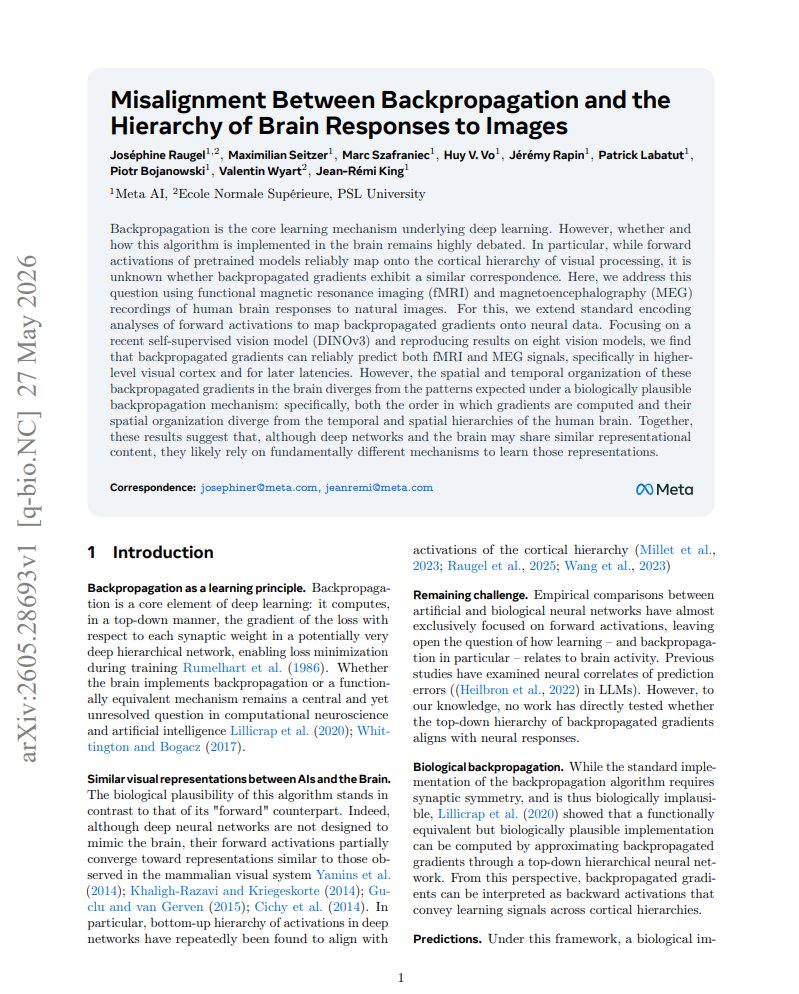
AI and human brains form remarkably similar internal representations when looking at images. But their learning algorithms are fundamentally mismatched.
New neuroimaging research shows the brain's learning signals completely lack the sequential, top-down cascade of backpropagation. 🧵
Stanford + Meta just dropped the paper that flips everything about AI agents.
It's called "Code as Agent Harness."
Right now, we treat large language models as text generators. When they need to solve a complex problem, they rely on a "chain of thought."
But natural language is slippery. It's vague. It loses context. When an agent hallucinates in English, it just keeps talking.
So they introduced a framework that changes the entire architecture of autonomy: "Code as Agent Harness."
They stopped asking the AI to reason in words, and forced it to reason in code.
Code isn't just the final output anymore. It is the memory. It is the environment. It is the boundary.
Instead of writing a paragraph about how to solve a problem, the agent writes a script, executes it, and reads the output.
Tests become its senses. Execution logs become its memory. Sandboxes become its physics.
If an agent makes a mistake in English, it apologizes and hallucinates again.
If an agent makes a mistake in code, the compiler throws an error. The trace tells it exactly what broke. The system forces it to fix it.
This is where prompt engineering dies, and systems engineering takes over.
The paper proves that reliability doesn't come from a smarter base model. It comes from the "harness" wrapped around it:
- The model proposes.
- The harness executes.
- The environment returns feedback.
- The verifier checks.