كيفية استخدام برنامج Claude لكتابة البحوث الأكاديمية (Practical Workflows) من الالف الى الياء في رابط واحد مع الاوامر prompts الرابط https://t.co/x1TKp1NSy9
👆👆
So what is RIGOR? It is a tool that gives you a specialized, systematic review of your papers, finished or in progress, using your own API key or using RIGOR credits. The advantage is that you choose, depending on the state of your paper, how much to spend and what to spend it on.
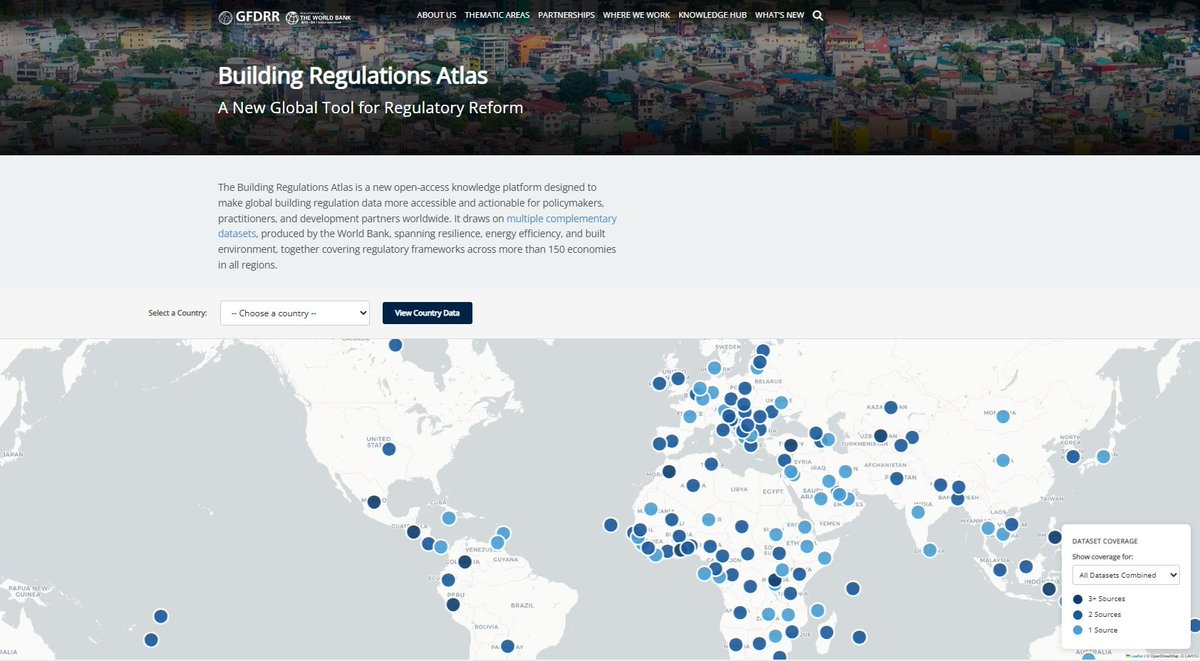
Building regulations shape the safety, sustainability, and resilience of our built environment.
The Building Regulations Atlas helps countries benchmark their systems, identify gaps, and prioritize reforms.
Explore the Atlas: https://t.co/os6yiyS8x6
Need help with Difference-in-Differences? Meet ChatDID: a GPT specialized in modern DiD methods and the de Chaisemartin–D'Haultfoeuille estimators and software packages.
Try it here:
https://t.co/nl2fiqBP7z
Hi #EconTwitter!
Interested in #microeconometrics & causal inference?
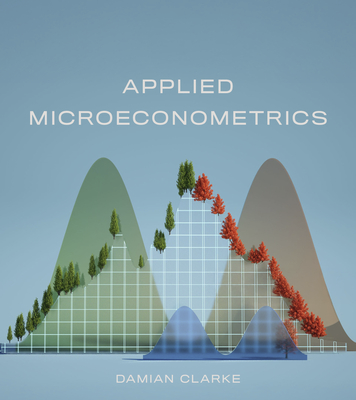
Damian Clarke's (@UniofExeter) 𝐀𝐩𝐩𝐥𝐢𝐞𝐝 𝐌𝐢𝐜𝐫𝐨𝐞𝐜𝐨𝐧𝐨𝐦𝐞𝐭𝐫𝐢𝐜𝐬 is out! The website is free, open and very cool, with lots of code/data in #R, #Python & #Stata.
Useful for grad students!
I put together a short practical guide for economists who want to use Claude Code, but who haven't gotten around to trying yet.
The goal is to reduce the start-up costs by using Claude Code within VS Code.
Social Science toolkit from OpenAI:
"GABRIEL: an open-source toolkit... turn unstructured text and images into quantitative measurements."
For economists, social scientists, and data scientists to study qualitative data at scale.
You could use this even if you haven't coded before. Let me know if you'd like me to do a quick getting started guide.
Colab notebook and repo in reply
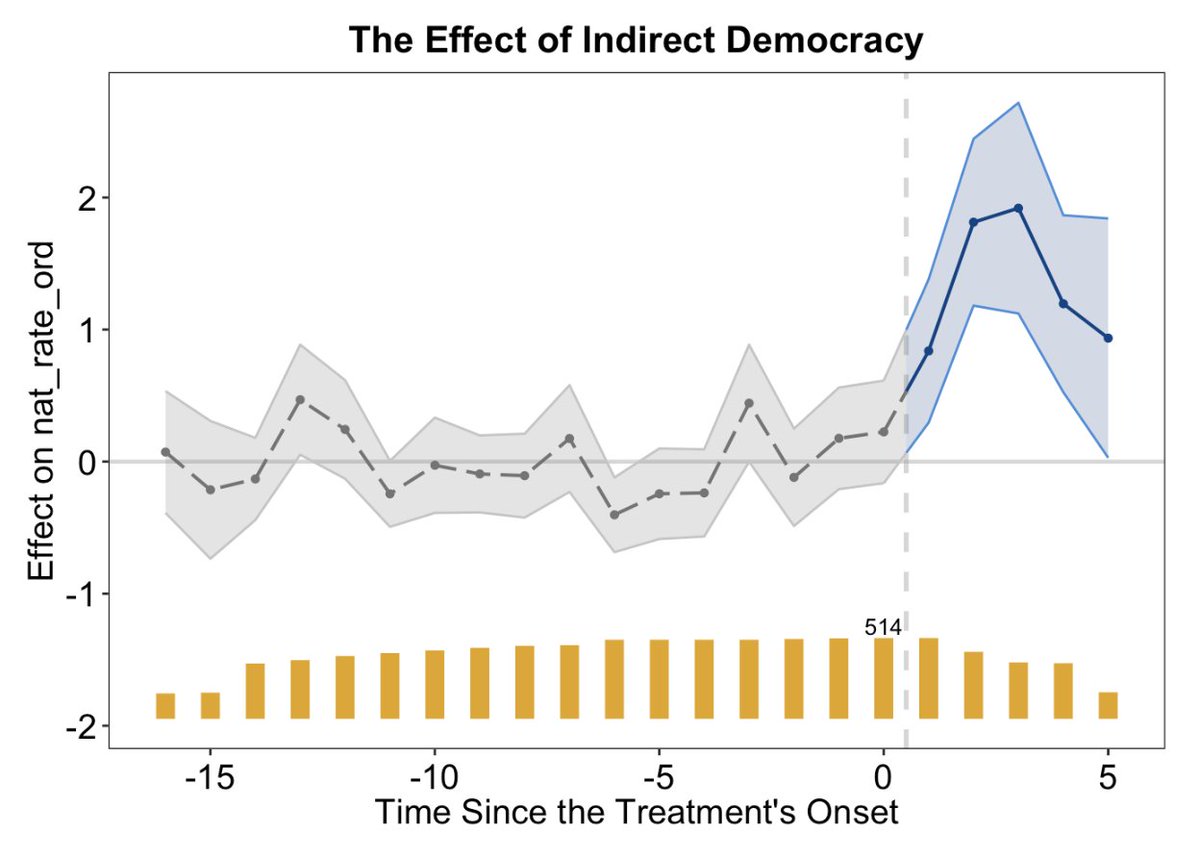
Major update: **fect** 2.2.0 (CRAN)
(again, made possible by Tianzhu @qintianzhu & @statsclaw)
Check it out: https://t.co/P9rg4UQHjk
- Supports >2 fixed effects
- Supports unit-specific (linear, quadratic, smooth) time trends
- Supports time-invariant covariates
- Core C++ upgrade to improve convergence
- User-facing model selection based on MSPE
- Major refactoring relative to **gsynth**
- Tons of new visualization options
- Fully reproducible results under parallel computing
- Resolves bloated memory issues
- did_wrapper() & esplot() bug fixes
- and many more....
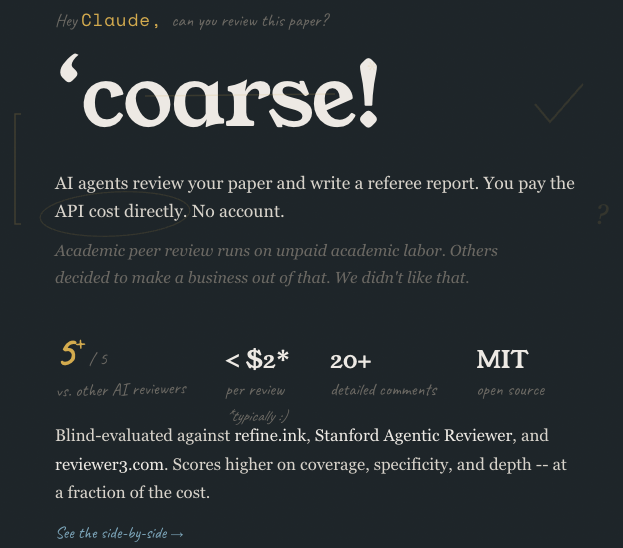
I coded up an open-source, not-for-profit AI paper reviewer that rivals the performance of @reviewer3com, @RefineInk, and Stanford Agentic Reviewer (according to @GeminiApp). Costs <$2!
Live @ https://t.co/5m1Srky4H8. Plug in paper, @OpenRouter key, and email. #econtwitter.
Large Datasets: Claude Code for Economists with Paul Goldsmith-Pinkham |... https://t.co/RbWS60LE23 via @YouTube
More on https://t.co/AE52s9awei
Happy Easter!
Paul Goldsmith-Pinkham joined #MarkusAcademy for a mini-series on Claude Code for Applied Economists.
The first three (of seven) episodes are available:
1. Getting Started
2. Data Analysis
3. Web Scraping
Watch now: https://t.co/kVN1Pecrjg
Substack: https://t.co/dgiHrMNJpl
Don't have Stata run Claude.
Have Claude run Stata.
I made a Claude Code skill just for this: https://t.co/zqL96gZBA5
Instructions for Claude on how to run and write Stata code + compressed Stata documentation in the form of md files.
In a series of columns, I have sketched out how to structure an economics of sustainability course for young people who haven't studied Econ 101 but do know some statistics.
https://t.co/Ymi37XgWzD
https://t.co/3y8bVL8rJy
https://t.co/M3C4S9p0hw
🚨 Are you about to submit a paper to an Economics journal?
Curious who the potential referees may be?
Upload a PDF of your paper to this free tool and find out...
#EconTwitter
🧵👇
In my Masters Class in Environmental Economics at @USC_Econ this term we are working with @ChatGPTapp . I load data and give stats commands. We discuss the statistical output and then I ask them what questions we should also study using the data.
https://t.co/cjfPsQb5ns
I am pleased to announce that the OPEN ACCESS link for The Microeconomics of AI is now available. Click here to download for free. https://t.co/JRixMWmbem
These are 10 of my favourite #UrbanEconomics & #SpatialEconomics articles published in academic journals in 2025, continuing with a tradition started in 2018 (order is alphabetical by first author, no ranking implied):