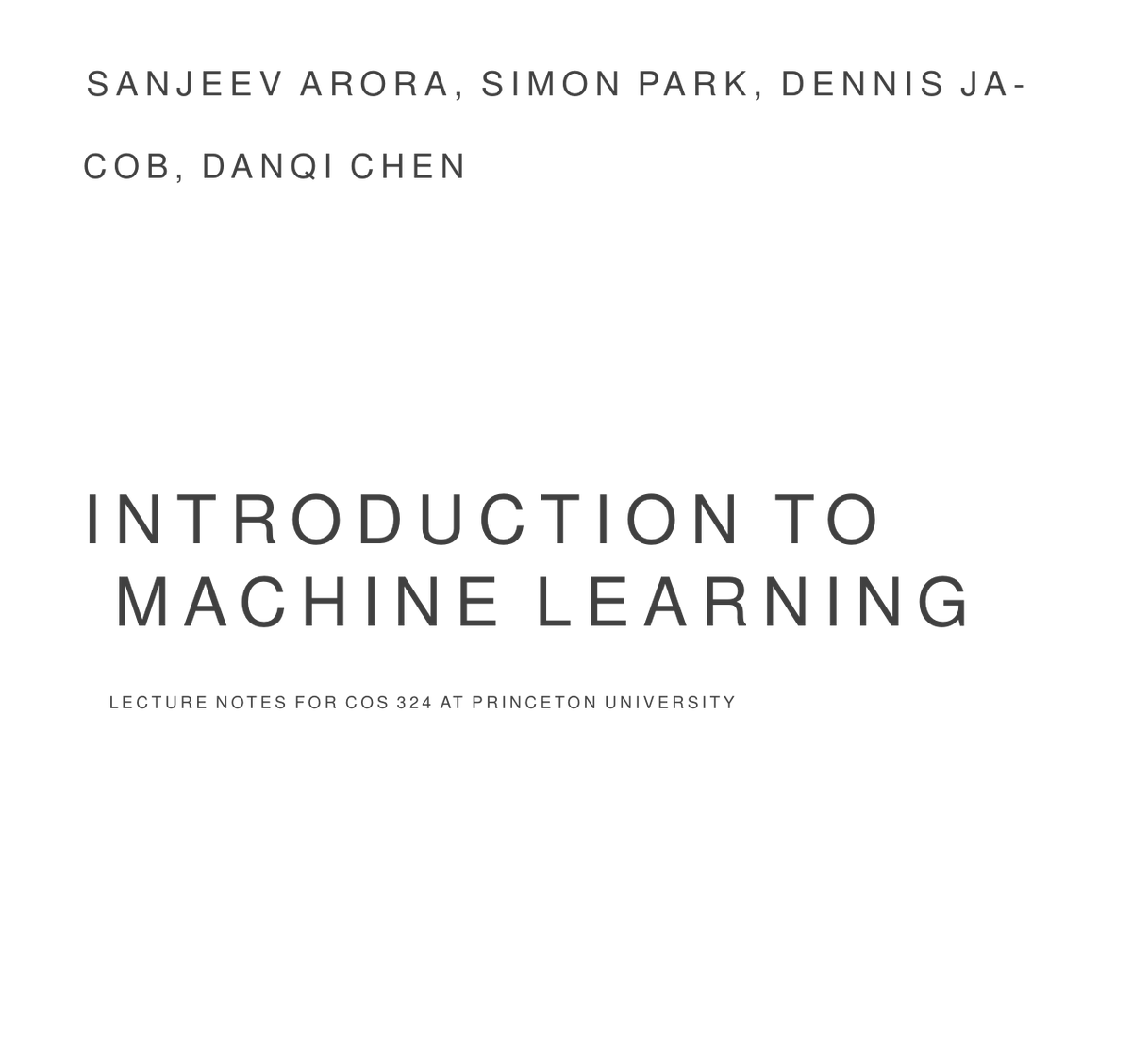
People underestimate the value cs336 & other free courses Stanford provides
Do cs336 assignment 1 & you have basically conquered LLM foundations with hands on pytorch coding.
one rule explicitly mentioned in assignment is to not use ai to write code while learning 🧐
I will be again running the same code on b200 as suggested by the updated assignment.
should we do a live run on X ??
Get this incredible 448-page guidebook "The Art of Statistics: Learning from Data" at https://t.co/RCD6HTcUiY
(Over 3700 4- and 5-star reviews)
#DataScience#DataScientist
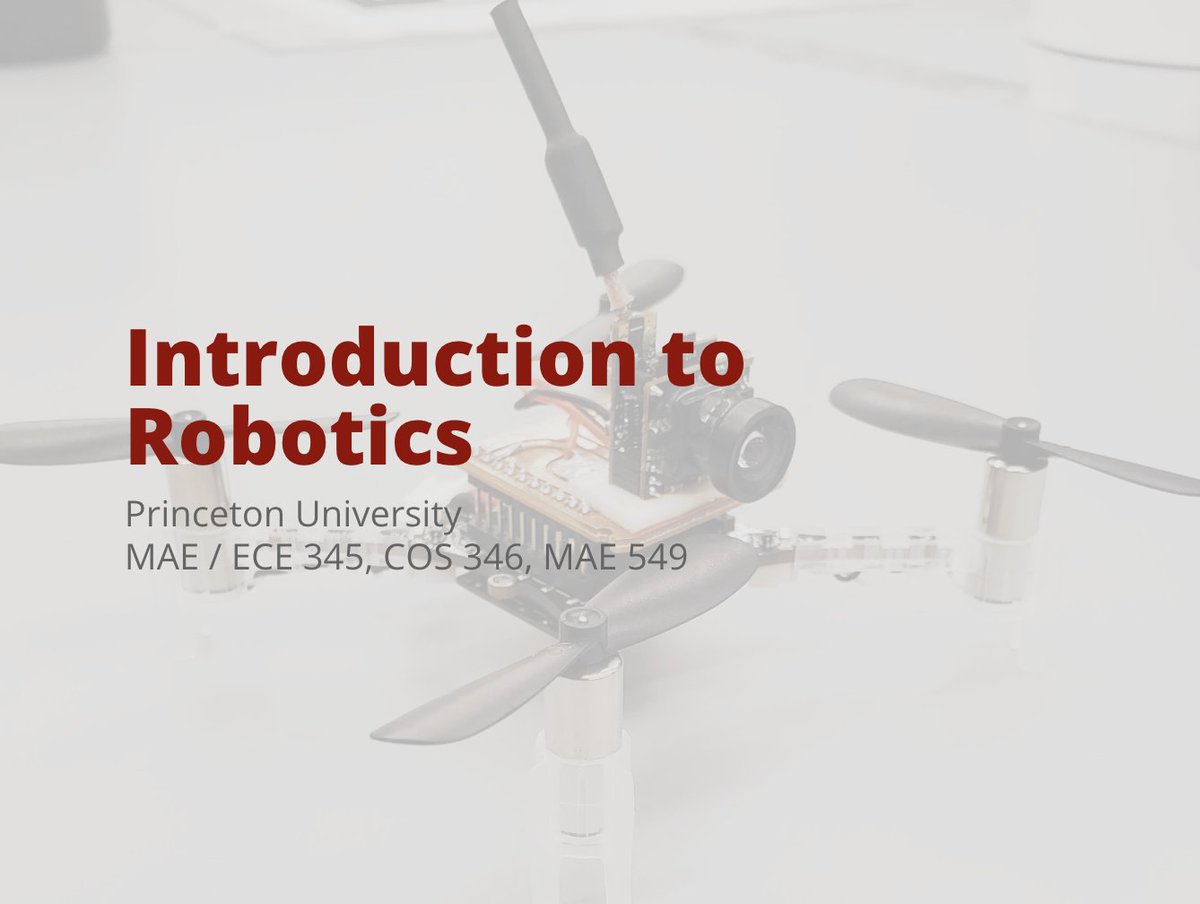
Princeton's Introduction to Robotics! 🎓
@Princeton University released their full Introduction to Robotics course publicly with lecture videos, notes, slides, and assignments.
This course provides fundamental theoretical and algorithmic principles behind robotic systems with hands-on experience.
Topics covered:
→ Feedback Control (dynamics, PD control, Linear Quadratic Regulator)
→ Motion Planning (discrete planning with BFS/DFS, optimal planning with Dijkstra/A*)
→ State Estimation, Localization, and Mapping (Bayes filtering, Kalman filtering, particle filtering, SLAM)
→ Vision and Learning (optical flow, deep learning, convolutional networks, reinforcement learning), and broader topics including robotics and law, ethics, and economics.
Assignments include theory, programming, and hardware implementation components. The final project has students program drones for vision-based navigation with attached cameras transmitting real-time images.
All lecture videos, notes, slides, and assignments are freely available. Prerequisites include multivariable calculus, linear algebra, basic probability, basic differential equations, and some programming experience in Python.
‼️ GO FOR IT: https://t.co/7KxhWsr6Ok
~~
♻️ Join the weekly robotics newsletter, and never miss any news → https://t.co/GoA3ZuwoPB
The Scientist and Engineer's Guide to Digital Signal Processing By Steven W. Smith
Amazing book to keep handy if you work on anything DSP. Loved the way the chapters are organized!
https://t.co/kmtyDJL1st
This paper is perfect if you want to study the math behind machine learning.
It covers probabilities, linear algebra, and calculus and optimization.
You can get it for free from the University of Berkeley:
https://t.co/jRCvKqfiS3
Gilbert Strang's "Matrix Methods in Data Analysis, Signal Processing, and ML"
📽️ Lecture Videos: https://t.co/onTIirwI4L
📷 Course Website: https://t.co/iikZlQr4Nt
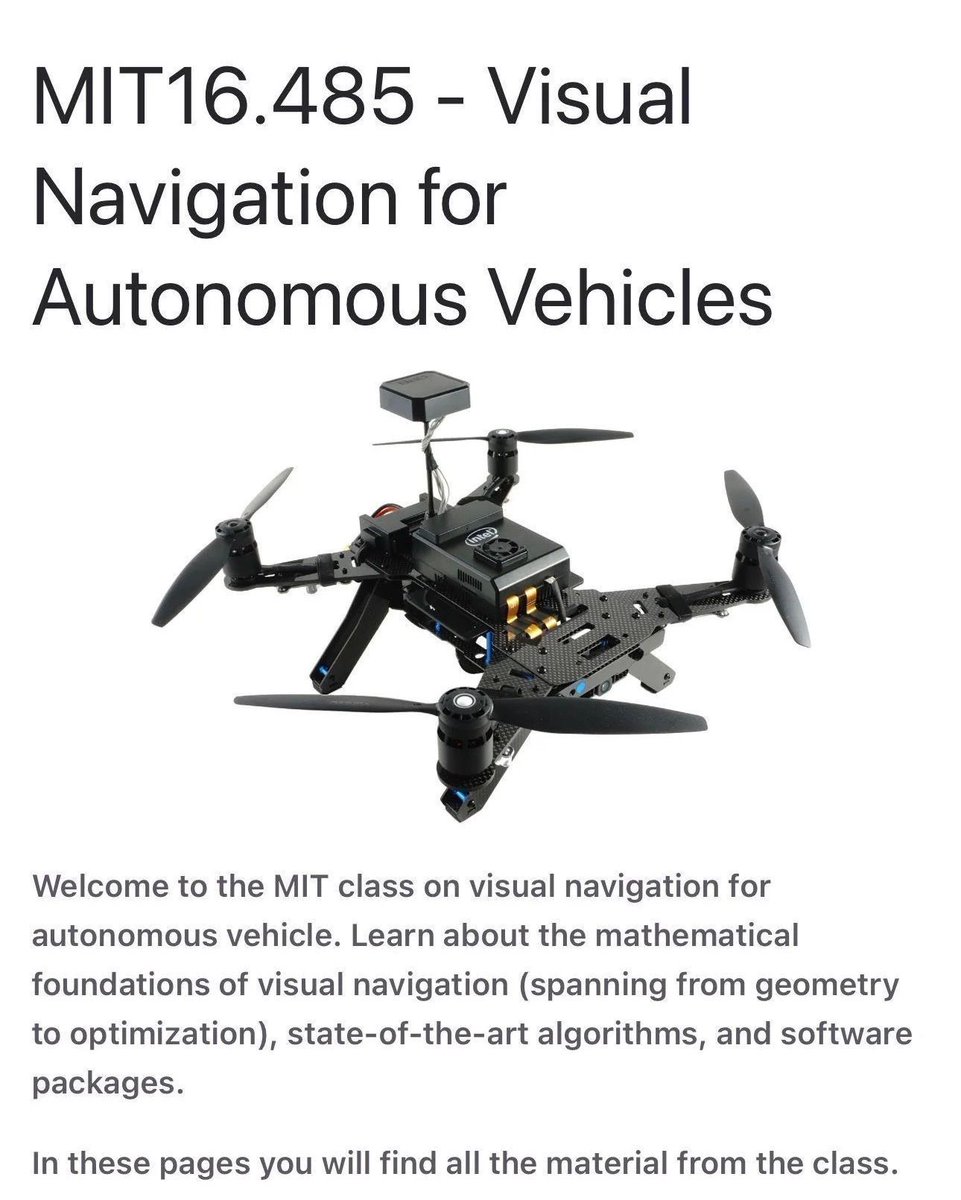
A full MIT course on visual autonomous navigation.
If you work on robotics, drones, or self-driving systems, this one is worth bookmarking‼️
MIT’s Visual Navigation for Autonomous Vehicles course covers the full perception-to-control stack, not just isolated algorithms.
What it focuses on:
• 2D and 3D vision for navigation
• Visual and visual-inertial odometry for state estimation
• Place recognition and SLAM for localization and mapping
• Trajectory optimization for motion planning
• Learning-based perception in geometric settings
All material is available publicly, including slides and notes.
📍https://t.co/Wt5mr6NPao
If you know other solid resources on vision-based autonomy, feel free to share them.
——
Weekly robotics and AI insights.
Subscribe free: https://t.co/9Nm01QUcw3
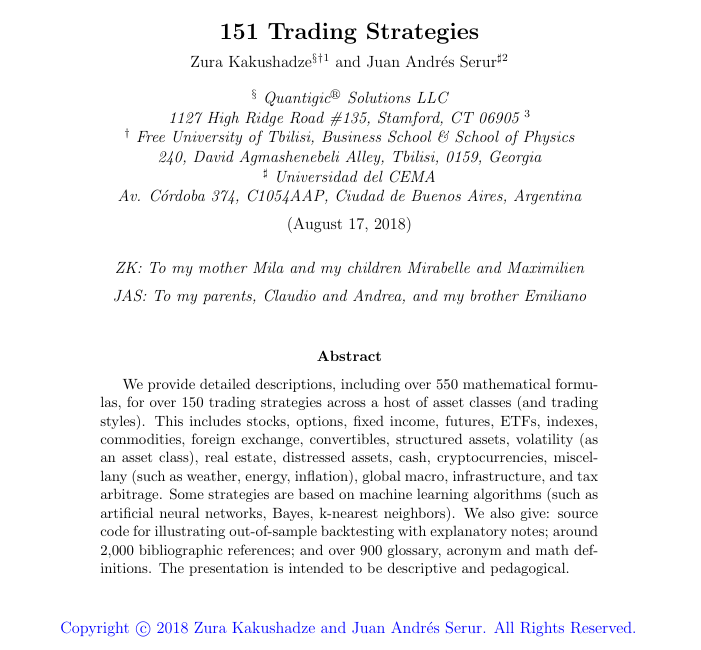
As someone who builds institutional level quant systems, this research book is the closest thing to a quant desk I have ever seen publicly shared.
361 pages. 151 trading strategies.
Bookmark & get this, then read the article below before someone takes it down.
Apple's M4 chip engineers earn $450k+
Intel's CPU architects earn $400k+
NVIDIA's hardware engineers power every AI model on the planet
They all understand one thing almost no software dev ever studies:
How a computer actually works at the hardware level
"ETH Zurich – Digital Design & Computer Architecture" by Onur Mutlu
Free on YouTube. 30+ full lectures. Spring 2023
By a professor who holds joint appointments at both ETH Zurich and Carnegie Mellon
Starts from a single transistor. Ends with a complete CPU you understand entirely:
• Logic gates – how electricity becomes computation at the most fundamental level
• Instruction Set Architecture – the contract between software and hardware every dev ignores
• Pipelining – how your CPU executes multiple instructions simultaneously without you knowing
• Out-of-order execution – why your CPU secretly reorders your code to run faster
• Memory hierarchy – the design decision that determines the speed of every program ever written
Every line of code you've ever written ran on hardware you don't understand
The engineers who built that hardware earn $450k
Now you know where to start
📢 @CVPR 2026 Tutorial
We’re turning our book 《The Principles of Diffusion Models》 into a live tutorial at #CVPR2026!
Part I · Continuous Diffusion — by me 👋
🎯 First-principles & intuitive view of diffusion
🎯 Fast generators & flow maps
🎯 Audio-visual content creation & protection — by @mittu1204
🔗 Link to our book: https://t.co/BRjPh6eF8q
Part II · Discrete Diffusion — by @ssahoo_
🎯 The first tutorial crafted for discrete diffusion
Co-organizers: @StefanoErmon@DrYangSong@gimdong58085414
Full schedule + details 👇
Pen & Paper Exercises in Machine Learning by Michael U. Gutmann
Book PDF here: https://t.co/FUo4Nb3SIo
This book is a collection of (mostly) pen-and-paper exercises in machine learning. Each exercise comes with a detailed solution.
The following topics are covered:
- Linear algebra
- Optimisation
- Directed graphical models
- Undirected graphical models
- Expressive power of graphical models
- Factor graphs and message passing
- Inference for hidden Markov models
- Model-based learning (including ICA and unnormalized models)
- Sampling and Monte-Carlo integration
- Variational inference
Repo: https://t.co/OZ219CXvmQ