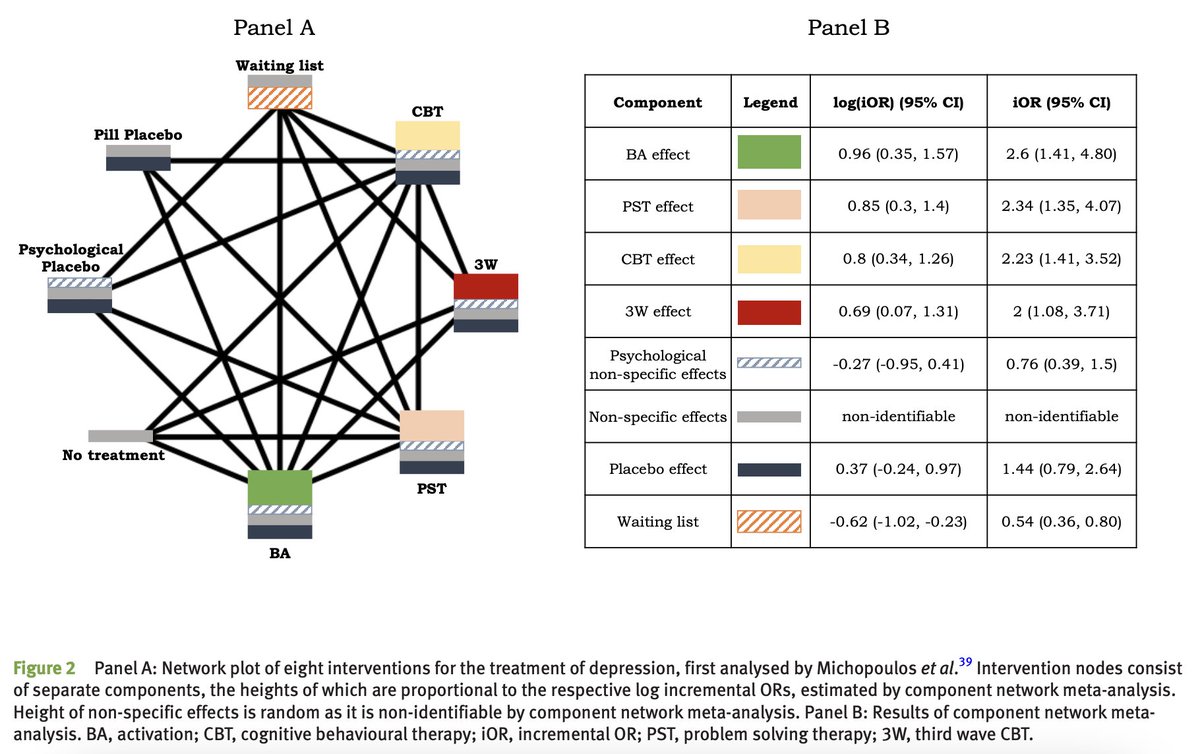
The most simple, straightforward, easy to understand explanation of fixed effect and random effect models appears in an unexpected place. https://t.co/fqzL2vdCaS
Recently published step by step approach to choosing the optimal MID when literature includes multiple published estimates for the same instrument. https://t.co/zQ3ltmcCdy
Meta-epidemiological studies have repeatedly demonstrated the superior responsiveness of disease-specific to generic instruments. https://t.co/VD3dnA9Smt
Best example ever of GRADE’s approach to surrogate outcomes: identify patient-important outcome (this case, heart failure symptoms) for which surrogate (mitral valve area) standing in and rate certainty of patient-important rating down for indirectness. https://t.co/VwrdPZiwEU
McMaster University will be holding an advanced GRADE workshop from May 7–9th. I will be playing a major role in this workshop which is guaranteed to enhance your expertise in GRADE. Registration now open. https://t.co/LFLUXbYuVB
Issue interpreting patient-reported outcomes: express results as relative (10 to 5 same as 4 to 2, both 50% better) or absolute (10 to 5, 5 better; 4 to 2 only 2). Evidence: best approach may differ, but absolute simpler & eases pooling across studies. https://t.co/hvlKuu8QYY
Series of 20 minute EBM lectures. Mostly Montori/Guyatt patient-centred care, the patient revolution, summarizing the evidence, avoiding being misled, the best way to achieve quality assurance, basic language of EBM, and why reasoning methods matter https://t.co/SM9eHiL3iN
@HEI_McMaster and @CMAJ are teaming up this November to host a two-day comprehensive medical writing and publishing workshop at @McMasterU. Register before September 1 and take advantage of discounted rates. More details here: https://t.co/XbyDIQnO1e
There are several guides for understanding & interpreting network meta-analysis. These users guides, published in two papers & presented for a surgical audience, represent the best for any clinical or junior methods audience.
1. https://t.co/Z8P7XbAkqu
2. https://t.co/Hj82a2qWQM
New, ground-breaking approach to help guideline panels clarify inferences about patient values and preferences: MIDs in outcomes; thresholds of benefits required to use treatment; choices patients would make when presented with benefits, harms, burdens. https://t.co/DJfuOV3I6l
Just published additional evidence: no one should take non-inferiority margins seriously. As we will increasingly demonstrate, clinicians can ignore whether designs superiority or non-inferiority: either one, just balance benefits vs harms/burdens. https://t.co/K1tnZf9hac