I can never understand people who will spend easily 500-700 rupees on coffee, pasta, pizza, or junk food.
But the same person will mind paying 200 rs to buy fruits and will call it as "expensive"
Nearly 50 years ago, we launched Voyager to chase the unknown. Today, it’s almost a light-day away, still speaking for humanity in the dark. 🚀
Hey @NASA , what’s next? Are we planning the successor to Voyager? The sooner we launch, the farther our story travels. 🌌
It's a shame that even in 2026, iOS doesn't have the ability to disable specific categories of notifications from apps.
On Android, I can only enable order notifications and disable this marketing crap. But I have to bear this spam on my "premium" iPhone 🤦🏻♂️
The West poured $50 billion into fast breeder nuclear reactors and abandoned every single one. India poured $900 million and just achieved criticality on the first commercially viable one outside Russia.
The US spent $15 billion. Gave up. Japan spent $12 billion. Their Monju prototype had one sodium fire in 1995 and never recovered. The UK spent $8 billion. Germany spent $6 billion. France, Italy, all walked away. Six of the richest nations on Earth concluded this technology was too hard and too expensive to pursue.
India started building in 2004 with an initial budget of $420 million. Twenty-two years, a dozen missed deadlines, and a cost doubling later, the Prototype Fast Breeder Reactor at Kalpakkam just sustained a controlled fission chain reaction. The reactor is now alive.
The reason India never quit is a constraint most people have never thought about. India has only 1-2% of the world's uranium reserves. For a country of 1.4 billion people trying to build energy independence, that's a death sentence if you're running conventional nuclear.
But India has 25% of the world's thorium. The single largest national reserve on Earth.
The problem: you can't just burn thorium the way you burn uranium. A physicist named Homi Bhabha designed a three-stage nuclear program in the 1950s specifically to solve this. Stage 1: burn natural uranium in heavy water reactors, collect plutonium as a byproduct. Stage 2: feed that plutonium into fast breeder reactors, where it breeds MORE plutonium AND converts thorium into fissile uranium-233. Stage 3: burn thorium directly at scale.
India just entered Stage 2. Seventy years after Bhabha drew it up on paper.
The math on the thorium endgame is wild. At current energy consumption rates, India's thorium reserves could power the country for over 700 years. Most nuclear nations are playing a uranium game with maybe 80-100 years of runway. India is playing a completely different game with a 7x longer fuel supply.
The West quit because uranium stayed cheap and sodium coolant is terrifying. It catches fire on contact with air. It explodes on contact with water. Russia's BN-600 had 27 sodium leaks and 14 sodium fires between 1980 and 1997. And Russia kept going anyway because Russia doesn't quit nuclear projects. India watched all of that and kept going too.
When you have 1% of the uranium but 25% of the thorium, the engineering difficulty stops being a reason to quit. It becomes the price of admission to a 700-year energy supply that nobody else can access.
T2Os shouldn't be call cricket anymore, it should be called batting. Call it T2O Batting instead of T20 cricket coz now they have taken everything away from bowlers & it has become game of batters where bowlers are used as slaves to just get smashed.
You have to be someone like Jasprit Bumrah or Josh Hazlewood level bowler in order to does well but if you are batter, you can smash any bowler here. It is so one sided game now, I don't know if you guys still enjoy this one sided bashing but not me. Scores of 200 are getting treated as 120 nowadays in IPL since last few overs!!
We are overstimulated and we don't even notice. Netflix while eating. Reels in the bathroom. Music while cooking. Podcasts on walks. We consume by default, not by intention. You keep filling every gap, then wonder why you feel foggy and unmotivated. Boredom and silence are the real growth drivers. They give you space to think and create. That's when solutions show up for problems that have been stuck for months. Leave some room.
What a time to be alive — witnessing every single ball from the legendary Jasprit Bumrah. 🐐🔥 Generations will talk about this spell. #JaspritBumrah#Cricket
The best advice I got in my 20s: When you feel stuck, shrink the time horizon. Don't ask what the year needs. Ask what today needs. One finished task. One workout. One closed loop. One hard conversation. Momentum is a byproduct of movement. Remember that.
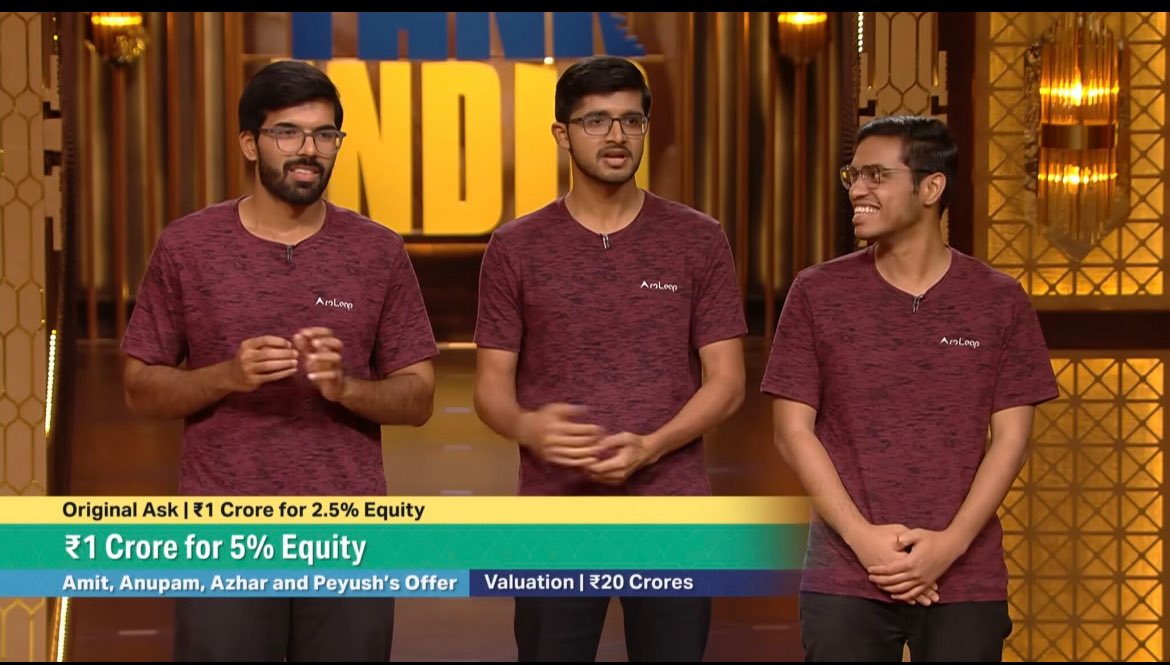
While pitching on Shark Tank, we made the most naive mistake possible- trying to get all four investors on the same deal.
More sharks, more connections, more credibility, that was the logic. But we ended up giving away more equity than was needed to score a deal with just 2 sharks.
What we didn't account for was the time it would take with multiple investors. Each shark at this point has organized teams to run their own due diligence. Parallel tracks, parallel timelines, parallel asks. A deal that should close in three weeks drags into four or five months.
And honestly, the relationships, intros, etc., are overrated. At the end of the day, they're running their own businesses and have probably invested in 100s of companies. It is unreasonable to think that you'll get any personal attention.
When you're raising a small round, one investor who writes fast and stays out of your way beats four names on a cap table, unless you're desperate. And if you're desperate, that tiny check won't get you very far, anyway.
Btw, this is true even in other non-Shark Tank VC rounds as well, usually better to pick one than to create a consortium.
Your career isn't defined by your talent alone, it's defined by the problems you choose to solve.
I've seen brilliant minds stagnate in roles solving trivial problems, while average performers become legends by tackling challenges that matter. The key is problem selection.
Great minds working on mediocre problems produce mediocre careers. Average minds working on great problems become great professionals.
The mathematician optimizing ad click-through rates vs. the one modeling climate change. The engineer building the 47th social media app vs. the one solving infrastructure at scale. Same skill level, completely different trajectories.
Your problem portfolio compounds over time. Small problems teach you small thinking. Big problems stretch your capabilities and attract big opportunities.
The best career advice I received was "get better at choosing what to work on."
What problems are you solving today? Are they worthy of the next five years of your life?
If you pay attention to the patterns of your life, you’ll realize that everything always works out. You survived what once felt impossible, not by accident, but by design. There’s a divine rhythm behind the chaos, a wisdom guiding the unfolding. So breathe. Trust where you are.