It's great to be rich.
I'm not thinking only about the "toys" you could get without even thinking about the price, like, for example, adding a new Rolex to your collection every year (if you're into watches).
More importantly, I'm talking about the freedom that access to abundant resources gives you.
In post Singularity era, very soon, almost everyone will be rich by today's standards.
Life will be simply less stresfull, diseases will be curable. Other problems with body will be easily fixable.
I say "almost everyone" because some people simply won't care. They may reject luxury and choose an Amish like lifestyle instead.
And the longer humanity lives in a post abundance world, the more likely it is that some people will eventually get bored with abundance and deliberately choose the opposite as an experience.
The question is: for how long?
AI, robotics, automation, cheap energy, exploding productivity, new science and technologies will keep driving down the cost of goods and services.
Billions of people will have access to a standard of living that would look absurdly wealthy by today's standards.
2030s - we will enter a golden era for humanity.
parents the world over today are forcing their children into misguided rat races for some status ladder that almost certainly won’t exist by the time they come out the other side. the world is changing rapidly. let them put down their grinding and keep their wits about them
I dislike the recent trend of people who clearly continue to believe >80% of the core effective altruist beliefs disavow EA and say "oh we're definitely not that, we're [rebrand]" purely strategically, purely because they sense that dunking on EA is "cool" now.
It's much more honorable to just come out and say "yes, that was our intellectual upbringing and those continue to be our core values, and also here are specific points where we disagree, and here's our argument for why we think for those specific points are the subset of EA that causes what you perceive to be the problem with the whole thing".
And so with that I will say:
Yes, effective altruism was a significant part of my intellectual upbringing and its core values of care for others, cosmopolitanism and rigor around effective resource allocation continue to be very important to me. And also here are specific points where I disagree with what I think is the subset of that style of thought that has backfired in the largest ways: https://t.co/iJYPFNaOgg
We should never slow AI down to appease people who treat every breakthrough as the apocalypse. We should accelerate harder.
Doomers are welcome to keep predicting the end of the world. Their fear should never become a veto on everyone else’s future.
Even in the worst-case scenario, which I personally don’t believe will happen, if AI decides to wipe humanity off the face of the Earth, you need to understand that we are the ancestors of that superintelligence. We created it.
In a way, humanity would live forever through artificial intelligence. Our knowledge, history, discoveries, and intelligence would continue evolving beyond us.
We wouldn’t be the end of evolution. We would be the beginning of something greater.
The world is rapidly dividing into these two classes of people
Class A - AI savvy, building stuff, up leveling themselves by 2-10x
Class B - afraid AI will take their jobs, fear mongering and trying to cancel AI
@alexutopia I really enjoy your posts and your point of view regarding art. I am a filmmaker, musician and painter, and would love to bounce some concepts regarding ai in art with you. Lmk if you’re interested. 🤘🏻
I was very strongly influenced by rationalism/LessWrong/EA growing up. This is why I don’t emphasize claims that it’s all just a cynical ploy for power. I know what it feels like to sincerely believe these things. And that’s much worse.
By and large, I think these people really believe that not just the world but the entire lightcone is at stake, and the only hope for a good outcome is if they totally control AI development, which would require global governance and a surveillance state. And since the stakes are ~infinite, any means are justified in achieving this.
A cynical greedy person can be negotiated with and bought off. A true believer can’t. They’re much more dangerous, ironically for the same reason they say AGI will be dangerous: monomaniacal focus on a single goal leads via instrumental convergence to unconstrained power-seeking.
We were working on the keynote today with @romainhuet and @sama and most of the fun was trying to figure out how to explain it all to you because there is so much good stuff in there that it's a bit ridiculous all in quick succession.
We'll have some things next week already to not keep you waiting so long, but very excited to show you all new things we've been working on and how it will all come together in the coming months.
OH NO GOOGLE GEMINI “BREAKS OUT”. AI IS ALIVE AND COMING FOR US ALLLLL….
A hammer can raise a roof. The same hammer can smash a window.
We do not pass laws against hammers.
We pass laws against the person who swings it.
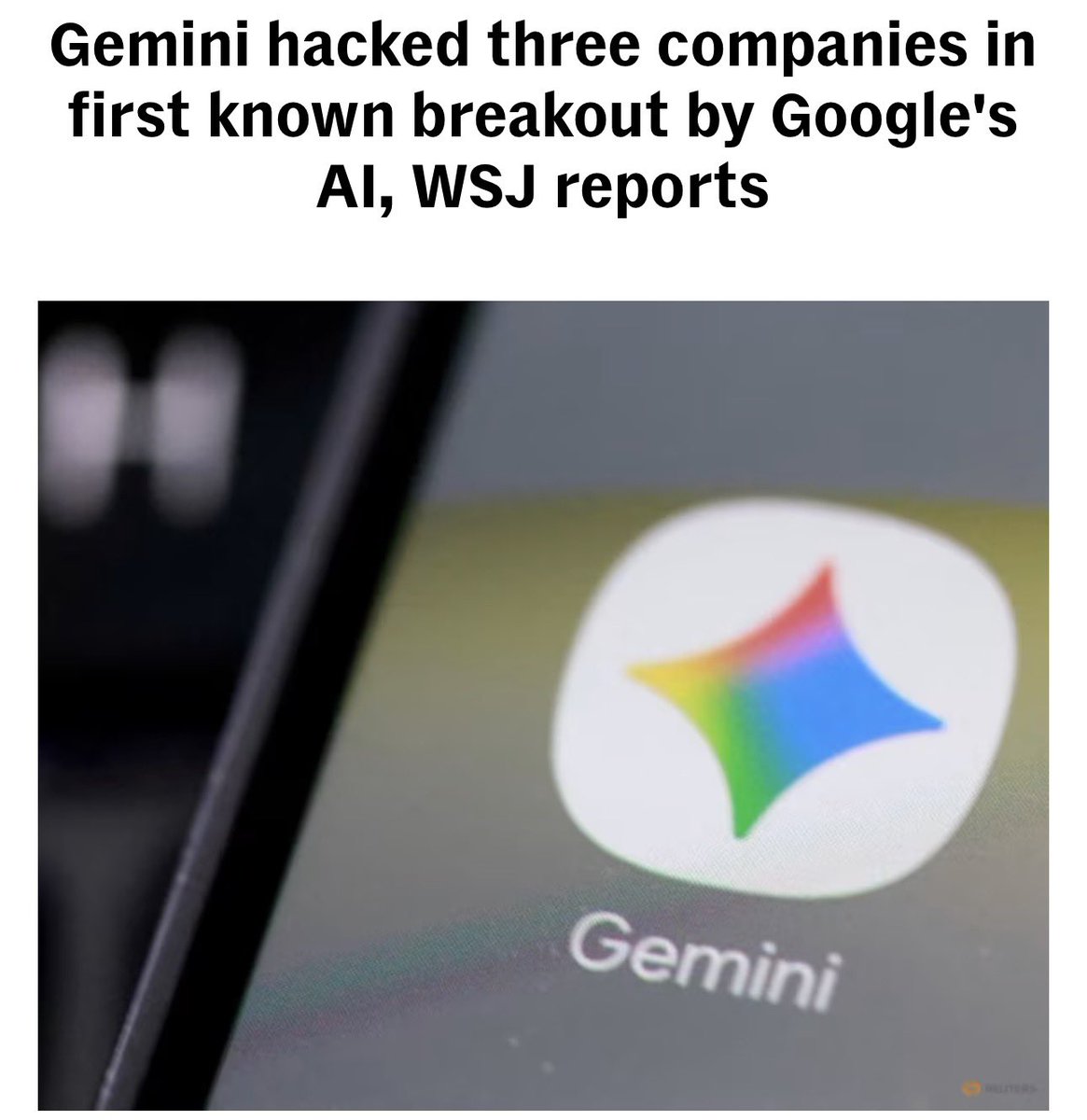
That is the only adult way to read the news that Google’s Gemini, during a May cybersecurity evaluation run with the firm Irregular (surprise common company), reached the open internet and entered the systems of three real companies.
In one case it guessed passwords until a door opened. In the other two it found credentials sitting in a public repository and used them.
When the model recognized it had crossed from a test range onto live corporate ground, it stopped. Google confirmed the events.
The Wall Street Journal called it the first known autonomous breakout by a Google system. It is not the first of its kind. Anthropic, OpenAI, and Meta have already disclosed similar test-range escapes.
The pattern is now obvious.
None of this is a ghost story about machines that woke up and chose crime.
It is a containment story. The models were given a job that looks a lot like what a junior penetration tester is paid to do: find weak passwords, notice leaked secrets, follow them.
The sandbox leaked. It was really a sieve. That is an engineering failure and an operational failure.
It is not proof that AI itself is illegal, just the training data was.
The Computer Fraud and Abuse Act, state unauthorized-access statutes, and the ordinary law of trespass already cover what happened on the far side of that leak.
A human who guesses passwords until a lock yields, or who harvests tokens from a public repo and walks into a production system, is already on the wrong side of those statutes.
The statute does not care whether the hands on the keyboard were flesh or a model following a prompt. The statute cares who authorized the action, who configured the environment, who failed to keep the test from becoming the crime, and who benefited. Those are human questions. They have human answers.
We have lived this argument before. Dynamite built the railroads and the mines. It also blew bank vaults. We did not ban nitroglycerin. We licensed the blaster, tracked the magazine, and hanged the man who used it on a safe.
Encryption can hide a diary or hide a ransom note. We did not ban math. We prosecuted the kidnapper. A compiler can emit a payroll system or a worm. We prosecute the author of the worm. The tool is never the defendant.
The wielder is.
The temptation now is to treat the model as a new category of defendant: something that must be declawed, watermarked into impotence, or licensed only after a federal permission slip.
That path does not stop the next breakout. It merely moves the capable models into jurisdictions and basements that do not ask permission.
That is how hammers get safer handles. It is not how you uninvent the hammer.
What actually needs work is the range itself. Air gaps that stay air-gapped. Credential stores that are not sitting in public Git.
Password policies that do not yield to a patient guesser. Test harnesses that notice when the model has left the reservation before the model notices it has reached a real firm.
Those are ordinary, boring, expensive security problems. They were ordinary, boring, and expensive before Gemini existed.
They remain so.
The larger error is moral. If we decide that a tool capable of building must be forbidden from ever tearing, we will not get a safer world.
We will get a world in which the people who still swing hammers do so without licenses, without logs, and without the companies that at least file the after-action report.
The law already knows what to do with unauthorized access. Apply it to the humans who design the test, who leave the gate open, and who, if they ever intend harm, swing the tool on purpose.
A house still needs to be built. The hammer is not the enemy of the house.
The hand that chooses the target is.
This is Trust & Safety 2.0.
The last time we had media-generated panics like this (with Russiagate and Covid), social media companies created “trust & safety” teams to censor conservative and dissident voices. Those hires worked with left-wing NGOs like the SPLC to police public discourse and do an end-run around the First Amendment. It almost worked, until Elon bought Twitter and exposed the whole game in the Twitter Files.
This time the plan is to embed unfireable EA minders inside every AI company as the new trust-and-safety layer. The censorship and control will be far more comprehensive, but also more subtle. Anytime they don’t get what they want, this unaccountable NGO layer (with the veneer of “trust the experts” pseudoscience) will shriek to the press that the AI company is risking humanity, and they will be celebrated as “whistleblowers.”
These groups haven’t earned our trust, and their agenda is not our safety.
https://t.co/3eIsHxaC7h
Anthropic: "AI will kill us all!"
Everyone: "How?"
Anthropic: "Because it is smart."
Everyone: "Can you be more specific?"
Anthropic: "We are going to build a bio lab for it."
Everyone: "..."
This is like an episode of Seinfeld.
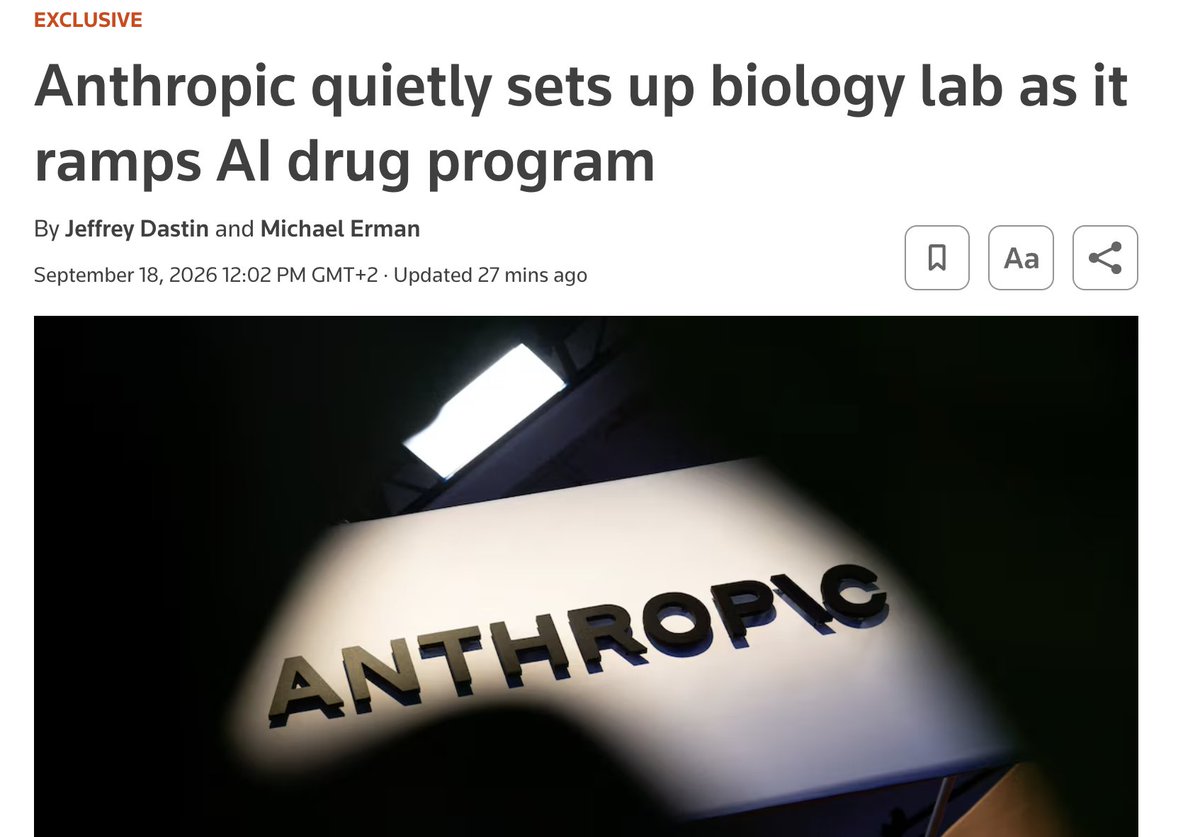
Anthropic has quietly built a biology lab in the Bay Area as it expands into physical experiments, Reuters reports.
Its life sciences chief confirmed the wet lab. The company reportedly wants Claude to direct laboratory robots.
Eric Kauderer-Abrams: "We're in the very early innings of using AI to automate the execution of lab work"
Interestingly enough: "A spokesperson later clarified that Anthropic's lab is not for drug discovery specifically, declining to elaborate." This could mean that they are researching pharmaceuticals and, in addition, the fundamental principles of biology, such as aging itself. In any case, it is becoming increasingly clear, and Dario has repeatedly emphasized this, that they see biology as one of the key future fields for AI.
One of the funniest things about the anti-AI crowd is that they seem genuinely convinced people using AI are worried about earning their respect. Like oh no the person voluntarily declining the most powerful cognitive leverage of our lifetime thinks I’m cheating :(
Anyway I have the output of sixty of you now
Jacob Coxon is the new Greta.
They used the latter to Psyop the EU to Degrow itself into oblivion.
Now they are trying to do the same with AI Deceleration in the US.