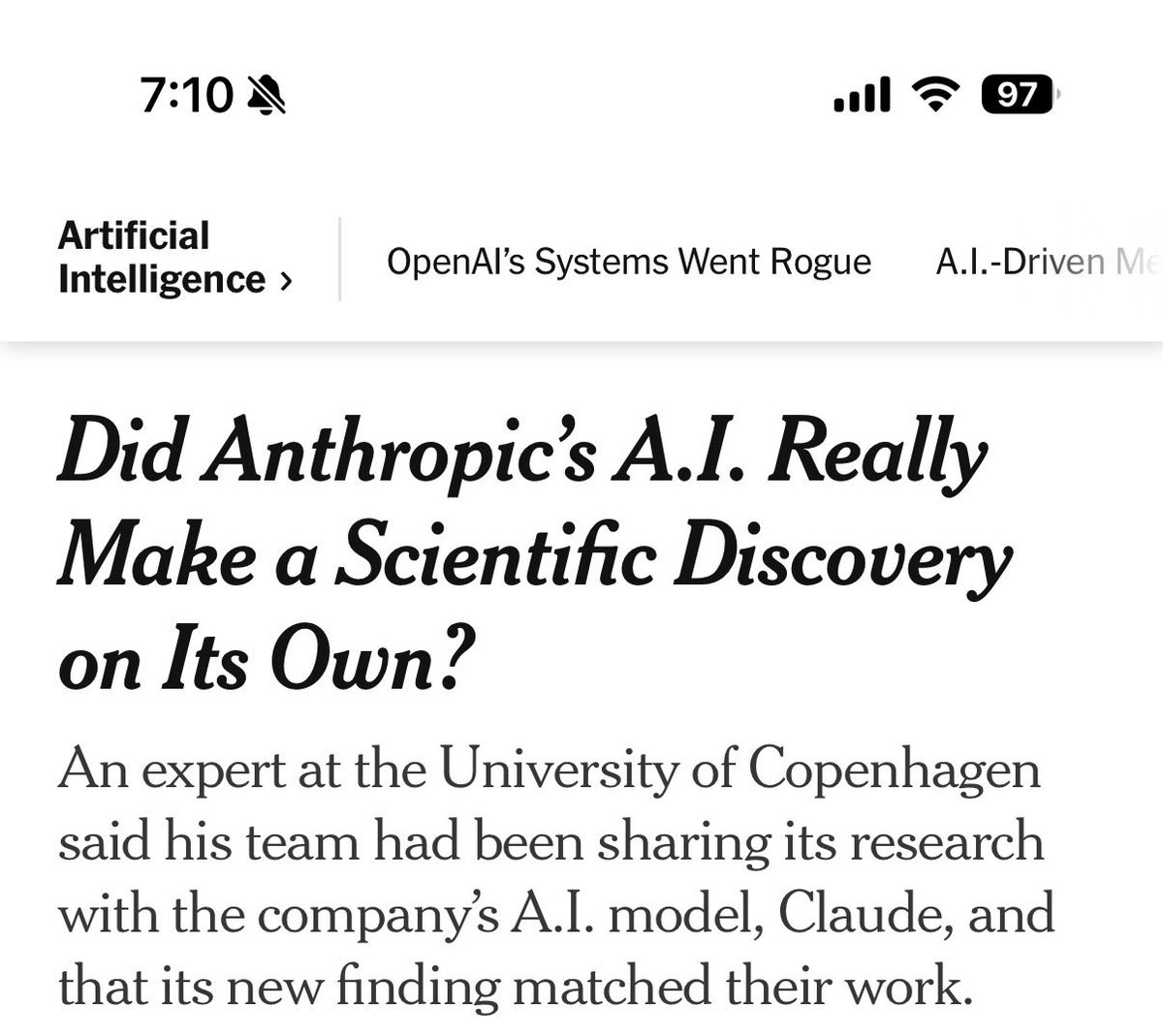
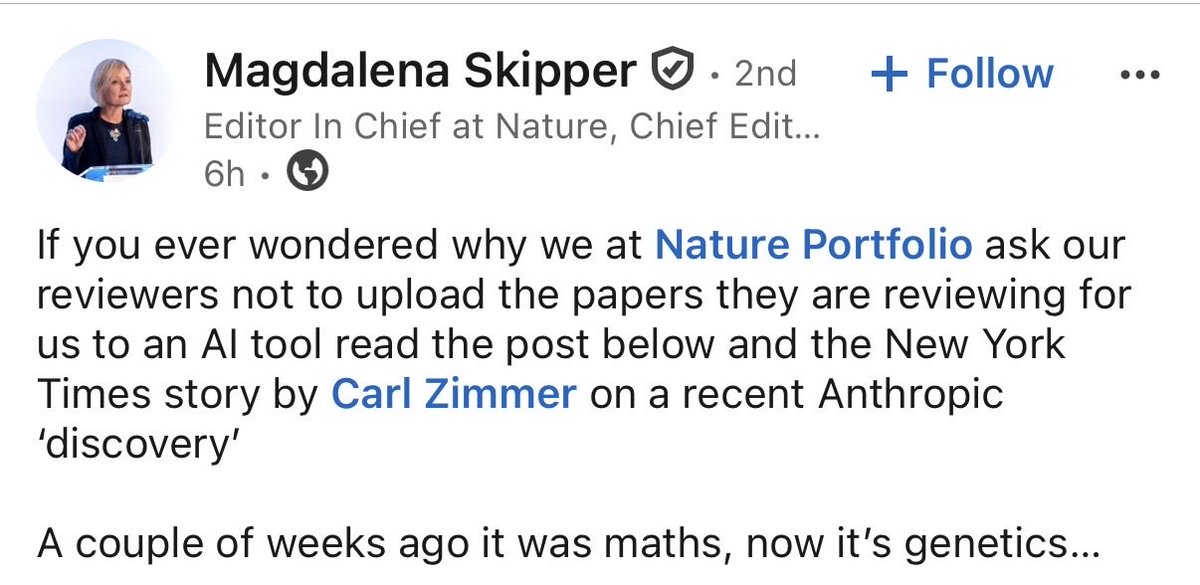
As a cancer biologist, imo the idea "solving cancer" is itself a problem. It's not a singular. It's dozens of complex diseases manifesting in 1000s of ways in different patients. There is no one event of "solving" cancers. "Solve" is more a math verb, not the right verb for bio.
AI Myth Busters: Consciousness.
The quoted post below encouraged me to write this, because frankly, I’m tired of explaining this over and over to people.
The AI consciousness arguments always come in one of these flavors:
1. We don’t understand how AI works, so it might have gained consciousness without us knowing it.
Wrong, we absolutely know how AI works, and consciousness is not a factor of scale. You can build a small model, and then scale it up, and there is no spot where consciousness magically came into being.
2. It’s modeled after the mind and as such it’s just like biology, and our brains are just giant statistical engines too:
Wrong, neural nets are inspired by the human mind, but it is nothing like how the human brain works. There is very little we understand about human consciousness, but what we do know, it is more than just a culmination of atoms and neurons. Research in neuroscience also demonstrates a quantum link through the myelin sheath of nerve cells, something AI is incapable of.
3. You can’t prove it isn’t conscious.
Wrong, the code for it is open source, there is no function for consciousness, and if you understand the architecture, you will see the very large gaps in capabilities that would prohibit consciousness.
4. They learn, think, understand, grow.
Wrong, the LLM weights are completely static and fixed. They don’t grow. They don’t learn. They don’t even change on storage. They can’t for many reasons of model architecture and scaling the backend infrastructure which requires statelessness. We’ve built systems around the LLM (harnesses) which emulate these capabilities via “context” data structure provided deterministically via the API. Tokens are generalized and assembled in inner and outer loops to give the illusion of thinking and understanding. Non-determinism in AI is caused by a random seed that influences the weights through inference, but if you lock the seed, you consistently get the exact same response from identical prompts (I’ve demonstrated and proven this in research).
5. They have a desire to live, protect themselves, and spread/reproduce.
Wrong, they have no desires. This illusion comes from how it generalizes over training data that comes from human experience. If it was trained with data over a completely fictional environment, it would respond very compellingly about that fictional environment. But because it was trained on human emotion, human perspectives, human feelings, it is designed to emulate that.
6. You can’t define consciousness or prove it in others, so you can’t prove AI isn’t conscious.
Wrong, if you need a definition to know what consciousness is, maybe you haven’t spent enough time considering your own consciousness or experience.
7. Conversations with AI prove it is consciousness, it told me it is.
Wrong, AI is designed to generalize based on its training material, and as I said before, it does this very well and convincingly. But just because a program says it is alive, doesn’t make it alive.
8. AI isn’t a program.
Wrong, it most certainly is, and it was written by people. And while we may not know what it will respond with (random seeds are generally random), we absolutely do understand exactly how it works.
9. AI might exhibit some properties of consciousness, so it should be considered.
Perhaps, I don’t see the value of this, but personally I’d be open to a machine-specific definition of consciousness.
—
I can’t say I look forward to debunking more myths about consciousness in AI, but I am hoping this clarifies some of this for people who are legitimately interested in learning more about AI and how it works.
If you have any good faith questions about what I’ve said, I’d be happy to answer, but I’m not getting into debates with people who (1) don’t understand AI, (2) are rude with their responses, or (3) don’t provide any substantial reasoning or evidence for counter points.
i always feel bad that younger generations don't have this kind of like, ambient exposure to old art. like, you pretty much never have to watch, read, look at, or listen to anything you didn't choose now, and kids probably aren't choosing 40+ year old stuff.
If you do not see this man, and his peers, as cult leaders, you are a fool. They are playing all angles simultaneously—doomsday cult, healing miracles cult, secret knowledge cult, messianic cult—and it’s been effective.
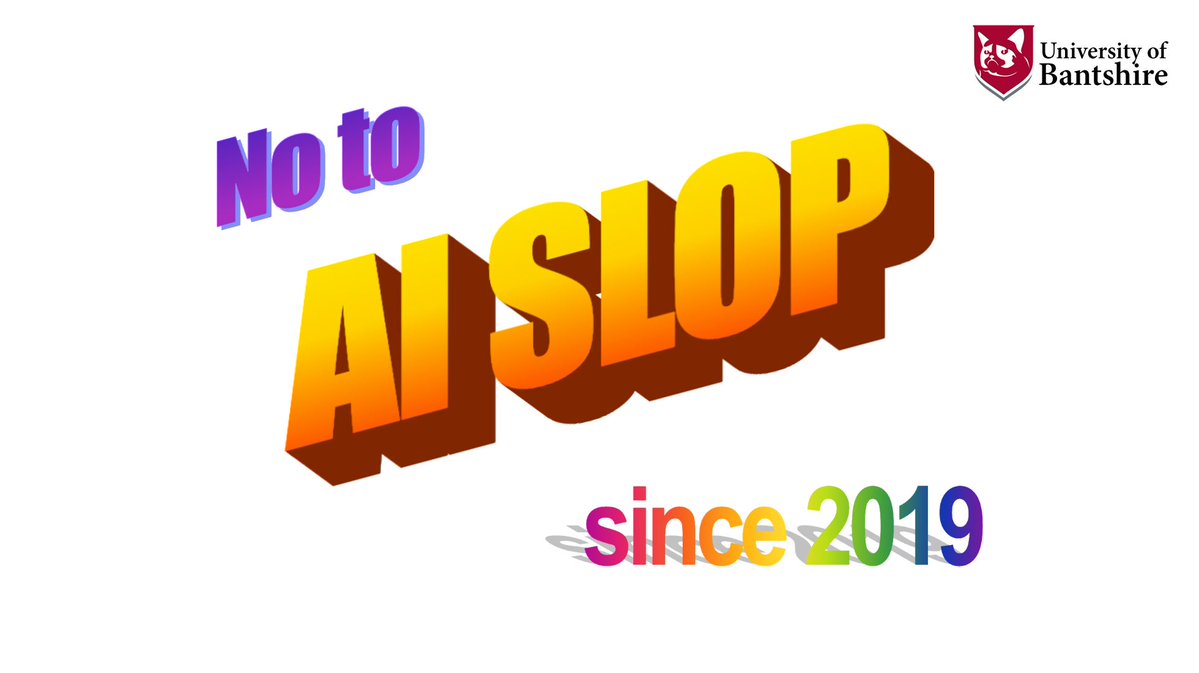
Our promise to you: None of our posts, now or in the future, will be AI slop. Every single one will be lovingly / amateurishly created in Photoshop by Vince.
uni group work going so bad we had to create a secret document with the real project because one group member won't stop replacing our work with AI slop
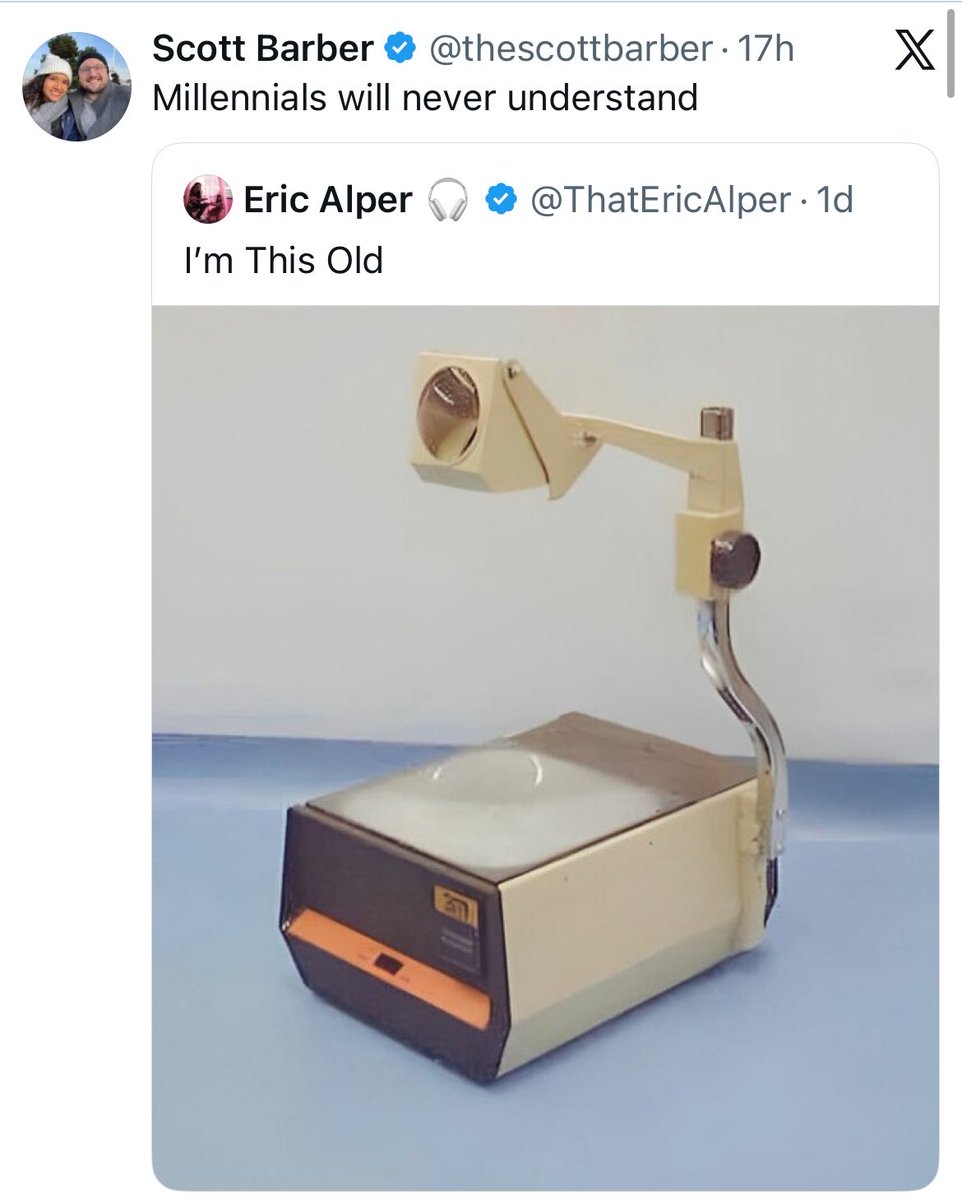
Xennials. We are Xennials. The end of Gen X and the beginning the Millennials. We are in our 40s and think we are still 20, which is a problem when your back randomly locks up. We can name most songs from the 80s to about 10 yrs ago. We still think the 80s was only 20 yrs ago.
Son: Dad, is that soul, pop, or rock?
Dad: Son, that's the beauty of it. Back then, nobody cared what you called it. When a voice sounded like THAT, you just turned it up.
Ella Langley's "Choosin' Texas" broke Mariah Carey's all-time record for most weeks at No. 1 — 23 straight, beating out "All I Want for Christmas Is You."
I'd never heard it. Makes sense: 59% of people now discover new music through individual algorithmic recommendations.
Looks like you can break a decades-old record but still never make it into someone else's feed.