NEW: "I would be able to confirm that one, at least one, and possibly in the coming weeks, two sovereign wealth funds have been accumulating spot Bitcoin specifically," says MidChains CEO Basil Al Askari.
Circle just lost a fifth of its value in a single day, and the blow came from its own inner circle. Its stock fell 17 percent after a new stablecoin launched, which is normal.
What is not normal is who built it…. the asset manager that runs roughly 80 percent of Circle's reserves, the exchange that co-founded USDC and is paid nearly a billion a year to distribute it, and the bank that holds the money. BlackRock, Coinbase, and BNY Mellon all backed a rival to the coin they help operate. The story is not really about a competitor.
Circle makes money one way, and it explains the whole reaction. $USDC is a digital dollar.
For every one in circulation, Circle holds a real dollar in cash and short-term Treasuries, roughly 74 billion dollars of reserves, and the interest those reserves earn is almost the entire business. About 80 percent of that pile sits in one fund, the Circle Reserve Fund, managed by BlackRock and custodied by BNY Mellon.
To get USDC into the world, Circle pays distributors. In one recent year it paid Coinbase alone 908 million dollars.
On June 30th more than 140 companies launched a competitor called Open USD, and it inverts the one thing Circle relied on. Instead of the issuer keeping the reserve interest, Open USD shares almost all of it with the businesses that use and distribute the coin. Free to mint, free to redeem, no caps. For any firm that had been helping Circle earn that interest for a fee, the math flips: stop collecting a fee to build someone else's yield, and collect the yield yourself.
The names that signed on are the core of Circle's own machine. The exchange that co-created USDC and earns close to a billion a year distributing it is not only backing Open USD, it is launching it on Base, the blockchain that exchange itself owns. The manager of roughly 80 percent of USDC's reserves is backing it too, and so is the custodian bank. The firms paid to run the reserves, sell the coin, and hold the assets are helping stand up an alternative.
This was clearly written into the incentives from the start. Coinbase earning 908 million to distribute Circle's product is Coinbase working for Circle. Coinbase owning a share of a rival that runs on its own chain is Coinbase working for itself. Once a distributor can own the economics instead of renting them, loyalty to the issuer means leaving money on the table. And the Coinbase deal is up for renewal in August, so Circle now renegotiates with a partner that just helped launch the alternative. That does not make the outcome certain. It changes who holds the leverage.
The deeper pattern reaches far past Circle if you look carefully. It is the risk in any business whose profit comes from sitting in the middle of other people's money.
Circle's role was to be the middleman on the digital dollar, holding the reserves and keeping the interest while everyone else moved the coin. That works until the parties on both sides decide they can route around you and split what you kept. The reserve manager, the distributor, and the custodian do not structurally need the issuer to capture that yield, and Open USD is the first serious attempt to prove it.
None of this means Circle is doomed, and the fair reading matters. This is also just rational diversification. BlackRock earns fees across every rail it can touch, backing a new one does not require abandoning the old one, and Open USD does not launch until later this year.
USDC is still trusted, deeply liquid, and regulated, and Circle's CEO argues the market is big enough for many winners, which may well be true.
But the message in the stock is hard to miss.
A company whose whole moat was owning the middle just watched the firms on either side of it agree to build a road around it. The most dangerous rival is rarely the stranger. It is the partner who already knows exactly how you get paid.
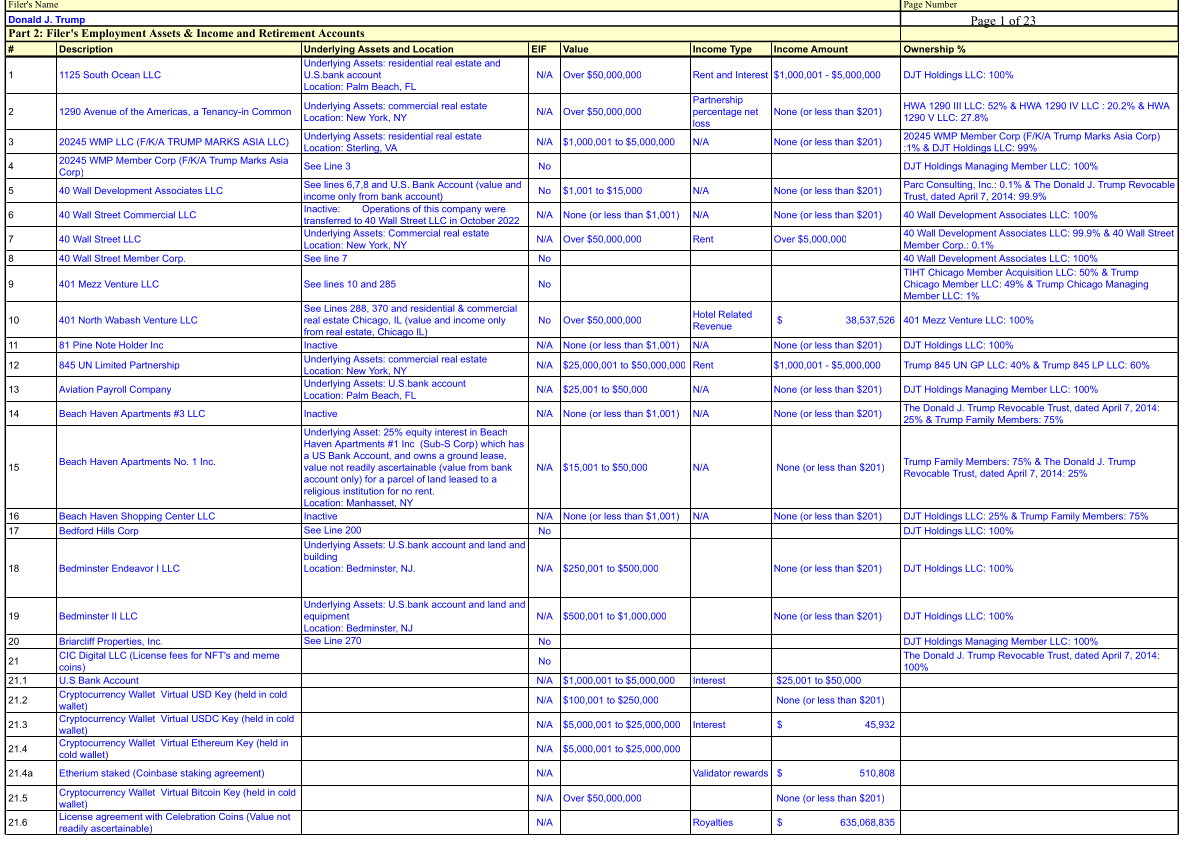
I analysed the 900+ pages of the Trump financial disclosure report.
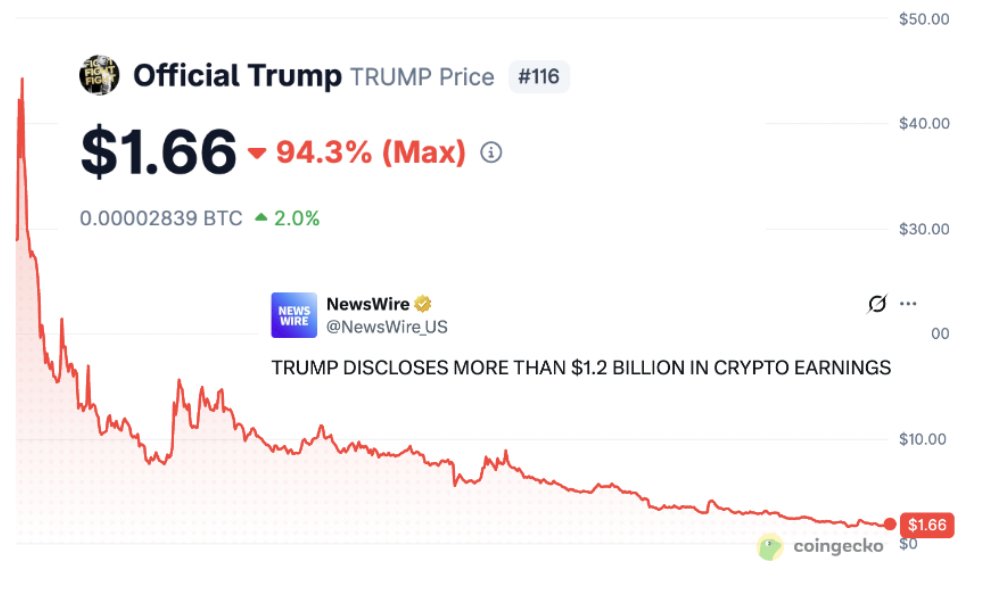
He extracted 1.1 BILLION from crypto, divided like this:
> $635.1M → TRUMP memecoin
> $236.3M → WLFI token sales
> $196.9M → Sale of ownership interests in the USD1 stablecoin venture
> $65.6M → Sale of part of Trump's stake in World Liberty Financial
> $6.0M → Melania Trump's NFT sales and collectibles business
> $1.82M → Ethereum validator (staking) rewards
The biggest scammer of all time
The overwhelming consensus today is that Bitcoin is headed much lower.
Maybe it is. The trend is still down on the higher time frames, macro uncertainty remains elevated, and there are legitimate reasons to be cautious.
But markets have a funny habit of making the majority feel smartest right before they make them the most uncomfortable.
So let's suspend our biases for a moment and ask a different question.
If Bitcoin were actually in the process of putting in a major bottom, what evidence would we expect to see?
A month ago, I laid out the historical case. At the time, I argued that Bitcoin was beginning to enter the same conditions that had accompanied every previous major cycle low. It wasn't a prediction. It was simply an observation that several independent indicators were beginning to align.
Since then, that case has become stronger.
The weekly bullish RSI divergencewith oversold conditions I discussed has now been confirmed. The daily chart is showing the same thing. Momentum is improving even as price remains near its lows, exactly the type of behavior technicians look for when trends begin exhausting themselves.
Bitcoin also continues to find support around its 50-month moving average, a level that has historically marked major long-term buying opportunities. It is also trading around the 200 Weekly MA, a level that has marked every bottom.
On-chain metrics continue to show underwater supply at levels typically associated with broad capitulation, suggesting a significant amount of forced selling has already taken place.
At the same time, whale accumulation has exploded. Large holders are accumulating Bitcoin at the fastest pace ever recorded. These were the same wallets that sold the top. That's worth paying attention to. Historically, the biggest players don't wait for perfect headlines or obvious trend reversals. They accumulate while uncertainty is highest and conviction is lowest.
Then there's sentiment.
Fear and greed is in the gutter.
Also, every major Bitcoin bottom eventually becomes associated with a narrative that feels impossible to overcome while you're living through it. In previous cycles it was Mt. Gox, China's mining ban, COVID, Luna, Celsius, and FTX. At the time, each felt like an existential threat. Looking back, they were signs of peak fear and capitulation.
Today that narrative has become Strategy.
The conversation has shifted away from Bitcoin itself and toward whether Strategy can continue financing its accumulation. The prevailing belief is that dilution is inevitable, capital markets are closing, and Bitcoin can't sustainably recover until Strategy fails first.
But nearly every one of those arguments depends on the same assumption: Bitcoin continues falling.
If Bitcoin stabilizes, trades sideways, or begins recovering over the coming months, much of the bearish case against Strategy begins to unwind naturally. Financing improves. Market confidence returns. Access to capital opens back up. The feedback loop everyone is worried about today begins working in the opposite direction.
In other words, perhaps the market has cause and effect backwards. Strategy doesn't necessarily need to survive in order for Bitcoin to recover. If Bitcoin is already entering a bottoming process, many of the concerns surrounding Strategy may simply resolve themselves.
This brings me to what I think is the most important point.
Major bottoms don't form when everyone suddenly becomes bullish. They form when the market quietly stops going down despite nearly everyone expecting it to.
That's exactly what bullish momentum divergences represent. Price continues testing lows, sentiment remains terrible, headlines stay negative - but underneath the surface, selling pressure begins fading. Momentum improves before price does. Strong hands quietly absorb coins from weak hands. By the time the news turns positive, much of the move has already happened.
None of this guarantees we've seen the final low. Markets don't provide certainty, and major bottoms are rarely clean. They tend to frustrate both bulls and bears before a new trend emerges.
But when I step back and look objectively at the evidence, I see a market where weekly and daily bullish divergences have now been confirmed, long-term support continues to hold, whale accumulation has reached unprecedented levels, on-chain capitulation resembles previous cycle lows, and sentiment has become overwhelmingly one-sided.
Could Bitcoin still make another lower low? Absolutely.
Could this process take longer than anyone expects? Of course.
But if you're intellectually honest enough to consider both sides, I think the bullish case today is far stronger than most people are willing to admit. And historically, that's often what major turning points have looked like.
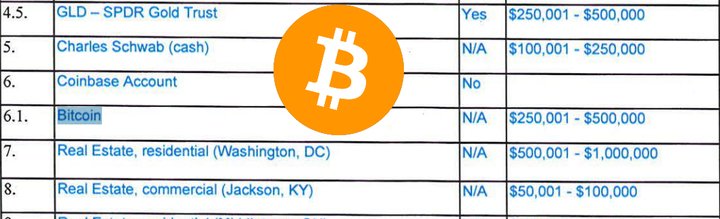
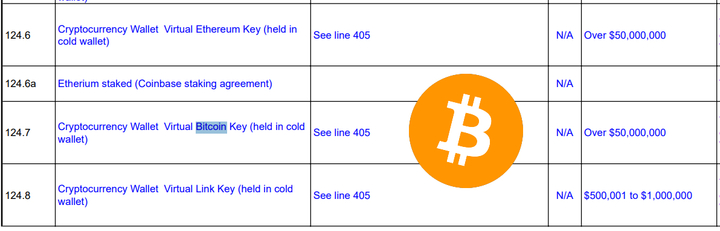
TRUMP DISCLOSES OVER $100M IN BTC AND ETH HOLDINGS
President Trump discloses owning more than $100 million worth of bitcoin and ether in his latest financial filing, alongside reporting more than $1.4 billion in income during the 2025 reporting period.
The filing shows Trump earned:
• Over $500 million from World Liberty Financial, the crypto venture co-founded with his sons.
• Approximately $635 million from the sale of the $TRUMP memecoin.
• More than $80 million from legal settlements with media companies.
The annual disclosure, filed with the U.S. Office of Government Ethics, underscores how digital asset ventures have become one of Trump’s largest sources of wealth as his administration has pursued more crypto-friendly policies.
Reuters previously estimated the Trump family’s crypto businesses have generated at least $2.3 billion in profits from investors since Trump returned to the presidency.
It’s going to be so much bigger than most people understand.
The launch of a new stable coin, Open USD, announced today…
And these are the businesses that have signed up to use it.
Absolutely massive development.
The amount of money that is going to come on chain is going to be silly.
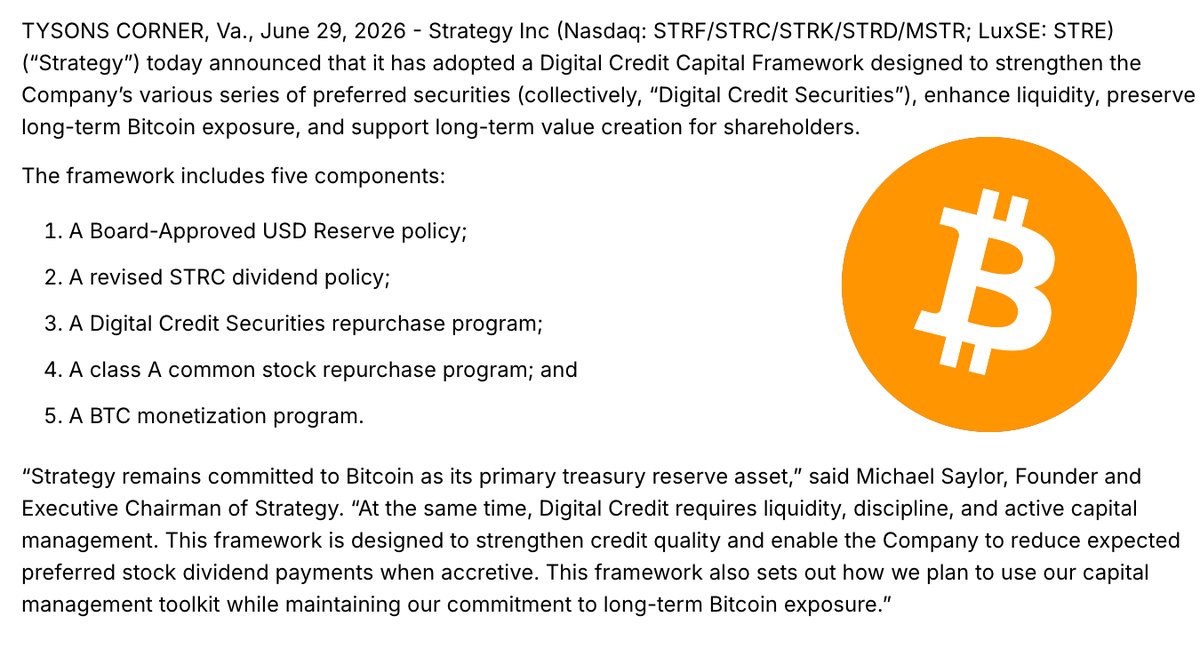
Strategy announces a Digital Credit Capital Framework designed to strengthen Digital Credit, enhance liquidity, preserve long-term Bitcoin exposure, and support long-term value creation. $MSTR $STRC https://t.co/AUoUCtem53
The delusion around $MSTR is staggering.
A stock that has returned 566% in almost 6 years has somehow become the most hated.
The numbers are almost comical.
Since Strategy put Bitcoin on the balance sheet in August 2020, the stock has delivered a CAGR of 38%.
CAGR of assets for context:
NVDA = 62%
MSTR = 38%
BTC = 32%
GOOG = 29%
TSLA = 27%
QQQ = 18%
AAPL = 17%
SPY = 15%
GLD = 12%
So despite being near the bottom of a Bitcoin bear market, Saylor is smoking all of the Mag 7 bar Nvidia.
More importantly, it's outperforming Bitcoin.
All the whining and shit talking is genuinely embarrassing.
Saylor derangement syndrome in full effect.
MSTR will likely outperform BTC from here.
- you are getting it at 0.6x of the BTC owned
- if BTC goes up 10x, debt and prefs are immaterial
- we are at 0.45x power law multiple. 10x is likely in 5 years
- 1MM in BTC going 10x = 10MM after 10 years
- 1MM in MSTR controls 1.6MM in BTC = 16 MM in 10 years
- after cost of capital, outperformance is likely to be 50%
$BTC
One thing I've noticed from years of backtesting Bitcoin is just how reliable weekly RSI divergence has become for identifying when a cycle top is approaching.
In both the 2021 and 2025 cycle, RSI began making macro lower highs while price continued pushing to fresh highs.
Momentum was fading relatively aggressively, even as we saw price grinding higher to reach new all-time highs.
By the time the third RSI drive completed, the divergence with price was quite significant, and both cycles were followed by sizeable corrections within a short period of time.
2017 was the slight outlier, largely because Bitcoin was still in a very early stage of adoption, with enough momentum behind it to push roughly 100x over a few years.
But we've started to see over the last few cycles, that once RSI starts diverging on the weekly, the probability that the cycle is entering its final stages begins increasing.
Your job now is to remember it for the next cycle.
The accumulation at these levels has exploded.
The spike in new whales is the most aggressive ever.
Is the same thing going to play out that is as old as time?
Mas fear for retail as whales scoop up?
Well, that is exactly what the data shows.
The Fear & Greed Index measures overall sentiment, but what if we analyze it using traditional bull/bear divergences versus price?
In 2025, $BTC trended higher while Fear & Greed trended lower (bearish divergence).
In 2026, Fear & Greed made a higher high while price made a lower high (bearish divergence again).
Right now, price has made a lower low while Fear & Greed has made a higher low, a bullish divergence.
In 2022, the same bullish divergence played out, the Fear & Greed Index made its low in mid‑2022, while Bitcoin didn’t bottom until the end of the year, and by then F&G was already much higher.
Price action is always lagging the RSI indicator (not the other way round).
The RSI has been going down in line with the price action but now the RSI is printing a higher low after having printed a higher high.
Bitcoin price will follow RSI upwards soon.