Our collaborative work with @zhejliu and @TjianDarzacq is now published in Nat Genet. Huge thanks to @549nm and @Yifeng_QI for their years of effort!
https://t.co/uh4tavD5Qv
@binzmit Thanks Bin, our group members and all our collaborators, colleagues over the past five yeas! It has been a great journey! Thank you all! Wish all of you guys the best of luck in the future endeavors!! MIT is always home
.@Yifeng_QI, a graduate student in Dr. Bin Zhang's (@binzmit) lab, discovered how #nucleoli droplets remain stable across an entire #CellCycle, instead of fusing together to minimize surface tension. 💧
Learn more: https://t.co/rqJ1eyArti
Our work on nucleoli formation is published in Nat Comm (https://t.co/xAzqi3I8Iz)! See the MIT News release (https://t.co/oiK6Y3HBDK). Great work, Yifeng!
I am delighted to share our preprint on nucleoli formation (https://t.co/2I9IdPSIVJ). We found that the chromatin network can slow down the kinetics of phase separation and stabilize a multiple-droplet state.
Our paper on tetra-nucleosome stability is now published in Nat Comm (https://t.co/Gojvjd8zoI). We computed a six-dimensional free energy surface using a neural network approach and quantified the stability of fibril vs irregular configurations.
Our collaborative paper with Shixin Liu from Rockefeller University is out. Well done, Xingcheng!
Single-molecule and in silico dissection of the interaction between Polycomb repressive complex 2 and chromatin https://t.co/eeo5acbs78
Our paper on whole-genome modeling is online (https://t.co/tmlQG3Y0ci) and highlighted as New and Notable in Biophysical Journal (https://t.co/hKQ14Z5FHe)! Nicely done, Yifeng!
Great work from Wenjun @Wen_Jun_Xie in using the generative model for characterizing a "folding coordinate" for chromosome folding using single-cell imaging! #PLOSCompBio: Characterizing chromatin folding coordinate and landscape with deep learning https://t.co/dMVd68nvvq
Check out this great effort from Xingqiang @xinqiang_ding in computing the "absolute" free energy which will enable calculation of free energy difference between states without extra sampling for intermediate states.
Our paper on "Computing Absolute Free Energy with Deep Generative Models https://t.co/zEPKwq0YU6" is finally out. The introduced method could potentially lead to orders of magnitude speedups for evaluating free energy differences. Great work, Xinqiang!
And hopefully we can leverage the model to provide further insights, from both physical and biological point of view, into how genome organization is influenced by specific elements, and how might genome organization is influencing other biological processes in the nucleus.
Data-driven modeling at the whole-genome level for diploid genome. Great honor to be highlighted by the journal @BiophysJ with insightful comments from Prof. Helmut Schiessel (with no prior notice, also just saw it...)
Our paper on whole-genome modeling is online (https://t.co/tmlQG3Y0ci) and highlighted as New and Notable in Biophysical Journal (https://t.co/hKQ14Z5FHe)! Nicely done, Yifeng!
As nicely pointed out in the comment from Prof. Helmut Schiessel, the model is meaningful (or maybe "powerful" according to Prof. Schiessel...) in further exploring mechanisms of topology by having specific perturbations to the wild type genome.
The model can quantitatively predict various experimental results that are independent to the model input, including chromosomal radial positioning, compartmentalization and inactive X chromosome compaction that results from X-inactivation.
The data-driven nature of the model was revealed by diploid structural inference standing on haploid high-throughput chromosome conformation capture data. The model can reproduce both haploid Hi-C contacts as well as allele-specific contacts.
The model was introduced as a data-driven polymer model at the resolution of 1Mb. Chromatin was labelled through block-wise compartment types and explicitly modeling of centromeric regions, which turns out to be important for reproducing individual chromosome radial positioning.
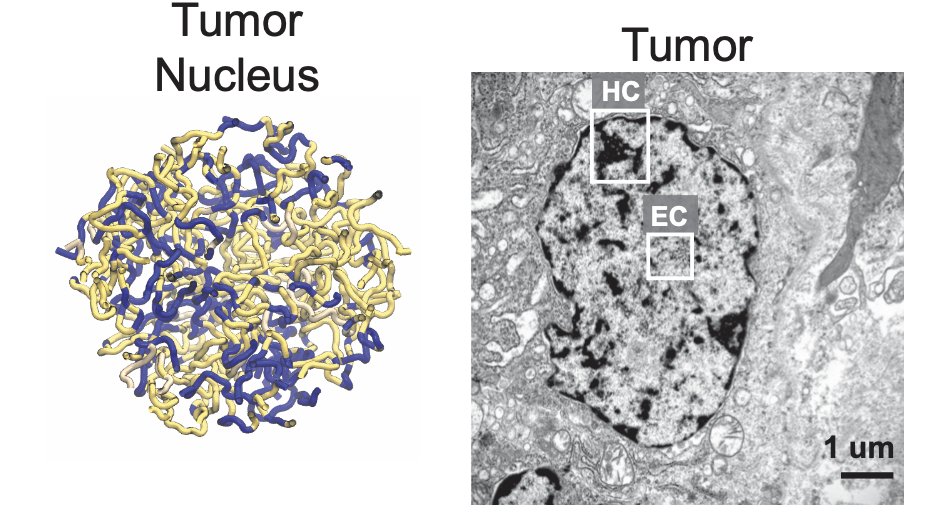
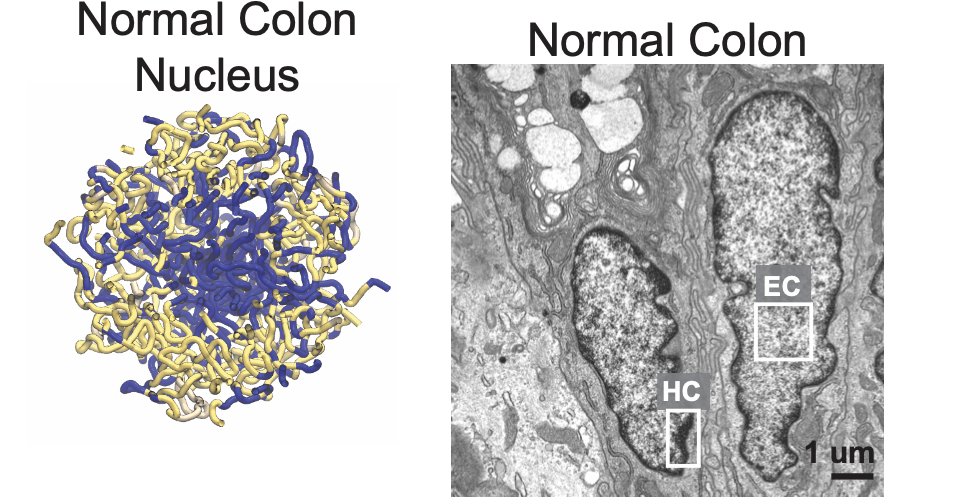
Combining efforts from high-throughput seq data, imaging and in silico whole-genome modeling, a large-scale reorganization of the genome topology in colorectal tumors was revealed, which advanced our understanding towards tumor-associated epigenomic alternations.
Terrific experience working together with Sarah, Alejandro
@areyesq, Martin @MartinAryee, Bin @binzmit, Brad @BradEBernstein and massive collaboration teams from all around!
Our paper on global reorganization of 3D genome architecture in colon cancer is out. Great collaboration with Sarah Johnstone, @areyesq, @BradEBernstein, @binzmit and @rafalab.