Delighted to share our latest work, part of the @ENCODE_NIH project, now published in Nature Communications: https://t.co/D4ys53LLZe
We uncover an enhancer-mediated allelic compensation mechanism that safeguards transcriptional stability of dosage-sensitive genes.
We @YinShenLab are excited to share our work on the functional characterization of enhancers of neuropsychiatric risk genes in human iPSC-induced excitatory neurons using CRISPR tiling deletion screening. https://t.co/sZjg1qkRSo 1/20
@YangEricLi@WashUGenetics Thank you for hosting me. I truly appreciated the opportunity to engage with both faculty and trainees, and thoroughly enjoyed the visit.
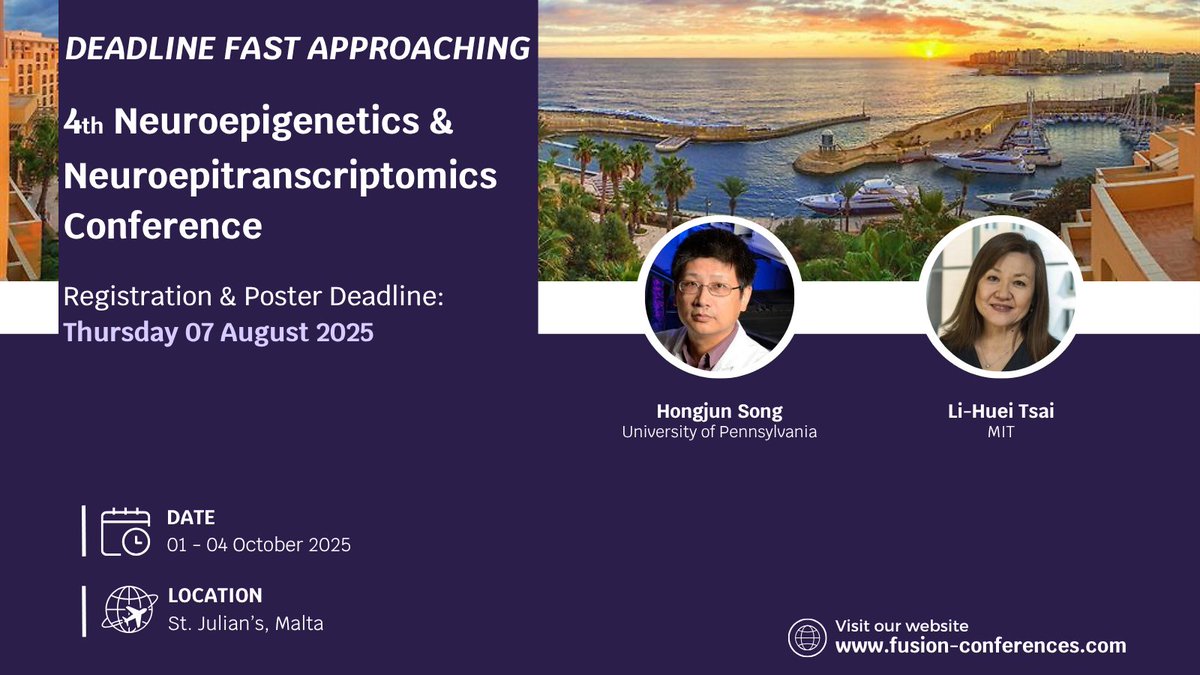
🚨 Don’t forget to register for #Neuroepi25!
⏳ The deadline is fast approaching - Thursday 7th August 2025.
This is your last chance to join; don't miss out on a fantastic meeting!
Click here to register➡️ https://t.co/zLWjCyxTG8
#FusionNeuro#FusionAgingResearch #FusionEpigenetics
How did we evolve brains capable of learning and complex language? @IHG_at_UCSF found that parts of our DNA evolved at hyperspeed, making our brains more complex than apes’, but possibly raising the risk of human brain disorders. https://t.co/QtP0XrcUwm
Our latest research on human accelerated regions has just been published with @SpringerNature https://t.co/xKCXjjTni0. Congratulations to @MarkTransposon@HanYang_Henry and the team! In this study, we characterize genome variants to function through the lens of evolution.
How did humans develop unique traits despite sharing nearly identical genomes with other primates like chimpanzees? Together with Han Yang (@HanYang_Henry), our new study on human accelerated regions (HARs) sheds light on this question @ https://t.co/B4yHNIm7ho. 1/12
🌟 SAVE THE DATE! 🌟
The 4th Neuroepigenetics & Neuroepitranscriptomics Conference is returning with its 4th edition! 🎉
Join us for this incredible event, chaired by Hongjun Song (University of Pennsylvania) and Li-Huei Tsai (MIT), in beautiful sunny St Julians, Malta! ☀️
💥 Save the date and stay updated on all the details!
👉 Sign up for updates by clicking here: https://t.co/3Es4M2LblW
In collaboration with Reuben Saunders, @JswLab, and Xiaowei Zhuang, we are very excited to release Perturb-Multi: a platform for pooled multimodal genetic screens in intact mammalian tissue.
Check it out!
https://t.co/iJ8hi3ddz4
Join us on Nov 18 at @UCSF for the QBI Chromatin Symposium, led by Drs. Vijay Ramani & Yin Shen. This event will showcase the latest in chromatin regulation, from bench to bedside. We look forward to seeing you there next week!
Register now: https://t.co/XUyGw6NYiq
New @ENCODE_NIH preprint from the lab! Through CRISPR screens, we identify functional enhancers for neuropsychiatric disease risk genes in iPSC-derived neurons. We revealed an exciting allelic compensation effect (ACE) on transcription for the dosage-sensitive gene SIN3A.
We @YinShenLab are excited to share our work on the functional characterization of enhancers of neuropsychiatric risk genes in human iPSC-induced excitatory neurons using CRISPR tiling deletion screening. https://t.co/sZjg1qkRSo 1/20
@Katz_Lab@emorygmb@angalus_d@BrainJZhou Thank you for the invitation. It was a pleasure meeting with the students and faculty at Emory. The GMB class model is truly unique—I wish I had experienced a course like that during my graduate studies.