Yesterday, $PATH joined NCQA’s AI Learning Collaborative and I think the significance goes beyond a normal partnership.
The Collaborative brings healthcare organisations together to share real-world AI implementation experience and develop practical playbooks for how AI can be responsibly implemented, governed and measured in specific healthcare workflows.
UiPath is contributing its real-world implementation experience directly into that process.
That gives the company an opportunity to help shape how AI is actually operationalised across one of healthcare’s most complex and regulated workflows.
In turn, UiPath could become part of the implementation model that the broader industry ultimately learns from and adopts.
$PATH As enterprises look to automate more of their processes with agentic AI, they are understandably confused as to how to proceed.
The crowded landscape is getting more fragmented every day with new models and SaaS agents constantly being brought to market.
The more fragmented the landscape becomes, the higher the demand will be for tool-agnostic solutions that simplify these complexities and deliver real ROI for their customers.
This is a main reason why I am so bullish on $PATH.
UiPath meets customers where they are: no matter where their data is, what SaaS agents they use, what model preferences they have, or if they still use non-API-based applications - UiPath provides end-to-end workflows that can handle all of it.
The company is extremely well positioned as they have gained the trust of their customers over the years as the #1 RPA solution on the market. They are now showing their customers the way to expand their automation beyond RPA and into agentic business process orchestration.
To illustrate the sheer fragmentation of the business process orchestration space, I have broken down some of the core components below:
Foundational Model Companies
- Anthropic
- OpenAI
- Google
- Meta
- Typesafe AI (Jev)
- xAI
- DeepSeek
- Mistral
- Moonshot (Kimi)
Cloud Database
- Snowflake
- Databricks
- Google BigQuery
- Amazon Redshift
Ecosystem Agent Frameworks
- Google Vertex
- Azure AI Foundry
- NVIDIA NIM
Agentic Developer Tooling
- Claude Code
- OpenAI Codex
- xAI Cursor
- LangChain
Enterprise SaaS Agents
- Workday (Illuminate)
- ServiceNow (Now Assist)
- SAP (Joule)
- Salesforce (Agentforce)
- Intercom (Fin AI)
- Clay (Claygent)
- 11x (Alice)
- Ramp
- Brex
Non-API Systems
- IBM Mainframes
- SAP GUI
- On-premise Databases
- Custom internal web portals
The more fragmented the AI stack becomes, the more valuable it is to have a single execution layer that can seamlessly stitch these tools together.
As long-term investors, we are still early - UiPath is beginning to gain traction in this market. With a large, global enterprise customer base and market-leading technology, I am confident UiPath will successfully guide its customers toward expanded products.
I remain highly convicted in the secular tailwinds that will propel this entire enterprise automation space forward - and $PATH along with it.
The $PATH partnership expansion with BDO is more important than it might look.
BDO is not only helping enterprises implement UiPath, but it’s effectively becoming another distribution channel.
BDO already has deep relationships across large enterprises and can now take pre-built UiPath-powered solutions directly into areas like internal audit, compliance, risk and the Office of the CFO.
That gives UiPath access to new customers, new buyers and new budget pools without having to build every relationship from scratch.
This is the advantage of having a strong partner ecosystem.
Turn other companies’ enterprise relationships into distribution for your platform.
Another hugely encouraging takeaway from the $PATH Investor Day was just how much room the company still has to grow inside its existing customer base.
Here’s what Hitesh Ramani said:
“…between 2020 to 2027, our average ARR for the top 25 customers has gone up from $2M to $10M, 5x. And our top 100 customers during the same duration has gone up 6x. Now this is a small subset of the 2,600 customers that I highlighted. I can just extrapolate the opportunity that we have in front of us in terms of continuing to expand the rest of the 2,500 customers.”
This is proof that individual accounts can expand several-fold.
What happens when it replicates this across the rest of the installed base?
People are vastly underestimating the kind of growth we could see over the coming 12+ months.
The potential is huge.
🚨 BREAKING: $PATH announces expanded partnership with $SNOW allowing seamless data integration and addition to Snowflake marketplace.
- Snowflake data can now be accessed seamlessly within UiPath solutions via UiPath's Data Fabric.
- Snowflake data can be leveraged by UiPath Cartographer when creating a Map of Work.
- UiPath Business Orchestration and Automation can now be found in the Snowflake marketplace unlocking another sales channel for the business.
One of the biggest developments to come out of the $PATH Investor Day last week is Cartographer.
It reminds me a lot of Palantir’s Ontology, but specifically for workflows.
Palantir’s Ontology essentially creates a digital representation of how an organisation operates by connecting its data, logic and actions.
Cartographer is designed to do something similar for how work actually gets done.
It creates what UiPath calls a Map of Work, which is basically a living representation of everything involved in how a business process actually works from end to end.
Essentially, UiPath wants to turn enterprise knowledge into an AI-readable map of work that agents and automations can operate against.
This is what enterprises have been missing for decades.
The knowledge required to run a process is usually fragmented across systems, documentation, business rules and the people who actually understand how the work gets done.
Cartographer brings that knowledge together into a structured model that both humans and AI can understand.
Instead of AI agents being dropped into an enterprise and somehow expected to understand how the business works, Cartographer provides them with a structured model of the workflow they are supposed to operate within.
And importantly, that map is not just documentation.
Cartographer can feed the same definition into Maestro, Studio and coding agents to actually build and orchestrate the process.
Even more interestingly, runtime decisions can feed back into the Map of Work, meaning the organisation’s understanding of its own workflows can improve as the system operates.
Discover → Map → Build → Orchestrate → Learn → Improve
This is where the Palantir comparison becomes really interesting to me.
Palantir has spent years building an Ontology that helps software understand the operational reality of an enterprise.
UiPath is building something analogous around the operational reality of work itself.
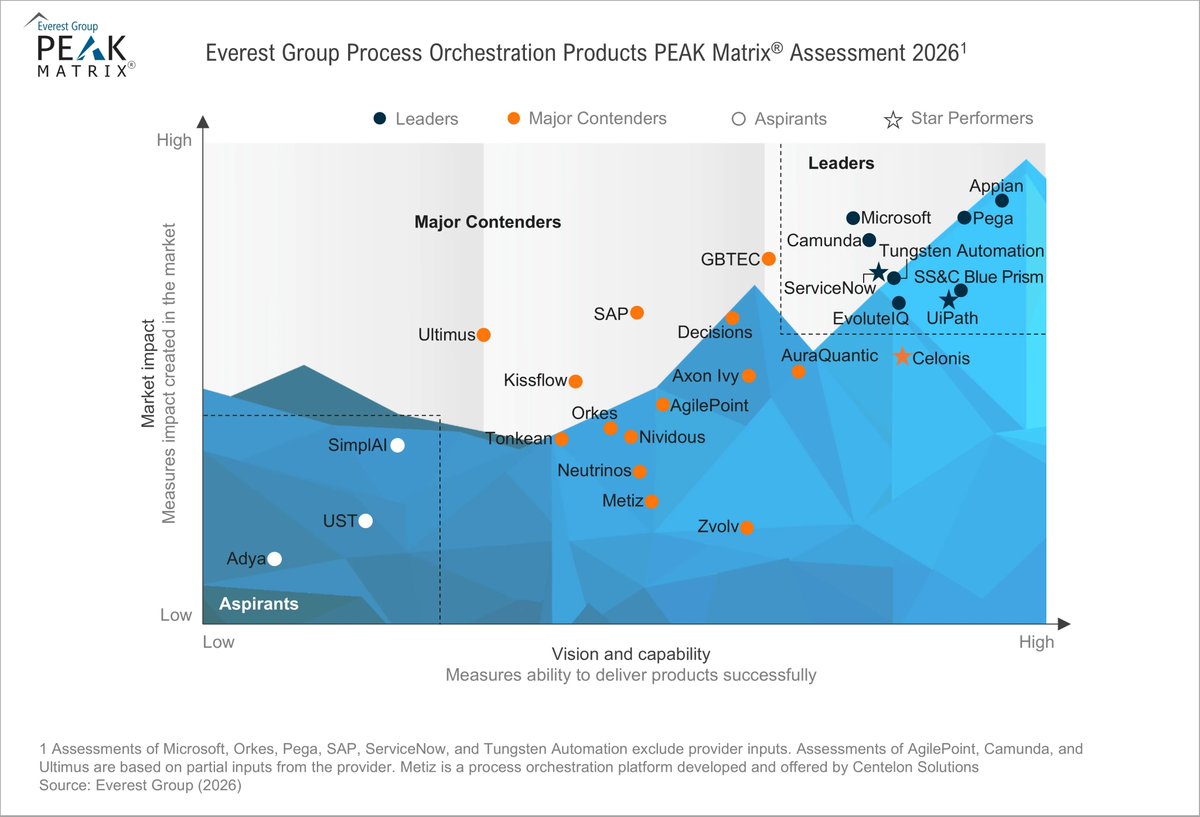
Everest Group Process Orchestration Products PEAK Matrix® Assessment 2026
Last year UiPath was not part of the Leaders group.
$PATH
https://t.co/GiAnIua0Dr
If you were unsure about where $PATH management’s priorities now lie, Investor Day made it pretty clear.
When Daniel Dines was asked whether successful execution should translate into faster ARR growth over the next few years, his answer was about as clear as it gets:
“…this is why we are all here in all fairness. We want to build a growth company, and we all believe we have a tremendous opportunity in front of us.”
The last few years have been about building the product, platform, go-to-market motion and cost structure required for the next phase.
Management now clearly believes those foundations are in place.
The focus is growth.