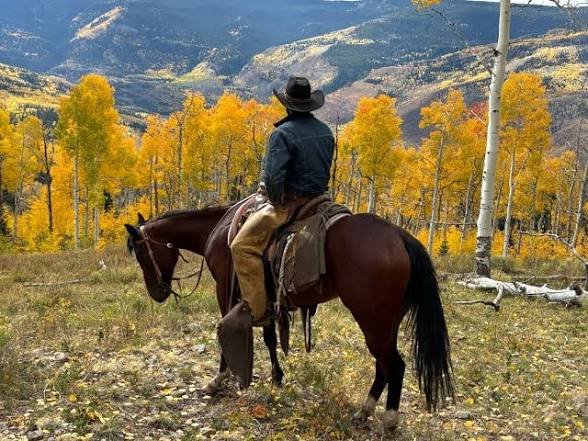
A dusting of the white stuff today and a norther with a bite. Critters, men and women gotta be tough and have some grit to make it thru a Chilcotin winter, the compliant and dependant types best for them to stay in their so called “civilized” world.
If God is good, why didn't He create a world without suffering?
Why must we face pain, failure and struggle?
Wouldn't it be better if everyone could simply be happy?
Dr Steiner once told the story of a king who was shown a model of the universe.
The movements of the stars, the relationships of the planets, and the complexity of the cosmos were explained to him.
But the king struggled to understand it all.
Overwhelmed, he finally said:
"If God had left it to me, I would have made a much simpler world."
Steiner saw in this statement human weakness.
We assume that because something appears difficult, painful, or complex to us, it must lack wisdom.
But what if the limitation lies not in creation, but in our understanding?
Consider a child learning to walk.
The child falls again and again.
A loving parent could prevent every fall by carrying the child everywhere.
But then the child would never learn to stand on its own.
The obstacle is not the goal.
Yet overcoming it makes growth possible.
Anthroposophy views human life in a similar way.
Earth is not merely a place for comfort and pleasure.
It is also the realm in which human beings can develop freedom, love, and moral individuality.
And these capacities cannot simply be handed to us as finished possessions.
Courage can arise because fear exists.
Compassion can arise because suffering exists.
Forgiveness can arise because mistakes exist.
The highest human qualities cannot simply be handed to us ready-made.
They must be freely developed.
This does not mean suffering is always good.
Nor does it mean injustice should be accepted.
Our task is not to glorify suffering, but to meet it with understanding and freely chosen moral action.
The question is not:
"Why didn't God create an easier world?"
But:
"What kind of beings are we meant to become through our existence on Earth?"
We see fragments.
We judge from the perspective of a single moment.
Then we imagine the whole universe should have been designed differently.
Wisdom begins when we recognize the limits of our own judgment.
Who were the first people in the Americas? This may be my most asked single question:
For decades the answer was Clovis. Those distinctive fluted points show up around 13,000 years ago and seem to spread across the continent almost overnight. The story was simple: people walked across the Bering land bridge, waited for an ice-free corridor to open between the two great ice sheets, and then moved south. Clean. Logical. And wrong.
The land bridge part is solid. During the last glacial maximum, sea levels dropped and Siberia connected to Alaska in a broad, cold, but livable region called Beringia. People lived there for a long time. Genetic work shows a population that got cut off from Asia somewhere after about 23,000 years ago. Those people are the ancestors of everyone who later lived in the Americas.
The problem was the ice. The Laurentide and Cordilleran sheets locked together for thousands of years and blocked any practical overland route south. The corridor that finally opened between them only became usable around 13,000–12,500 years ago. That’s too late. We already have people much farther south by then.
So the coastal idea started looking better. Along the North Pacific, kelp forests and rich nearshore waters could have fed people moving by boat, even while the interior was still locked in ice. A lot of that old shoreline is underwater now, which is frustrating, but the logic holds up.
Then the sites started piling up. White Sands in New Mexico has human footprints in old lake beds dated between 23,000 and 21,000 years ago. Multiple methods—seeds, pollen, sediment dating—keep landing in the same range. Some people still argue about it, but the evidence is hard to wave away. People were already in the Southwest during the height of the ice age.
In Idaho, Cooper’s Ferry has stemmed points and clear occupation layers going back to about 16,000 years ago. That’s before the inland corridor was open. In Texas, the Friedkin site on Buttermilk Creek has thousands of artifacts sitting under a Clovis layer, dated between roughly 15,500 and 13,200 years ago. And Monte Verde in Chile has been solid at around 14,500 years for a long time now, way too far south and too early for the old model.
There are claims of even older sites, some pushing past 26,000 or 30,000 years. Most of those still need better proof. The genetics also fit more cleanly with people entering after the worst of the glacial maximum rather than long before it.
So the first people weren’t Clovis hunters waiting for the ice to melt. They were the descendants of that Beringian population who found ways south, mostly along the coast, maybe through temporary openings, thousands of years earlier. By the time Clovis points show up, people had already been living all over the Americas for a good long while.
The details will keep shifting as new sites turn up and old ones get re-examined. But the big change has already happened. People got here earlier than we used to think, and they didn’t wait for the ice to melt.